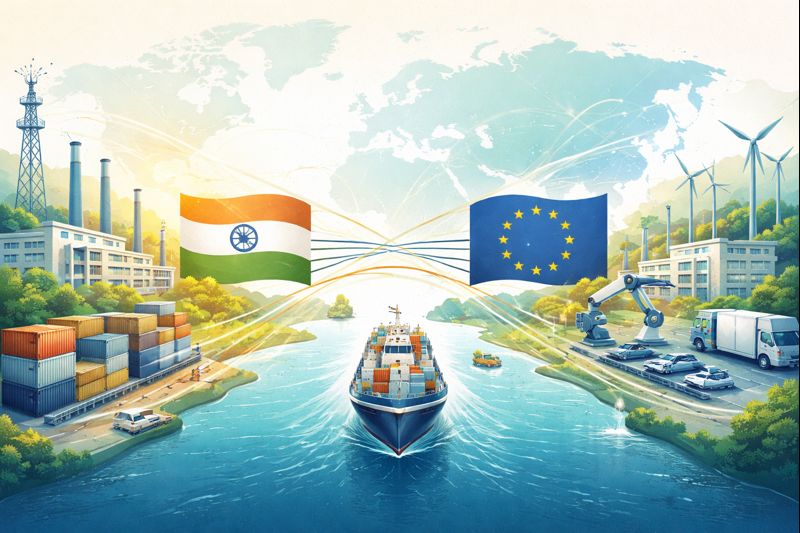
After years of stalled negotiations, India and the European Union are poised to finalize a sweeping free trade agreement—signaling a shift in global trade strategy as major economies seek resilience, diversification, and geopolitical balance in a post-pandemic, post-Ukraine-war world.
Why This Deal Matters Now
The timing of the India-EU Free Trade Agreement could hardly be more consequential. As officials from both sides prepare to announce the conclusion of negotiations during the EU leadership’s visit to New Delhi on January 27, 2026, the agreement arrives amid unprecedented fragmentation in the global trading system. The once-stable architecture of international commerce has given way to a volatile landscape defined by trade wars, tariff escalations, and the deliberate restructuring of supply chains away from geopolitical flashpoints.
For more than a decade, the India-EU FTA remained in limbo after talks collapsed in 2013. What changed? The answer lies less in tariff arithmetic than in a fundamental reassessment of economic security. The COVID-19 pandemic exposed the brittleness of globally dispersed supply chains. Russia’s invasion of Ukraine demonstrated how quickly energy and commodity flows could be weaponized. And Washington’s aggressive tariff policies—including a 50 percent levy on Indian goods announced in early 2025—accelerated the search for alternative trade anchors.
Europe and India now find themselves natural partners in a world where economic interdependence increasingly follows political alignment. The EU needs scale, growth markets, and alternatives to Chinese manufacturing dominance. India requires secure access to advanced technology, capital, and the world’s wealthiest consumer markets. Both seek to reduce their vulnerability to unilateral policy shocks from major powers.
What the India-EU FTA Covers
The agreement under discussion represents one of the most comprehensive trade pacts negotiated in recent years, covering goods, services, investment protection, digital trade, and regulatory cooperation. While final details remain subject to legal review, the broad contours have emerged from fourteen rounds of intensive negotiations.
Goods Trade and Tariff Reduction
On goods trade, the FTA aims to significantly reduce tariffs across key sectors. For European exporters, this means improved access for automobiles (currently facing tariffs exceeding 100 percent in India), wines and spirits, machinery, and chemicals. Indian exporters stand to benefit from lower duties on labor-intensive manufactures including textiles, leather goods, apparel, pharmaceuticals, and engineering products.
Services and Professional Mobility
The services component addresses one of India’s core strengths. Information technology, professional services, and business process outsourcing have long faced opaque visa regimes and uneven regulation across EU member states. The FTA seeks to establish clearer frameworks for temporary movement of professionals, mutual recognition of qualifications, and more predictable regulatory treatment.
Digital Trade Provisions
Digital trade provisions reflect the realities of 21st-century commerce. Both sides have negotiated text covering data flows, e-commerce facilitation, and digital services—though final language around data localization and privacy standards remains sensitive given the EU’s stringent data protection framework.
Sustainability and Climate Measures
Perhaps most challenging have been discussions around sustainability and climate-related trade measures. The EU’s Carbon Border Adjustment Mechanism (CBAM)—which would impose levies on carbon-intensive imports including steel, aluminum, and cement—has emerged as a major sticking point. India has pushed back against what it views as protectionism disguised as environmental policy, insisting on preserving differential treatment for developing countries under WTO rules.
Strategic Drivers Behind the Agreement
To understand why this deal is moving forward now, one must look beyond commercial considerations to the profound geopolitical realignment reshaping global trade.
The EU’s De-Risking Strategy
For the European Union, the FTA represents a critical pillar of its “de-risking” strategy toward China. While Europe has carefully avoided Washington’s more confrontational “decoupling” rhetoric, Brussels recognizes that excessive dependence on any single supplier creates dangerous vulnerabilities. China’s dominance in critical sectors—from rare earth elements to solar panels to pharmaceuticals—has prompted urgent searches for alternative sources.
India offers precisely what Europe needs: a democratic polity, a massive and growing domestic market, an increasingly sophisticated manufacturing base, and a government eager to position itself as a reliable partner. The EU’s $140 billion investment stock in India as of 2023 reflects confidence in the country’s trajectory. The FTA would formalize and deepen that relationship.
India’s Global Ambitions
From India’s perspective, the agreement advances Prime Minister Narendra Modi’s vision of establishing India as a “Vishwa Mitra”—a partner to the world. The government sees international trade agreements as essential instruments for achieving its 2047 development goals, which envision India as a developed economy by the centenary of independence. Integration into European value chains would accelerate industrial upgrading, technology transfer, and job creation in manufacturing sectors.
Friend-Shoring and Supply Chain Resilience
The concept of “friend-shoring”—concentrating supply chains among politically aligned countries—has moved from academic discussion to active policy implementation. U.S. Treasury Secretary Janet Yellen’s 2022 speech calling for trade with “trusted countries” crystallized thinking that had been developing throughout the pandemic. While the practice carries risks of further geopolitical fragmentation, it reflects a fundamental recalculation of the relationship between economic efficiency and strategic security.
For both India and the EU, the FTA serves as a hedge against American unpredictability. The Trump administration’s tariff shock in early 2025 reminded both partners that even longstanding alliances offer no immunity from sudden policy shifts. Diversifying trade relationships reduces exposure to any single market’s volatility.
Economic Impact and Winners
The potential economic gains from the India-EU FTA are substantial, though realizing them will require more than eliminating tariffs.
Current Trade Volumes
Bilateral trade in goods currently stands at approximately $136 billion annually (FY 2024-25):
- Indian exports to EU: ~$76 billion
- EU exports to India: ~$60 billion
- Trade in services: $59.7 billion (2023)
The EU is India’s largest trading partner, accounting for 11.5% of India’s total trade. India ranks as the EU’s 9th largest trading partner, representing 2.4% of total EU goods trade.
Sectors Poised to Benefit
European Exporters:
- Automobile manufacturers facing lower tariffs from current 100%+ levels
- Machinery and transport equipment producers
- Wine and spirits exporters
- Chemical and pharmaceutical companies
- High-value technology firms
Indian Exporters:
- Pharmaceutical industry (already major EU supplier)
- Textile and apparel manufacturers
- Leather goods producers
- Engineering products and auto components
- IT and business services sector
Industry analysts project the agreement could unlock $10-11 billion in additional exports for both sides over the medium term.
Services Sector Opportunities
The IT and business services sector may see the largest gains. Indian services exports to the EU have grown from €19 billion in 2019 to €37 billion in 2024—a trajectory that improved visa provisions and clearer regulatory frameworks could accelerate. Major Indian IT firms have long complained about bureaucratic barriers to deploying talent across EU member states; the FTA’s services provisions could ease these constraints.
Implementation Challenges
However, past experience with free trade agreements suggests that tariff preferences alone guarantee nothing. Rules of origin requirements—which determine whether a product qualifies for preferential treatment—can be so complex and certification so burdensome that small and medium enterprises find it easier to simply pay normal tariffs. Indian exporters have struggled with utilization rates in previous FTAs. Unless domestic customs procedures, testing capacity, and exporter support systems improve dramatically, many firms may find FTA benefits inaccessible in practice.
Agriculture will see limited liberalization on both sides. Neither India nor the EU can expose domestic farmers to full international competition amid current inflation pressures and political sensitivities. Exclusions and carve-outs acknowledge this reality. The real gains lie in manufacturing and services, not farm trade.
Global Trade Implications
The India-EU FTA carries significance well beyond the bilateral relationship. It represents a clear signal about the future architecture of global trade.
Message to China
For China, the agreement demonstrates the limits of economic gravitational pull. Despite being the world’s largest manufacturer and a central node in global supply chains, China faces systematic efforts by major economies to reduce dependence. Beijing’s response has been to double down on its dual circulation strategy—reducing reliance on foreign markets while attempting to increase foreign reliance on the Chinese economy. The success or failure of these competing visions will shape trade patterns for decades.
Impact on WTO Relevance
The deal also represents a blow to the relevance of the World Trade Organization’s multilateral framework. While both India and the EU remain vocal supporters of the WTO in principle, their pursuit of bilateral and plurilateral agreements acknowledges the organization’s practical inability to facilitate major trade liberalization. The Doha Development Round’s collapse and the Appellate Body’s paralysis have pushed countries toward second-best alternatives.
Comparison with Mega-Regional Agreements
In this respect, the India-EU FTA joins a proliferation of mega-regional agreements attempting to write new rules for 21st-century trade:
- CPTPP (Comprehensive and Progressive Agreement for Trans-Pacific Partnership)
- RCEP (Regional Comprehensive Economic Partnership)
- UK-India FTA (recently concluded negotiations)
- EFTA-India Agreement (signed earlier)
This fragmentation carries costs. Overlapping and inconsistent rules across different agreements create complexity for businesses operating across multiple markets. The global trading system becomes less transparent, more discriminatory, and potentially less efficient. Economists have long worried about the “spaghetti bowl” effect of proliferating FTAs creating tangled regulatory frameworks.
Yet supporters argue that bilateralism and plurilateralism allow for deeper integration than multilateral negotiations could achieve. The India-EU FTA covers areas like digital trade, investment screening, and climate-related measures that would be nearly impossible to negotiate among 164 WTO members with vastly different interests and development levels.
Challenges and Risks Ahead
Announcing the conclusion of negotiations represents a significant milestone, but substantial hurdles remain before the agreement enters into force.
Ratification Hurdles
Ratification in the European Union requires approval from both the European Parliament and the 27 member state parliaments—a process that can take years and remains vulnerable to domestic political opposition. The EU’s trade agreement with Canada, for example, took more than seven years from signature to provisional application. Agricultural lobbies, particularly in France, may resist provisions they view as threatening to European farmers. Environmental groups could mobilize against any agreement they perceive as inadequately addressing climate concerns.
In India, opposition parties have already begun raising concerns about market access for automobiles and the potential impact on domestic manufacturing. The automobile industry has expressed particular anxiety about European competition. Trade unions worry about job displacement in sectors that would face increased import competition.
Implementation Complexity
Implementation complexity poses its own challenges. Even after ratification, translating the agreement’s provisions into operational reality requires massive administrative effort. Customs procedures must be updated, certification systems established, regulatory bodies coordinated across dozens of agencies and ministries. India’s track record of FTA utilization suggests significant capacity constraints that could limit real-world benefits.
Unresolved Climate Issues
The carbon border adjustment mechanism remains incompletely resolved. If the EU proceeds with CBAM as currently designed and India views the provisions as discriminatory, the dispute could poison the broader relationship. Climate-related trade measures represent uncharted territory in international trade law, and their treatment in the India-EU FTA will establish precedents for future agreements.
Geopolitical Uncertainties
Perhaps most fundamentally, geopolitical conditions could shift in ways that undermine the strategic logic underpinning the agreement. A dramatic thaw in US-China relations, however unlikely, would reduce pressures for supply chain diversification. Conversely, an escalation of tensions—potentially involving military conflict over Taiwan—could render economic considerations secondary to security imperatives.
Conclusion: A Template for Future Trade Deals?
The India-EU FTA may represent more than simply a bilateral agreement between two important economic actors. It could establish a template for how major economies navigate trade policy in an era of geopolitical competition and supply chain reconfiguration.
Distinctive Elements
Several elements distinguish this agreement from earlier generation FTAs:
- Explicit security considerations alongside economic benefits
- Political realism about domestic sensitivities on agriculture and automobiles
- Forward-looking frameworks addressing digital trade, data governance, and climate measures
- Strategic diversification as a hedge against single-market dependence
Alternative Models Emerging
Whether other countries adopt similar approaches remains to be seen. The United States’ retreat from multilateralism under successive administrations has created space for alternative models. China’s Regional Comprehensive Economic Partnership emphasizes simplicity and flexibility over regulatory harmonization. The UK’s post-Brexit trade strategy prioritizes speed over comprehensiveness.
The New Trade Reality
What seems clear is that the post-World War II vision of ever-deepening global integration under universal rules no longer commands consensus. The India-EU FTA reflects a world of competing trade blocs, selective partnerships, and explicit linkages between commerce and security.
For investors, corporate executives, and policymakers, this requires fundamental recalibration:
- Supply chain decisions must factor in geopolitical risk alongside cost and efficiency
- Market access strategies need to account for preferential arrangements creating competitive advantages
- Long-term planning must acknowledge contested and evolving trade rules
Final Assessment
The India-EU Free Trade Agreement matters not because it represents a return to globalization’s golden age—it doesn’t. It matters because it shows how major economies are adapting to globalization’s fragmentation, seeking partners they can trust in an uncertain world, and attempting to build resilience through selective interdependence rather than universal integration.
As the agreement moves toward formal signature and ratification, its success or failure will offer important lessons about whether this model of trade diplomacy can deliver on its promises. The stakes extend well beyond tariff schedules and market access provisions. They touch on fundamental questions about how economic power and political alignment interact in the 21st century, and whether it’s possible to maintain prosperity while managing security risks in an increasingly fractured international system.