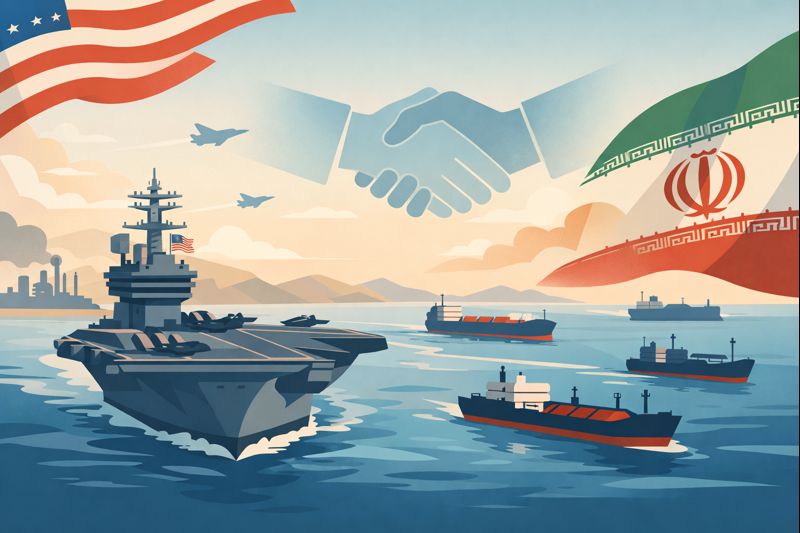
As a US aircraft carrier moves into the Middle East, former President Donald Trump’s claim that Iran “wants talks” has injected ambiguity into an already fragile geopolitical landscape. Markets are now forced to interpret whether recent signals point to de-escalation—or merely a pause before further confrontation.
Rising Military Signals
The USS Abraham Lincoln Carrier Strike Group entered the Middle East this week, accompanied by guided-missile destroyers capable of launching Tomahawk cruise missiles. US Central Command confirmed the deployment but declined to specify the strike group’s precise location, stating only that it arrived “to promote regional security and stability.”
The deployment is not symbolic. Military officials told reporters the carrier is positioned within striking distance of Iran and could launch operations within 24 to 48 hours if ordered. The strike group commands dozens of fighter jets and approximately 5,000 crew members, flanked by destroyers carrying advanced missile and air defense systems.
Beyond naval assets, the Pentagon has deployed additional F-15E Strike Eagle fighter jets, Patriot missile batteries, and THAAD air defense systems to the region. On Tuesday, US Central Command announced a multi-day aerial readiness exercise designed to demonstrate “the ability to deploy, disperse, and sustain combat airpower” across the Middle East theater.
“Our airmen are proving they can disperse, operate, and generate combat sorties under demanding conditions—safely, precisely and alongside our partners,” said Lt. Gen. Derek France, Air Forces Central commander. The timing and scale of these exercises send an unmistakable message: the US military is prepared to respond swiftly to escalation.
Why does military signaling matter for deterrence? In crisis diplomacy, visible military assets serve dual purposes—they demonstrate capability while creating off-ramps for de-escalation. For Tehran, the presence of a carrier strike group represents both a threat and an opportunity. The Iranian regime must calculate whether confrontation serves its interests when its military infrastructure remains weakened from last year’s 12-day war with Israel and subsequent US strikes on nuclear facilities.
Diplomatic Messaging vs Reality
In an interview with Axios, Trump described the deployment as “a big armada next to Iran,” adding: “They want to make a deal. I know so. They called on numerous occasions. They want to talk.” The statement reflects Trump’s characteristic blend of pressure and negotiation—maximum military presence paired with claims of Iranian willingness to negotiate.
But Iran’s public responses tell a different story. Tehran has maintained channels of communication through Foreign Minister Abbas Araghchi and US envoy Steve Witkoff, despite the absence of formal diplomatic relations. Yet Iranian officials have been careful not to appear weak domestically. Revolutionary Guards spokesman Mohammad Ali Naini warned that “if their aircraft carrier made a mistake and entered Iranian territorial waters, it would be targeted.”
Iran’s conservative press has been even more direct. The Javan newspaper declared Iran “ready for a major response” and suggested Tehran could seize control of the Strait of Hormuz. A billboard erected in Tehran’s Revolution Square depicts a US aircraft carrier under attack, with the warning: “If you sow the wind, you will reap the whirlwind.”
This pattern—talks amid tension—has historical precedent in US-Iran relations. During previous crises, Tehran has maintained backchannel communications while escalating public rhetoric to satisfy domestic hardliners. The question for markets is whether this represents genuine negotiation or strategic theater designed to buy time while Iran repositions militarily.
The political context complicates interpretation. Trump faces domestic pressure to avoid entanglement in another Middle Eastern conflict, having campaigned partly on keeping America out of costly foreign wars. Yet he has also drawn clear red lines regarding Iran’s brutal crackdown on protesters, which rights groups say has killed thousands since late December. Senator Lindsey Graham told The New York Times that Trump’s conversations with him indicate “the goal is to end the regime.”
For Iran’s leadership, the calculus is equally complex. The regime confronts its most serious internal challenge in decades, with protests spanning 22 provinces and an internet blackout failing to contain public anger. US intelligence assessments presented to Trump reportedly indicate the Iranian government’s hold on power “is at its weakest point” since the 1979 revolution. Tehran must balance external threats with internal fragility—a combination that historically leads either to compromise or desperate escalation.
Oil Markets on Edge
Oil traders responded predictably to rising tensions. West Texas Intermediate crude climbed to approximately $59 per barrel this week, while Brent crude reached $64—the highest level for 2026 so far. The moves reflect a risk premium as markets price uncertainty rather than actual supply disruption.
The sensitivity stems from the Strait of Hormuz, the world’s most critical energy chokepoint. Approximately 20 million barrels per day of crude oil transit the narrow waterway—roughly 20% of global petroleum consumption. The strait also handles about 20% of global liquefied natural gas trade, with Qatar routing nearly all its LNG exports through this route.
Yet despite headline tensions, most analysts see limited probability of major disruption. The global oil market currently faces a massive surplus of approximately 3.8 million barrels per day in 2026, according to International Energy Agency projections. This surplus acts as a cushion, limiting how high prices can sustainably rise even with geopolitical risk premiums.
“Markets are pricing risk, not rhetoric,” noted one energy analyst. “A disruption through the Strait of Hormuz could cause a global oil and gas crisis, but Iran closing the strait would hurt its own exports and antagonize China—its only significant oil buyer.”
Historical precedent supports cautious interpretation. During the 2019-2020 Strait of Hormuz incidents, when tanker attacks and US-Iran tensions spiked, oil prices rose sharply but briefly. The June 2025 conflict between Iran and Israel, which included direct strikes on Iranian nuclear facilities, caused oil price volatility but no sustained shortage. Both episodes demonstrated that even serious military confrontation does not necessarily translate into prolonged supply disruption.
China’s role adds another layer of complexity. Beijing imports approximately 5.4 million barrels per day through the Strait of Hormuz and accounts for 90% of Iran’s current oil exports. Trump recently signaled it is “now okay” for China to purchase Iranian oil, potentially increasing volumes by 400,000 barrels per day and adding $10 billion in annual revenue for Tehran. This creates an economic incentive for Iran to avoid actions that would alienate its primary customer.
Still, analysts caution against complacency. Options markets show the skew toward bullish calls is the strongest for US crude futures since July 2025. The global head of oil at Trafigura Group told Bloomberg that Iran represents “the bullish wild card the oil market is currently worried about.” Even temporary harassment of tankers or brief disruptions could trigger sharp price spikes, especially given thin trading volumes and algorithmic responses in futures markets.
Regional and Global Stakes
The standoff’s implications extend far beyond bilateral US-Iran relations. Gulf Arab states—Saudi Arabia, the UAE, Qatar, Egypt, and Oman—have reportedly lobbied Trump intensively, warning that military intervention would destabilize the region and shake the global economy. The UAE has publicly stated it will not allow attacks on Iran from its territory, signaling regional concerns about being drawn into conflict.
For Israel, the situation presents both opportunity and risk. Prime Minister Benjamin Netanyahu issued warnings to Iran, noting that “the capabilities of the axis of evil are far from what they were on the eve of the war.” Israeli officials view the weakened state of Iran’s military and proxy networks as a strategic window, but also recognize that Iranian retaliation could target Israeli assets or reignite broader conflict.
China and Europe watch with particular concern. Beyond energy security, they worry about second-order effects on global trade routes, inflation, and financial market stability. Any sustained oil price spike would complicate central bank efforts to manage inflation without triggering recession. European leaders fear that instability in the Middle East could trigger new migration flows and complicate their already fraught relationship with Tehran over nuclear diplomacy.
Safe-haven assets have responded with characteristic caution. Gold prices remain elevated, and volatility indices in equity markets reflect investor nervousness. Yet the responses have been measured rather than panicked—suggesting markets believe escalation remains manageable.
De-escalation or Delay?
Three scenarios dominate strategic thinking. First, genuine negotiation: Trump’s pressure campaign could force Tehran to the table, leading to some form of interim agreement that addresses both the protest crackdown and broader sanctions issues. This scenario assumes Iranian leadership calculates that survival requires accommodation rather than confrontation.
Second, extended standoff: Neither side escalates to major military action, but tensions remain elevated. Military posturing continues, diplomatic channels stay open but produce no breakthrough, and markets price a persistent risk premium. This scenario resembles the period between major US-Iran crises—managed tension without resolution.
Third, miscalculation: An incident—whether planned or accidental—triggers escalation that neither side fully controls. Historical examples abound: the 1988 USS Vincennes incident, the 2020 Soleimani assassination, tanker attacks in 2019. In conditions of high alert and mutual distrust, small events can cascade.
Markets should watch several signals to gauge which scenario is unfolding. Track diplomatic communications: Are backchannel discussions producing concrete proposals or merely buying time? Monitor Iranian domestic politics: Is the regime stabilizing or fracturing under protest pressure? Watch Chinese and regional responses: Are they mediating actively or preparing for disruption?
Oil price movements will tell part of the story, but can mislead. A sharp spike doesn’t necessarily predict war—markets often overreact then correct. Conversely, stable prices don’t guarantee calm if traders believe major players won’t allow sustained disruption.
The Bottom Line
“Diplomacy in the Middle East often moves in parallel with military escalation, not instead of it.” That axiom applies fully to the current US-Iran standoff. Trump’s claims of Iranian willingness to negotiate may be accurate, cynical, or aspirational—possibly all three simultaneously. Tehran’s threats to close the Strait of Hormuz may be deterrent posturing, genuine capability, or desperation—again, potentially all three.
For investors and policy professionals, the prudent approach involves scenario planning rather than prediction. Assess portfolio exposure to oil price volatility and Middle East instability. Monitor not just headlines but logistical indicators: tanker movements, insurance premiums, actual supply flows. Recognize that this crisis differs from recent precedents because it combines external military pressure with Iran’s deepest internal instability in decades.
The presence of a US carrier strike group and the announcement of multi-day military exercises represent serious strategic positioning, not mere rhetoric. Yet the economic costs of sustained conflict—for all parties—create powerful incentives for restraint. The question is whether those incentives override political calculations in both Washington and Tehran.
Markets are pricing uncertainty correctly: risk premiums without panic, watchfulness without paralysis. That calibration may shift quickly if circumstances change. Until then, the standoff continues—military moves advancing alongside diplomatic signals, with oil markets caught between geopolitical risk and fundamental oversupply.
The next weeks will test whether Trump’s “armada” represents the prelude to strike, the backdrop for negotiation, or simply another chapter in the long history of US-Iran confrontation that stops short of full-scale war. For now, all options remain on the table—which is precisely the ambiguity that keeps markets, allies, and adversaries alike off balance.