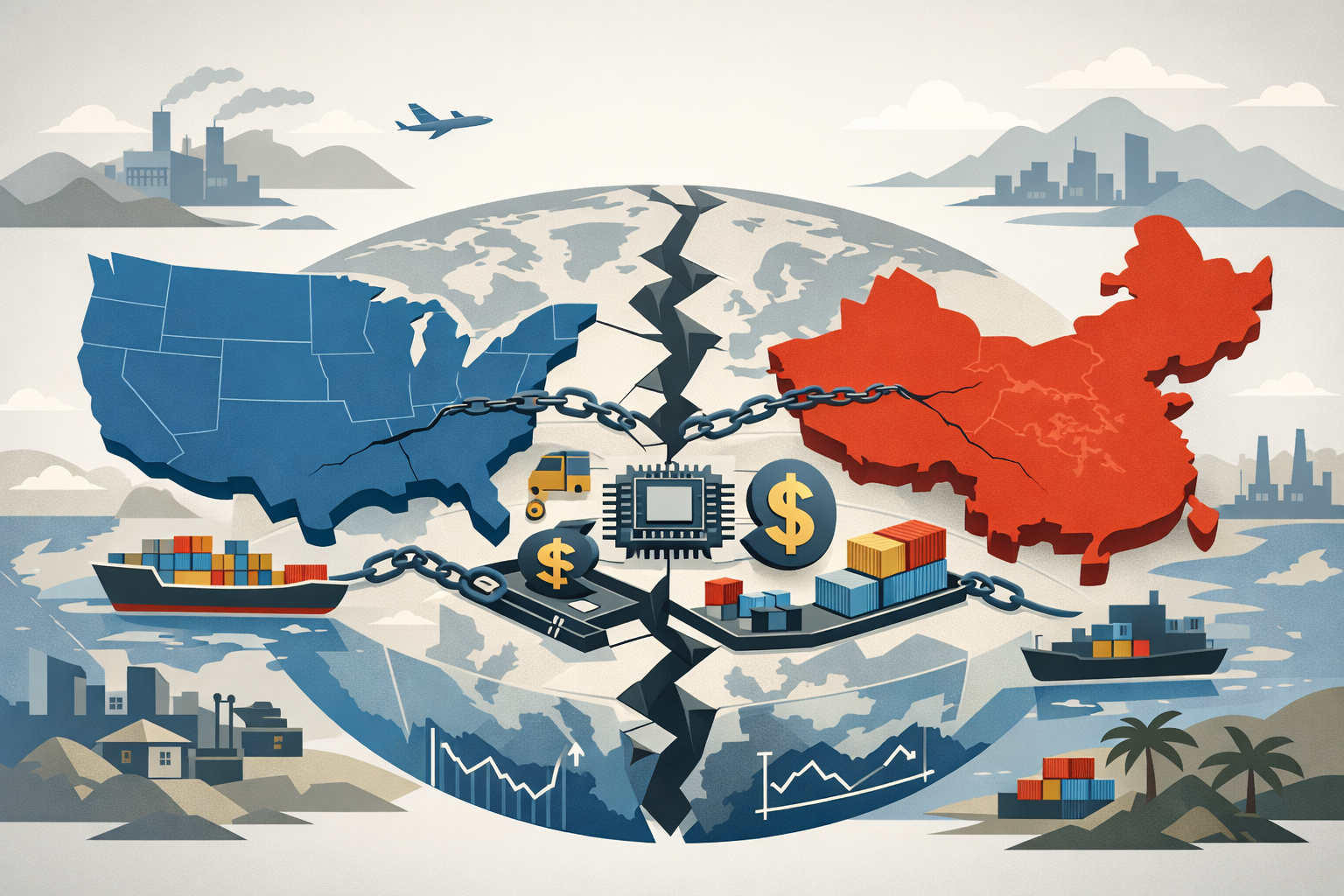
For years, Washington and Beijing claimed they could “de-risk” without fully decoupling. Policymakers on both sides insisted that selective guardrails—targeted export controls, strategic investment screens, and measured trade barriers—would protect national security interests while preserving the economic benefits of engagement. But recent moves in trade, technology, finance, and industrial policy suggest the world’s two largest economies are sliding toward a disorderly economic separation—one with unpredictable consequences for global growth and stability.
From De-risking to De Facto Decoupling
The rhetoric of “de-risking” emerged as a politically palatable alternative to full decoupling. The idea was straightforward: reduce exposure in critical sectors like semiconductors, rare earths, and advanced manufacturing, while maintaining commercial ties in less sensitive areas. European leaders, in particular, embraced this framing to signal alignment with U.S. security concerns without abandoning lucrative Chinese markets.
Yet the gap between de-risking rhetoric and decoupling reality is widening. What began as targeted measures has cascaded into expanding restrictions across multiple domains. The U.S. has progressively tightened controls on semiconductor manufacturing equipment, artificial intelligence chips, and quantum computing technology. China has responded with its own export restrictions on critical minerals, cybersecurity reviews of foreign firms, and regulations that effectively wall off sectors from Western participation. Each action triggers countermeasures, and the spiral proves difficult to contain.
The result is a form of decoupling that neither side fully intended—one driven less by strategic design than by the cumulative logic of mutual retaliation and defensive industrial policy.
Trade and Tariffs: Fragmentation Becomes the Norm
The trade dimension of this separation has evolved from a tactical skirmish into a structural reorganization of global commerce. U.S. tariffs on Chinese goods, first imposed in 2018, remain largely in place, affecting over $370 billion in bilateral trade. China’s retaliatory tariffs persist as well, though both sides have granted selective exemptions to manage domestic inflation pressures.
More significantly, non-tariff barriers are proliferating. Product standards, regulatory approvals, and compliance requirements are diverging as each economy builds its own technological ecosystem. “Friend-shoring”—the practice of relocating supply chains to allied or neutral countries—has accelerated, with U.S. companies shifting production to Vietnam, Mexico, and India, while Chinese firms deepen ties with ASEAN partners and pursue Belt and Road infrastructure investments.
This fragmentation comes at a cost. The IMF estimates that a sustained bifurcation of global trade could reduce long-term global GDP by 1.5% to 2%—a loss of roughly $2 trillion annually. Efficiency gains from comparative advantage erode as firms duplicate production facilities and maintain parallel supply chains. Inflation dynamics become stickier as procurement costs rise and alternative suppliers command premium pricing.
Technology and Capital: The Hardest Break
If trade fragmentation is economically costly, the technology split represents an existential challenge for innovation-driven growth. Semiconductors have become the flashpoint. U.S. export controls now restrict China’s access to advanced chip-making equipment from firms like ASML and Applied Materials, while limiting Chinese companies’ ability to purchase cutting-edge AI processors from NVIDIA and AMD.
China’s response has been to double down on indigenous innovation through massive state subsidies and coordinated industrial policy. The country is pouring hundreds of billions into semiconductor self-sufficiency, though most analysts believe technological parity remains years—if not decades—away, particularly in sub-7nm manufacturing.
Beyond chips, the technology divorce extends to software standards, cloud infrastructure, and telecommunications networks. The exclusion of Huawei and ZTE from Western markets runs parallel to China’s efforts to reduce dependency on American software and platforms. This duplication of R&D efforts and the fracturing of talent pools pose long-term risks to the pace of global innovation.
Capital flows are similarly constrained. U.S. investment screening mechanisms now scrutinize outbound investment in Chinese tech sectors, while Beijing’s regulatory crackdowns on domestic firms and data security concerns have chilled Western venture capital enthusiasm. Cross-border technology M&A—once a vibrant channel for knowledge transfer—has collapsed to a fraction of pre-2018 levels.
Financial and Currency Implications
The financial dimension of the US-China split receives less attention than trade and technology, but its implications are equally profound. Foreign direct investment flows between the two economies have declined sharply. U.S. FDI into China fell from $14 billion in 2021 to less than $9 billion in 2023, while Chinese investment in the U.S. remains constrained by CFIUS reviews and political sensitivity.
Portfolio investment faces similar pressures. Delisting threats for Chinese companies on U.S. exchanges, auditing disputes, and investor concerns over governance standards have prompted some firms to shift primary listings to Hong Kong or pursue dual listings. American pension funds and institutional investors increasingly face political pressure to reduce China exposure, even as Chinese authorities limit outbound capital flows.
Currency dynamics add another layer of complexity. While the U.S. dollar remains the dominant global reserve currency, China has incrementally pushed RMB internationalization through bilateral currency swap lines, commodity pricing agreements, and the Cross-Border Interbank Payment System (CIPS). These efforts aim to reduce dependency on dollar-based settlement systems and shield Chinese entities from U.S. financial sanctions.
Yet the RMB’s global role remains limited—accounting for less than 3% of international payments—constrained by capital account restrictions and concerns over legal predictability. The result is not a clean shift from dollar dominance to RMB ascendance, but rather a messy fragmentation of financial infrastructure that increases transaction costs and liquidity risks.
Global Spillovers: Why the World Can’t Stay Neutral
The US-China economic divorce imposes costs far beyond Washington and Beijing. Emerging markets face impossible choices: align with U.S. technology standards and risk losing access to Chinese markets, or integrate into Chinese systems and face Western regulatory barriers. Many countries attempt to hedge—maintaining trade ties with both while avoiding explicit alignment—but this strategy grows harder as standards diverge and political pressure mounts.
Supply chains that span multiple countries find themselves caught in compliance nightmares. A Vietnamese electronics manufacturer using Chinese components for U.S.-bound exports must navigate overlapping regulatory requirements and shifting rules of origin. European automakers sourcing batteries from China while selling into U.S. markets face similar complexity.
The economic costs compound over time. Duplicate investments in production capacity drain resources that could fund productivity improvements. Firms pay premiums for politically acceptable suppliers rather than economically optimal ones. Innovation slows as research communities fracture along geopolitical lines. The World Bank estimates that comprehensive trade fragmentation could reduce global efficiency by 5-8%, with the heaviest burdens falling on smaller, trade-dependent economies.
Perhaps most troubling is the uncertainty premium. When businesses cannot reliably predict policy trajectories—when a semiconductor sale approved today might be sanctioned tomorrow—long-term investment decisions become exercises in political risk management rather than economic optimization. This uncertainty tax discourages the very investments needed to drive future growth.
A Divorce Without a Settlement
The trajectory of US-China economic relations increasingly resembles a divorce proceeding where neither party can agree on asset division, custody arrangements, or even the grounds for separation. Unlike the Cold War split between the U.S. and Soviet Union—which occurred between economies with minimal integration—the US-China separation involves unwinding four decades of deep commercial, technological, and financial interdependence.
This makes the current decoupling fundamentally harder to manage. There is no clean division of assets, no neat separation of economic spheres. Instead, we face a protracted, messy process of partial separation across multiple domains, with neither side willing to bear the full cost of complete disengagement, yet neither able to halt the momentum toward fragmentation.
For investors, the implications are clear: prepare for persistent volatility driven by policy shocks, reduced efficiency in global supply chains, and the gradual formation of parallel economic ecosystems with different standards, regulations, and power structures. For policymakers, the challenge is to slow the drift toward unmanaged separation while maintaining necessary security protections—a balance that grows harder to strike as domestic political pressures intensify on both sides.
The coming years will test whether the global economy can function effectively with its two largest components operating increasingly separate systems. The answer will shape growth prospects, financial stability, and geopolitical alignments for decades to come. What’s certain is that the cost of this messy divorce will be measured not just in GDP points lost, but in opportunities foregone, innovations delayed, and the erosion of the cooperative frameworks that underpinned decades of global prosperity.