SEO Title: Fed Chair Uncertainty: Why Kevin Warsh’s Confirmation Could Shake Markets Meta Description: A potential battle over the next Federal Reserve Chair is raising concerns about central bank independence, market volatility, and U.S. monetary credibility. Meta Keywords: Federal Reserve Chair, Kevin Warsh, Fed independence, US monetary policy, global markets
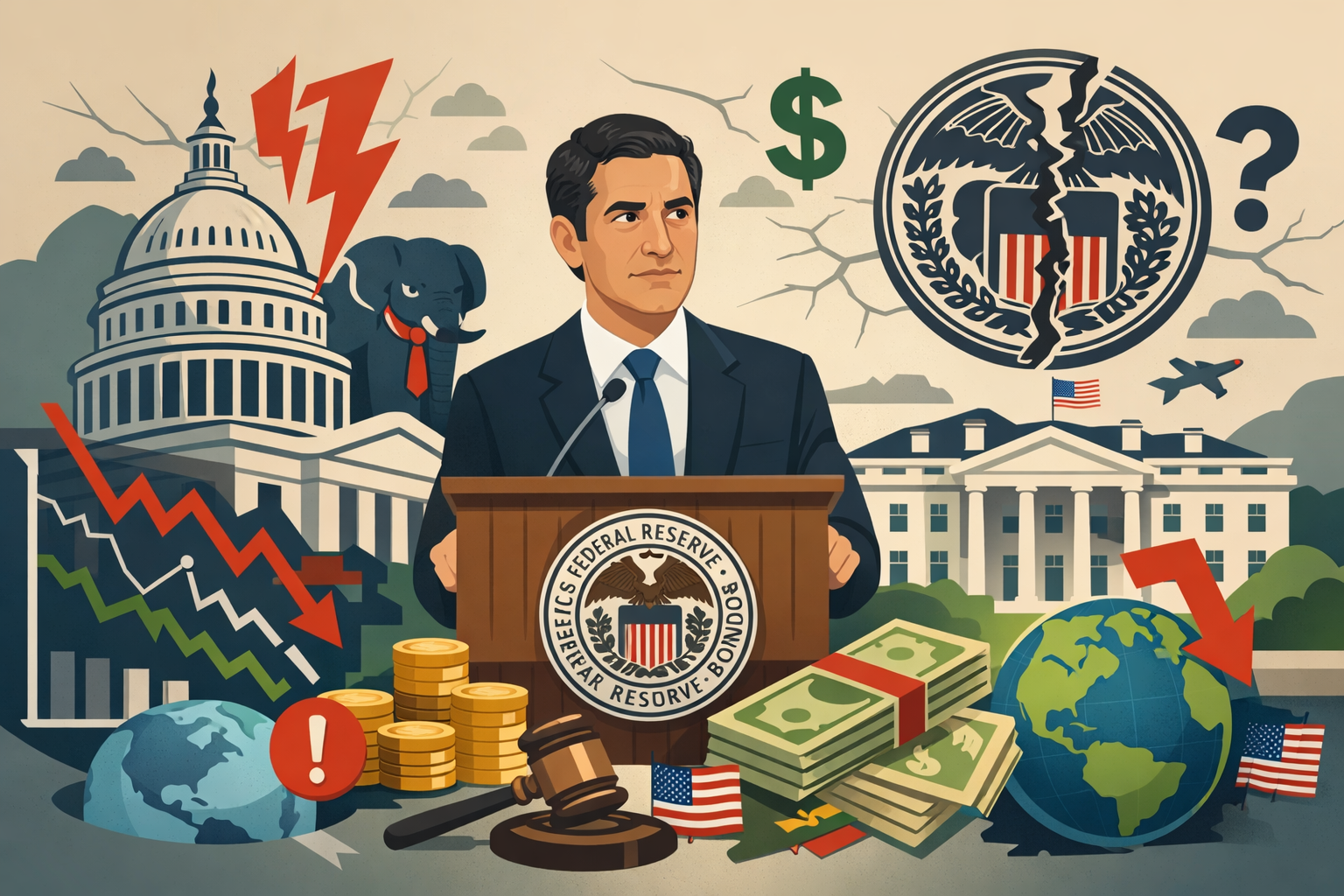
Markets tend to obsess over Federal Reserve interest-rate decisions—but far less attention is paid to who leads the institution itself. That may be about to change. On January 30, 2026, President Donald Trump formally nominated Kevin Warsh to succeed Jerome Powell as Chair of the Federal Reserve. The announcement ended months of speculation—but it may have opened a far more consequential chapter of uncertainty. As Washington braces for a potentially contentious confirmation process, investors worldwide are confronting an uncomfortable question: what happens when central bank independence itself becomes a market risk?
Why the Fed Chair Matters More Than Ever
The Federal Reserve has always been powerful, but its role has expanded dramatically since the pandemic era. Massive balance sheet operations, emergency lending facilities, and forward guidance have made the Fed not just a rate-setter but a global market signal. The Chair of the Federal Reserve does not merely preside over meetings—they shape expectations across every major asset class, from U.S. Treasuries to emerging market currencies.
Past transitions at the top have occasionally moved markets—think of the shift from Paul Volcker’s inflation-fighting regime to Alan Greenspan’s era of “irrational exuberance,” or the relatively smooth handoff to Jerome Powell in 2018. But this time is different. The nomination arrives against a backdrop of unprecedented White House pressure on the Fed, an active criminal investigation into the sitting Chair, and partisan gridlock that threatens to delay the confirmation well past Powell’s May 2026 departure.
Who Is Kevin Warsh?
Kevin Warsh, 55, is no stranger to the Federal Reserve. He served as a Governor on the Fed’s Board from 2006 to 2011—the youngest appointee in the institution’s history at the time—and played a central role as the Fed’s liaison to Wall Street during the 2008 financial crisis. A Stanford and Harvard Law graduate, Warsh went on to become a fellow at the Hoover Institution and a lecturer at Stanford’s Graduate School of Business.
Warsh built a reputation as an inflation hawk during his time on the Board, publicly opposing the Fed’s second round of quantitative easing before resigning in 2011. In the years since, he has been a persistent critic of the Fed’s expanded balance sheet, its communication strategy, and what he calls institutional “mission drift.” In a notable April 2025 speech to the Group of Thirty and the IMF, Warsh called Fed independence “important and worthy” while arguing the central bank had weakened its own case by straying beyond its core mandate.
More recently, however, Warsh’s tone has shifted. He has echoed Trump’s criticism of Powell for not cutting rates aggressively enough, and has voiced support for lower interest rates, arguing that AI-driven productivity gains could sustain faster economic growth without reigniting inflation. As David Wessel of the Brookings Institution put it: “The test will come probably in 2027 and 2028, when he will have to decide if the president’s view of the economy matches his, and will he prove to be independent.”
The Confirmation Battle: Politics vs. Markets
On paper, Warsh’s qualifications are strong—former Fed Governor, Wall Street experience at Morgan Stanley, bipartisan name recognition. Senate Banking Committee Chairman Tim Scott called the nomination a reflection of the President’s focus on “accountability and credibility” at the Fed. The Financial Services Forum, representing the eight largest U.S. banks, endorsed him immediately.
But the path to confirmation is anything but clear. The central obstacle is not Warsh himself—it is the Justice Department’s criminal investigation into Jerome Powell, ostensibly over cost overruns related to the Fed’s $2.5 billion headquarters renovation. Senator Thom Tillis, a Republican on the Banking Committee who is not seeking reelection, has vowed to block all Fed nominations until the probe is “fully and transparently resolved.” His position is unequivocal: “Protecting the independence of the Federal Reserve from political interference or legal intimidation is non-negotiable.”
The arithmetic is stark. The Senate Banking Committee is split 13 Republicans to 11 Democrats. All Democratic members, led by ranking member Elizabeth Warren, have demanded a delay until both the Powell investigation and a separate probe into Fed Governor Lisa Cook are concluded. With Tillis joining them, the committee would deadlock, preventing Warsh’s nomination from reaching the Senate floor. As Bloomberg reported this week, even GOP senators who support Warsh are calling the Powell probe a “waste of time”—but that frustration has not yet translated into a resolution.
Policy analysts estimate Warsh may not be confirmed until March or April at the earliest. If the standoff persists beyond Powell’s May departure, Vice Chair Philip Jefferson would likely serve as acting Chair—an unprecedented scenario that could itself become a source of market anxiety.
Market Reaction Channels
The market response to Warsh’s nomination was swift, multifaceted, and revealing.
Precious metals experienced the most dramatic moves. Spot gold plunged roughly 9% on the day of the announcement, while silver suffered its worst single-day decline since March 1980, falling over 31%. The sell-off reflected a rapid unwinding of “debasement hedges”—positions built on the assumption that the Fed would continue its accommodative stance indefinitely. Warsh’s well-known opposition to quantitative easing signaled that the era of the “Fed put” might be ending.
The U.S. dollar rallied, with the Dollar Index climbing to 97.09, as traders priced in a more hawkish and credible Fed leadership. Richard Saperstein, chief investment officer of Treasury Partners, summarized the sentiment: Warsh is “a steady hand, well known in market circles and is expected to maintain the independence of the central bank, which is critical for markets.”
Treasury yields told a more nuanced story. The 10-year yield edged up to 4.245%, while the 30-year rose to 4.881%. The 2-year yield, which tracks near-term Fed expectations, dipped slightly. This yield curve steepening reflects the market’s dual expectation: rate cuts in the near term, but a smaller Fed balance sheet driving long-term yields higher.
Equities fell modestly—the S&P 500 dropped 0.4%, the Nasdaq lost 0.9%—as investors weighed the implications of reduced central bank intervention. The VIX has remained elevated as confirmation uncertainty persists.
Central Bank Independence at Stake
The deeper concern for global investors is not about Warsh’s policy views per se—it is about the institutional framework within which those views will be expressed. Trump’s sustained campaign against Powell—publicly calling him “stupid,” a “stubborn moron,” and threatening to sue him for “incompetence”—has already tested the boundaries of Fed independence in ways not seen since the Nixon era.
The criminal investigation into Powell, which the Fed Chair himself has attributed to his refusal to cut rates as aggressively as the President demanded, represents a qualitative escalation. At Warsh’s eventual confirmation hearings, Senator Warren asked Treasury Secretary Scott Bessent whether Warsh would face prosecution if he, too, declined to cut rates at the President’s direction. Bessent’s response—”That is up to the President”—sent a chill through markets and policy circles alike.
History offers sobering lessons. The stagflation crisis of the 1970s was exacerbated by political interference with Fed monetary policy under Arthur Burns. More recently, both Turkey and Argentina have experienced severe financial crises linked directly to the erosion of central bank independence. Fourteen international central bank chiefs issued a joint statement affirming that “the independence of central banks is a cornerstone of price, financial and economic stability.” The question now is whether the U.S. will heed that principle or test its limits.
Global Spillovers
The Federal Reserve is not just America’s central bank—it is, for better or worse, the world’s. A contested or delayed confirmation process has implications far beyond Washington.
Emerging markets are particularly vulnerable. The South Korean Kospi index dropped 5.3% on February 2, reflecting fears that aggressive Fed balance sheet reduction could drain dollar liquidity from developing economies. Capital flows into emerging markets are highly sensitive to perceptions of U.S. monetary stability; any signal that the Fed’s decision-making has been compromised by politics could trigger outflows.
The repricing of U.S. risk-free assets affects every portfolio on the planet. If the term premium on Treasuries rises—not because of inflation but because of governance uncertainty—it raises the cost of capital globally. The Treasury Borrowing Advisory Committee’s February 3 report noted that “markets were little changed” immediately after the nomination, but flagged elevated currency and commodity volatility as a concern.
Global monetary coordination also hangs in the balance. The Fed regularly coordinates with the European Central Bank, Bank of Japan, and Bank of England on matters ranging from dollar swap lines to financial stability. A perception that the Fed Chair operates under political constraint could undermine trust in these mechanisms at a time when geopolitical fragmentation is already straining international cooperation.
What Investors Should Watch Next
The coming weeks will be critical. Several signposts deserve close attention:
First, the resolution—or continuation—of the DOJ investigation into Powell. This is the single biggest variable in the confirmation timeline. Senate Banking Committee Chair Tim Scott has said publicly that he believes Powell “was not prepared for that hearing” and “did not commit a crime.” If the White House signals a conclusion to the probe, the path clears rapidly.
Second, any indication from Tillis that his position is softening—or hardening. As a retiring senator with no electoral incentive to compromise, Tillis holds unusual leverage. His latest statement: “I’m not budging one inch.”
Third, Warsh’s confirmation hearings themselves. Markets will parse every word for signals on balance sheet policy, the pace of rate cuts, and—above all—independence from White House direction. His articulation of a “New Treasury-Fed Accord,” echoing the 1951 agreement that formally separated Fed monetary policy from Treasury debt management, will be closely scrutinized.
Fourth, Fed communications during the transition. Powell’s remaining months at the helm will set the stage. The Fed held rates steady at 3.5%–3.75% in late January, with two dissents in favor of a cut. How the FOMC navigates the interregnum between Powell and a potential Warsh chairmanship will shape market expectations through mid-2026.
Markets can price in higher rates. They can price in lower growth. What they struggle to price in is uncertainty about the rules of the game. A politicized Fed is not just a U.S. problem; it is a global one. For investors, the Warsh confirmation process is not merely a Washington drama—it is a stress test for the institutional architecture that underpins the entire global financial system.