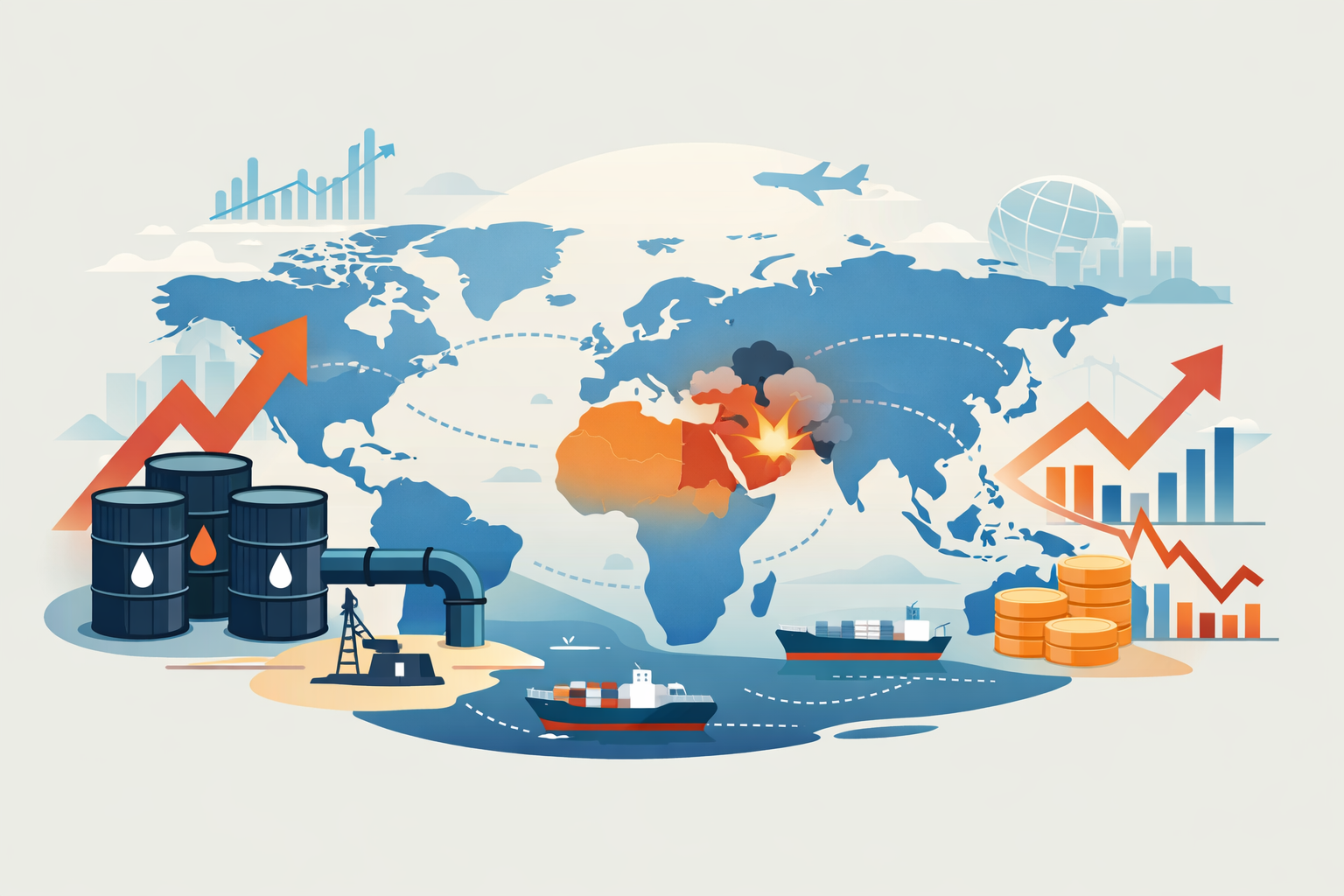
The global economy had a story it was telling itself: inflation was beaten, rate cuts were coming, and the worst was behind us. That story is now under pressure.
As conflict involving Iran continues to rattle energy markets, the International Monetary Fund has put a number on the risk. Speaking on Bloomberg Television, IMF Managing Director Kristalina Georgieva warned that if oil prices stay 10% higher for a sustained period of one year, global inflation could rise by 0.4 percentage point — 40 basis points — and trim global growth by somewhere between 0.1 and 0.2 percentage point. In a policy environment where central banks have spent the better part of two years fighting to pull inflation down by just a few tenths at a time, those are not trivial figures.
From Conflict to Consumer Prices
The mechanism linking war in the Middle East to grocery bills in Germany or petrol prices in Japan is not complicated, but it is worth tracing clearly.
Crude oil is the upstream input for fuel, plastics, fertilizer, shipping, and virtually every form of industrial transport. When crude prices rise sharply and stay elevated, the cost pressure does not stay confined to petrol stations. It moves through supply chains, lifts freight costs, squeezes food production margins, and eventually shows up as a broad-based consumer price increase that is far harder for central banks to address than a simple energy price spike.
This is the concept economists refer to as second-round effects. The initial oil price move is just the opening act. The real policy problem begins when businesses pass higher transport costs into their prices, when workers in energy-intensive sectors push for higher wages to compensate, and when inflation expectations — the psychological anchor of price stability — start to drift. At that point, a commodity shock becomes something more structural. Bloomberg Economics has modeled scenarios in which oil prices move significantly beyond the 10% threshold, and in those cases the inflation impact scales materially. The IMF estimate is, in that sense, a floor, not a ceiling.
Reuters reported that investors are increasingly concerned that a prolonged Iran conflict could trigger precisely this kind of sustained energy shock — one severe enough not merely to lift prices temporarily, but to delay the rate-cutting cycle that markets had priced in across most major economies. That anxiety is already visible in bond markets, where inflation expectations have been creeping higher and yield curves have shifted in ways that imply investors are reassessing how quickly central banks can move.
Central Banks in an Uncomfortable Position
Entering 2025, the broad consensus was that the Federal Reserve, the European Central Bank, and several other major central banks were on a credible path toward easing. Inflation had fallen substantially from its post-pandemic peaks. Core measures were trending in the right direction. The question was not whether cuts would come, but when and how many.
An oil shock disrupts that calculus in a specific and frustrating way. Central banks cannot directly control commodity prices, and they generally understand that responding aggressively to supply-side shocks — raising rates sharply to offset a war-driven oil spike — risks doing more damage than good. But they also cannot ignore what higher energy costs do to broader inflation dynamics, especially if expectations start rising. The result is a kind of forced patience: they watch, they wait, and they delay.
The ECB offers the clearest current illustration. ECB Executive Board member Steven Oosterhaus and Governing Council member Olaf Sleijpen have both suggested the oil move is not yet large enough to fundamentally alter the ECB’s policy stance. The eurozone was already in what ECB officials described as a “good place” on inflation. But they were also careful not to sound dismissive. Reuters reported that Sleijpen acknowledged the situation was being watched closely, with the trajectory of the conflict — and whether it escalates further — clearly a factor in future deliberations. That kind of language from a central banker is a signal in itself: the baseline holds for now, but the margin for error has narrowed.
Meanwhile, eurozone inflation data released in recent weeks showed a jump that was partly attributable to energy prices, according to Reuters. It was an early empirical indication that the transmission channel from oil markets to the official inflation statistics is already operating. One month does not establish a trend, but it reinforces the case for caution.
What Bond Markets Are Already Saying
Financial markets rarely wait for official forecasts to catch up. Bond markets in particular tend to price geopolitical risk quickly, sometimes before the macroeconomic data has even registered a change.
Since the Iran conflict intensified, inflation breakeven rates — the market’s implied forecast for average inflation embedded in the spread between nominal and inflation-linked government bonds — have ticked upward in the United States and Europe. Treasury yields have also moved higher as traders repriced the probability of near-term rate cuts. This matters well beyond the bond market itself. Higher sovereign yields raise borrowing costs for governments, corporates, and households. They strengthen the dollar, which then tightens financial conditions in emerging markets that borrow in US currency. A sustained oil shock does not stay in one asset class; it propagates.
For equity markets, the implications are mixed but generally negative at the margin. Higher discount rates compress valuations, and sectors sensitive to consumer spending face a double pressure: input costs rising on the production side, purchasing power eroding on the demand side.
The Uneven Global Map
Not every country experiences an oil shock the same way, and it is worth being precise about who faces the greatest exposure.
The obvious beneficiaries are oil exporters: Gulf producers, Saudi Arabia, the UAE, and to some extent Norway and Canada, whose fiscal positions improve when crude prices rise. For them, a sustained oil spike is, paradoxically, a windfall.
The burden falls most heavily on energy-importing economies. Japan, South Korea, and most of Southeast Asia import the overwhelming majority of their crude. The European Union, still working through the structural adjustment forced by the loss of cheap Russian gas after 2022, is particularly sensitive to any further energy price elevation. Higher oil means higher import bills, which worsen trade balances and apply downward pressure on currencies — which in turn risks importing even more inflation.
The most acute vulnerability, however, belongs to lower-income, import-dependent economies with limited fiscal buffers and high food and fuel shares in consumer price indices. For these countries, a 40-basis-point global average understates the domestic impact considerably. In economies where food and fuel account for 50% or more of the CPI basket, even a moderate sustained oil price move can translate into politically and socially destabilizing inflation. This is where the story shifts from a discussion about financial market repricing to something with real humanitarian consequences.
What the Next Months Will Determine
The IMF estimate is built on a specific scenario: a 10% oil price increase, sustained for exactly one year. Reality rarely cooperates with such tidy parameters. The actual impact will depend on several variables that remain genuinely uncertain.
The first is duration. A brief spike — even a sharp one — that reverses quickly is manageable. Markets absorb it, central banks look through it, and the macroeconomic footprint is limited. What concerns the IMF and investors alike is a scenario where conflict-related supply disruption, or the sustained threat of it, keeps prices elevated for six months, nine months, a year or more. In that case, the second-round effects have time to embed themselves.
The second variable is whether Strait of Hormuz transit — through which roughly 20% of global oil passes — faces any direct disruption. So far, shipping through the strait has continued, but the risk premium attached to that transit has grown. If that changes materially, the oil price arithmetic changes with it.
The third, and ultimately most consequential, variable is inflation expectations. If consumers, businesses, and financial markets remain broadly convinced that inflation will return to target over a reasonable horizon, central banks preserve the space to respond flexibly. If expectations start to become unmoored — if households start adjusting wage demands and businesses start adjusting pricing assumptions based on a belief that inflation will stay high — then the task for policymakers becomes categorically harder.
The real lesson from the post-2021 inflation experience is that energy shocks do not stay contained. They move through economies in ways that are difficult to anticipate and even harder to reverse quickly. The IMF’s 40-basis-point warning is not alarmist; it is a careful, bounded estimate. But it is precisely that boundedness that should give policymakers and investors pause. It assumes a limited shock, a limited duration, and limited spillovers. Each of those assumptions could be wrong. Duration, in the end, is everything. The first price spike is rarely the problem. It is what happens in month four, month seven, and month ten that determines whether the disinflation story survives.