The damage reported at Qatar’s Ras Laffan Industrial City is no longer just a regional security headline. It is rapidly becoming a global economic story, with consequences that reach from Asian utility bills to European factory floors to the interest-rate decisions of central banks already stretched thin by geopolitical uncertainty.
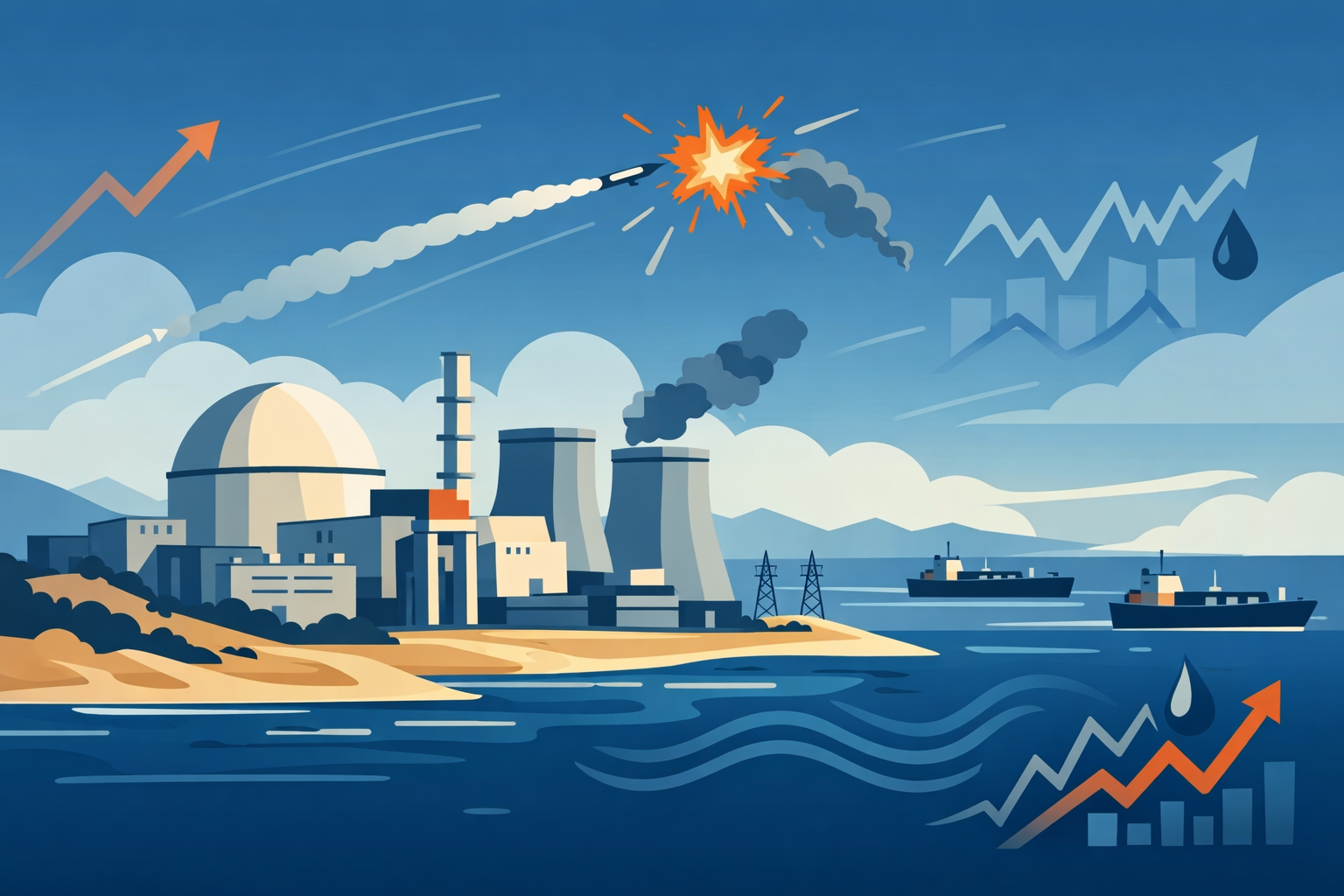
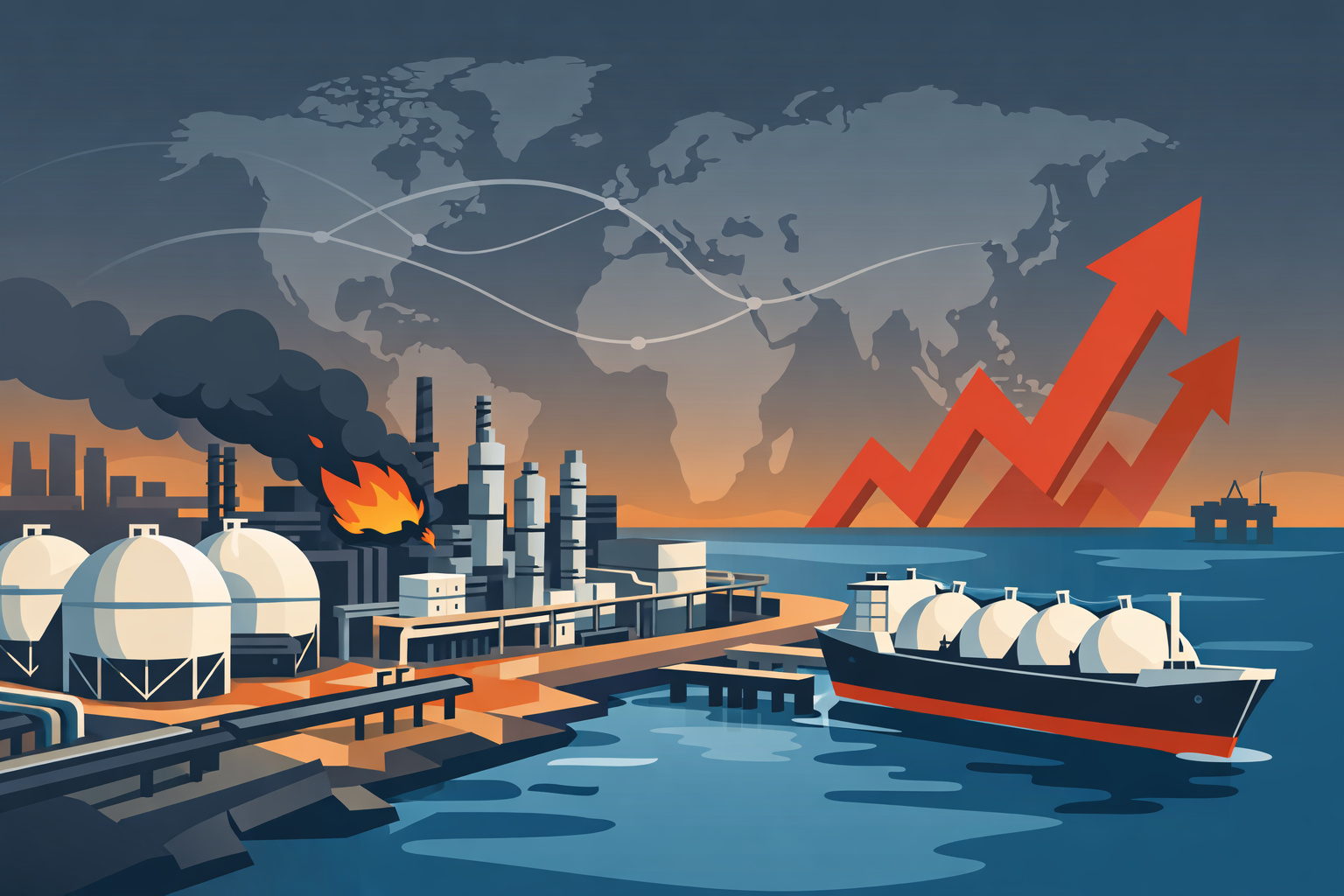
On March 18, Qatari officials confirmed that Iranian missile strikes had caused “significant damage” to the Ras Laffan complex, the site of the world’s largest liquefied natural gas production facility. QatarEnergy later reported that additional LNG facilities had been hit, with “sizeable fires and extensive further damage.” Hours earlier, Iran’s Revolutionary Guard had threatened to attack energy infrastructure across the Gulf—including sites in Saudi Arabia and the UAE—in retaliation for an Israeli strike on Iran’s South Pars gasfield. Qatar’s foreign ministry expelled Iran’s military and security attachés within 24 hours.
This is the second time in less than three weeks that Ras Laffan has been targeted. Qatar initially halted LNG production on March 2 after Iranian drone strikes hit both Ras Laffan and the Mesaieed Industrial City. That shutdown alone removed roughly 20 percent of global LNG supply from the market overnight. The latest attack compounds the disruption and raises a harder question: how long before the world’s most important gas export complex can operate normally again?
Why Ras Laffan Matters
Ras Laffan is not just another energy facility. Located about 80 kilometres northeast of Doha, it is the operational heart of Qatar’s LNG empire—the infrastructure through which the country processes and ships gas drawn from the massive North Field, the world’s largest non-associated gas reservoir. Qatar is the second-largest LNG exporter in the world after the United States, and Ras Laffan accounts for nearly all of that output. Before the March disruptions, Qatar supplied approximately 20 percent of global LNG trade.
That market share makes Ras Laffan systemically significant. LNG is not like oil, which can be redirected relatively quickly through a global network of tankers and refineries. Liquefied natural gas requires specialised processing—the gas must be cooled to minus 162 degrees Celsius to become liquid—and moves through a chain of liquefaction plants, purpose-built carriers, and regasification terminals. When a major liquefaction hub goes offline, there is no simple substitute. Spare global capacity is limited, and the infrastructure needed to bring new supply online takes years to build.
That structural rigidity is precisely why the Ras Laffan strikes matter so much.
From Regional Strike to Global Gas Shock
The transmission mechanism of an LNG supply shock is more direct than many observers appreciate. Physical damage to a liquefaction complex creates supply uncertainty. Uncertainty drives up futures prices. Higher prices raise import costs for buyer nations, which then feed through into utility bills, industrial energy costs, and eventually consumer price indices. The entire chain can move in a matter of days.
It is already moving. The Japan-Korea Marker (JKM), the main benchmark for LNG deliveries into Northeast Asia, hit a one-year high after the initial March 2 shutdown, with prices reaching around $22.50 per million British thermal units before easing slightly. Goldman Sachs estimated that a month-long halt to flows through the Strait of Hormuz could push European TTF and Asian JKM prices toward 74 euros per megawatt hour—the level that triggered large-scale demand destruction during the 2022 European energy crisis. LNG prices overall have risen roughly 60 percent since the start of the conflict, according to data from Kpler.
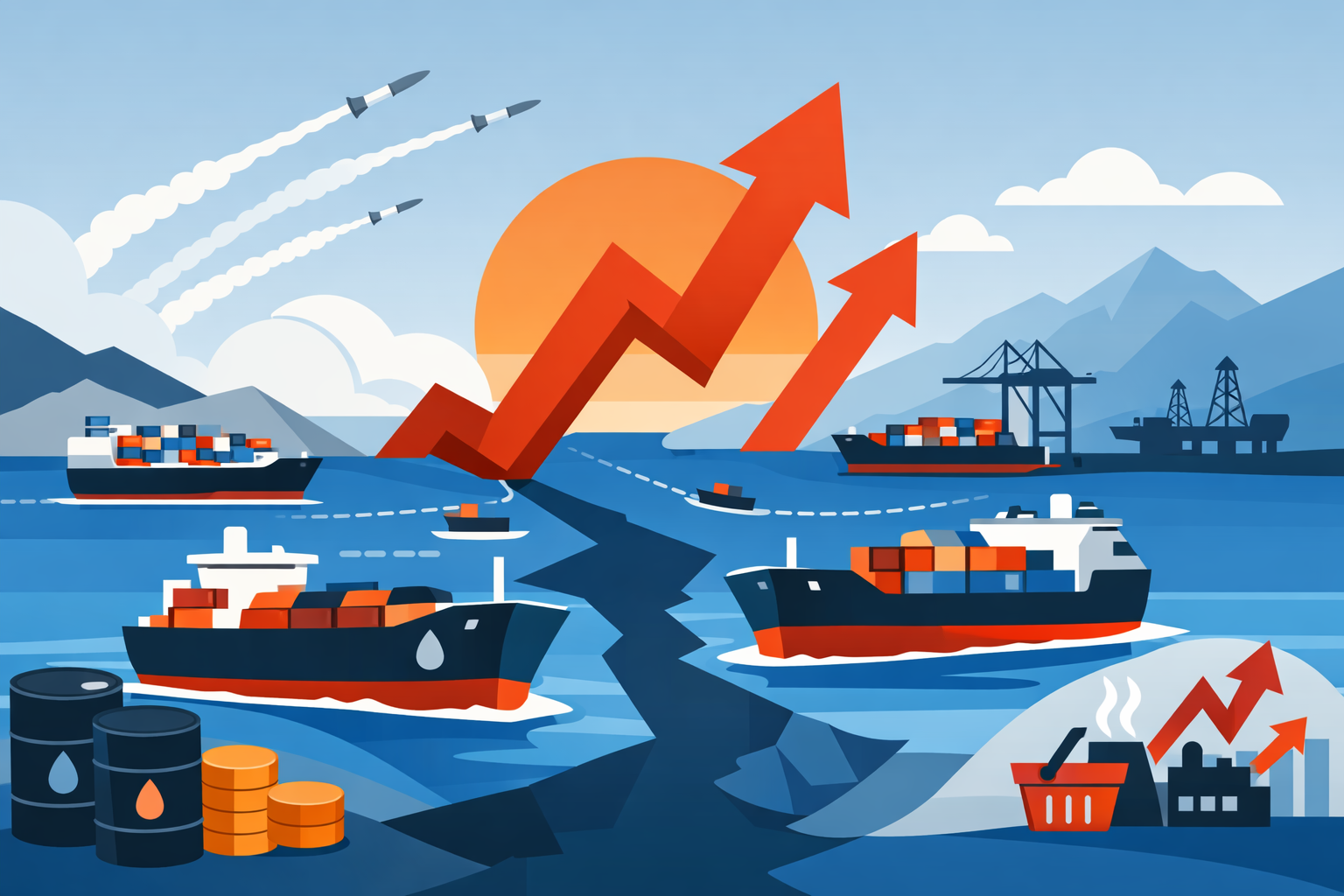
The Strait of Hormuz is central to this picture. Iran has effectively closed the strait to commercial shipping, disrupting not only LNG flows but also about 20 percent of global oil supply. Around 84 percent of crude oil and 83 percent of LNG transiting the strait in 2024 was bound for Asia. For countries that depend on seaborne energy imports, the combination of production shutdowns at Ras Laffan and transit blockages through Hormuz amounts to a double shock.
Who Is Most Exposed
Asia is the most directly vulnerable region. Japan, South Korea, Taiwan, and China are all major LNG importers, and a significant share of their supply either originates in Qatar or transits the Strait of Hormuz. South Korea sources about 70 percent of its crude and 20 percent of its LNG from the Middle East. Japan depends on the region for roughly 10 percent of its LNG, with about 6 percent of total imports passing through Hormuz.
The response from major buyers has been swift. JERA, Japan’s largest LNG buyer and power generator, has begun talks with global suppliers for potential additional purchases. The company handles about 35 million metric tons of LNG annually, with roughly 5 percent of its shipments passing through Hormuz. JERA’s Global CEO Yukio Kani warned against planning on the assumption of a quick resolution. JERA and South Korea’s KOGAS have also signed a cooperation agreement to explore cargo swaps and supply management—a sign that buyers are not waiting for the situation to stabilise before adapting.
Europe, still recovering from the loss of Russian pipeline gas after 2022, faces a different but related vulnerability. Around 25 percent of Europe’s total gas supply now comes from LNG, and a prolonged disruption to Gulf flows could recreate the pricing stress that battered the continent three years ago. Equinor, one of Europe’s largest natural gas suppliers, saw its shares reach a 52-week high as markets priced in tighter supply. Goldman Sachs estimated that a sustained 10 percent rise in energy prices over four quarters would cut 0.2 percent from GDP in both the UK and the eurozone.
Emerging markets are perhaps the most fragile. Countries with high energy import dependence, weaker currencies, and limited fiscal buffers—including Pakistan, Bangladesh, and several Sub-Saharan African economies—face both higher import bills and tighter external financing conditions. India, heavily reliant on Middle Eastern crude and with thinner strategic reserves, is particularly exposed to a prolonged disruption.
The Inflation and Central-Bank Dilemma
The macroeconomic consequences of all this depend on one variable above all: duration. If the disruption is contained and Ras Laffan returns to operation within weeks, the price spike will likely be transitory, and central banks can afford to look through it. If it drags on for months, the picture changes materially.
Research from the National Institute of Economic and Social Research (NIESR) estimates that a one-year persistence of elevated oil and gas prices could raise UK inflation by 0.7 percentage points, push the Bank of England to raise rates by 0.8 percentage points, and shave 0.2 percent off GDP. Goldman Sachs has estimated that a six-week Hormuz closure could add 0.7 percentage points to inflation across Asia, with the Philippines and Thailand most at risk. The IMF’s managing director, Kristalina Georgieva, warned on March 9 that a prolonged conflict poses a clear inflationary risk to the global economy.
Central banks find themselves in an uncomfortable position. The traditional toolkit—adjusting interest rates—is designed for demand-driven inflation. Supply shocks driven by geopolitical conflict are structurally different. Raising rates cannot fix a liquefaction plant or reopen a shipping lane. Yet if energy price increases begin feeding into wages and broader price expectations, central banks may feel compelled to tighten, even at the cost of growth. Former U.S. Treasury Secretary Janet Yellen noted that the Iran situation has put the Federal Reserve “even more on hold,” reinforcing the reluctance to cut rates. ECB council member Pierre Wunsch signalled caution, saying that if the energy price increase persists, policymakers will need to reassess their models.
The spectre of stagflation—rising prices alongside stalling growth—is now back in the conversation. It is not a certainty. But the risk distribution has shifted in a way that markets and policymakers cannot ignore.
Market Implications Beyond Energy
The fallout extends well beyond the energy sector. Airlines, chemicals producers, heavy manufacturers, and other energy-intensive industries face margin compression as input costs rise. South Korea has introduced maximum wholesale gasoline prices. China has ordered state-owned oil companies to halt clean product exports to preserve domestic supply. European ethanol producers report that natural gas, previously around 20 percent of production costs, has now risen to 30 percent.
Bond markets are repricing inflation risk. Brent crude has climbed about 40 percent since the conflict began on February 28, settling above $103 per barrel. Currency markets are diverging along predictable lines: energy importers face pressure, while some commodity-exporting economies see support. The global stock sell-off in early March—the Dow fell over 400 points, the S&P 500 dropped 0.7 percent, and European and Asian indices fell 1–2 percent—reflected investor anxiety about both the inflation outlook and the growth drag from higher energy costs.
Freight costs have amplified the shock. Shipping rates for Atlantic-to-Asia LNG routes reportedly surged more than 600 percent in a single week, a reminder that the cost of moving energy can spike faster than the cost of the commodity itself. War-risk insurance premiums have also risen sharply, creating economic barriers to trade even where physical routes remain technically open.
What Comes Next
The range of possible outcomes remains wide, and the economic consequences depend far more on duration than on any single headline.
In a contained scenario, the damage at Ras Laffan is repaired over the coming weeks, Hormuz shipping gradually resumes, and prices cool from their peaks. Capital Economics has argued that if the war ends within a few weeks, the impact on GDP and inflation outside the Gulf will be limited. Venture Global, the second-largest U.S. LNG exporter and a JERA supplier, has described the current volatility as “very short-term” and said that new U.S. liquefaction capacity coming online next year would meaningfully shift supply dynamics.
In an extended scenario, Ras Laffan remains impaired, the Strait of Hormuz stays contested, and buyers are forced into a scramble for alternative cargoes that keeps prices elevated for months. Qatar’s energy minister, Saad al-Kaabi, said last week that it could take months to return to normal LNG deliveries. Under this scenario, Capital Economics projects Brent crude could average $150 per barrel over the next six months, with eurozone growth slowing to 0.5 percent and China’s growth falling below 3 percent.
A further escalation—additional strikes on Gulf energy infrastructure, wider military operations, or sustained closure of Hormuz—would deepen the shock well beyond what current models capture. The World Economic Forum’s 2026 Global Risks Report warned that such a confluence of supply disruption, trade friction, and inflationary pressure could prove toxic for a global economy already navigating tariff disputes, post-pandemic debt, and strained fiscal positions.
The Fragility Beneath the Surface
What the Ras Laffan strikes reveal is not just the vulnerability of a single facility, but the fragility of a global energy architecture that has concentrated critical LNG capacity in a small number of locations, linked them to contested maritime chokepoints, and assumed that geopolitical stability would hold.
That assumption is now being tested in real time. Markets have spent years pricing geopolitical risk as a tail event—something feared but improbable. The damage at Ras Laffan, the closure of Hormuz, and the rapid repricing of gas, oil, and inflation expectations are forcing a recalibration. The question is no longer whether the world’s energy supply chains are exposed to political shocks. It is how deep and how lasting this particular shock will prove to be.