Japan’s long battle with deflation may be entering a new phase — not because of domestic demand, but because of a war thousands of miles away. As the Iran conflict grinds on and tankers sit idle in the Strait of Hormuz, Japan’s inflation is accelerating again, and the Bank of Japan is being forced to rethink a policy path that, just months ago, looked almost settled.
Inflation Reaccelerates, But Not for the Right Reasons
The March data released on April 24 tells a simple story with complicated implications. Core CPI — the measure that excludes fresh food and is the BOJ’s preferred gauge — rose 1.8% year-on-year, up from 1.6% in February. That’s the first acceleration in five months, and it matched market expectations closely enough that the number itself wasn’t the headline. The composition was.
Energy prices fell 5.7% year-on-year in March, a noticeably slower decline than February’s 9.1% drop. In other words, the deflationary pull from energy is fading fast, and government subsidies that had been masking underlying pressure are losing their effect. Meanwhile, the “core-core” measure that strips out both food and energy — the one economists watch to see if domestic demand is really generating price pressure — eased slightly to 2.4% from 2.5%.
That divergence matters. It means the renewed inflation Japan is seeing is not the kind policymakers spent a decade trying to engineer. Core-core at 2.4% suggests domestic wage-price dynamics remain relatively stable, while headline and core are being pushed up by imported costs. This is, to borrow the phrase that comes up in every BOJ briefing, the “bad” kind of inflation.
The Middle East Shock, in Transmission
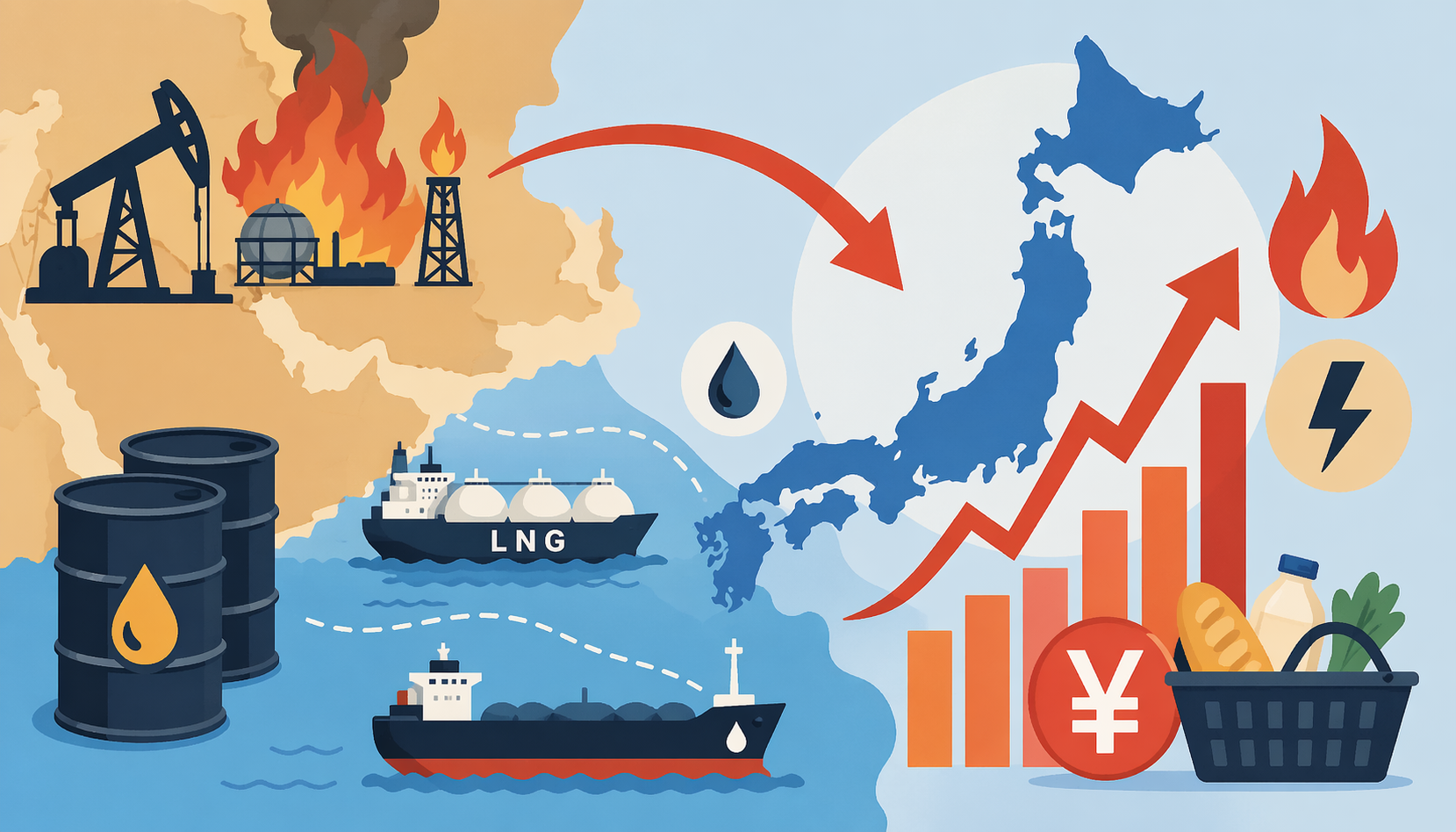
The channel running from Tehran to Tokyo’s CPI basket isn’t subtle. The Strait of Hormuz, which handled roughly 20% of the world’s daily oil and LNG flows before the war began in late February, has been operating at a fraction of normal capacity since the U.S. imposed a naval blockade on Iranian ports on April 13. Brent crude, which traded near $70 a barrel before the conflict, has spent April oscillating between the high-$90s and $106, with Iran and the U.S. trading tanker seizures in what amounts to a slow-motion maritime standoff. As of April 24, Brent was above $106 after Israel’s defense minister signaled readiness to resume operations against Iran pending a U.S. green light.
For Japan, which imports roughly 90% of its primary energy and sources around 40% of its crude and a meaningful share of its LNG from the Middle East, this is a direct pass-through. The BOJ’s own data made the transmission mechanism visible in the same release: services producer prices rose 3.1% in March, up from 2.7% in February, driven by a 42.1% jump in ocean freight transportation costs — a line item that essentially measures how expensive it has become to move goods when a chunk of the world’s energy corridor is compromised.
Layered on top is the yen. USD/JPY was trading around 159.8 on April 24, having weakened more than 11% against the dollar over the past twelve months. A weaker yen makes every barrel of oil and every MMBtu of LNG more expensive in domestic currency terms, compounding the underlying commodity shock. Finance Minister Katayama has reiterated that the government retains a “free hand” to intervene, but verbal intervention at these levels has limited credibility without action behind it.
The BOJ’s Narrowing Path
The central bank meets next week, and the consensus is that it will hold the policy rate at 0.75% while signaling readiness to move — possibly as soon as June. Reuters reporting, citing sources familiar with the BOJ’s thinking, indicates the bank will cut its FY2026 growth forecast while sharply raising its inflation projection. That combination — lower growth, higher inflation — is the textbook definition of a stagflationary shock, and it leaves the BOJ with no clean options.
Credit Agricole analysts captured the dilemma in a note following the CPI release: if crude stays elevated and energy subsidies aren’t expanded, core inflation could approach 3% by the end of FY2026, even as core-core stays below 2% because household purchasing power is being eroded rather than expanded. The BOJ would likely emphasize rising inflation expectations — a BOJ survey this week showed more than 83% of respondents expect higher prices a year from now — while the government, worried about the terms-of-trade hit, would emphasize the growth drag. Same data, two different political readings.
Masato Koike at Sompo Institute Plus framed it succinctly in comments to reporters, noting that cost-push pressure from the Middle East conflict will feed through not just to energy but to a broad range of goods, and that government subsidies can blunt but not eliminate the effect. His projection: no hike in April.
There is also the political dimension. The Takaichi administration has made clear — per reporting around the CPI release — that it wants the BOJ to pursue both “strong economic growth” and “stable inflation,” a dual mandate-style framing that implicitly pushes back against aggressive tightening. With 10-year JGB yields already around 2.45%, any signal of faster normalization would tighten financial conditions at precisely the moment the real economy is absorbing an energy shock.
Markets: Split Signals
The market reaction has been characteristically mixed. The Nikkei 225 has held up — it was up 0.6% in early trading after the CPI print — partly because a weaker yen continues to flatter exporter earnings translated back into yen. But that’s a selective benefit. Energy-intensive domestic sectors, utilities, and retailers dependent on imported inputs are absorbing the shock, while trading houses with upstream energy exposure benefit from price inflation.
The JGB market is the more interesting signal. Yields have been climbing steadily, and the combination of fiscal expansion under Takaichi and inflation risk from energy makes the long end particularly vulnerable. A move in 10-year yields past 2.5% would start to matter for the broader cost of capital in ways Japan hasn’t grappled with in over a decade.
Global Spillovers
Japan is not alone. Europe, which spent 2022–2023 rebuilding its gas supply architecture away from Russia, is again exposed to LNG price swings driven by Middle East disruption. Asian importers — South Korea and Taiwan in particular — face a similar pass-through to Japan’s. The IEA has flagged that global oil supply disruption from the Hormuz situation is, by some measures, the largest in history, and a sustained elevation in energy prices would push other central banks toward the same uncomfortable question the BOJ now faces: do you tighten into a supply shock, or do you let inflation expectations drift?
The historical analogue that gets mentioned is the 1970s, but the comparison only partly holds. Energy intensity of developed economies is far lower than it was fifty years ago, and monetary frameworks are more credible. Still, the policy dilemma is structurally similar, and the longer the Hormuz situation persists, the more that dilemma spreads.
Risk Scenarios Worth Watching
Three scenarios deserve attention over the next two quarters.
The first is duration. If the U.S.-Iran standoff drags past summer, the energy-price elevation stops being a shock and becomes a regime. That forces fiscal responses — expanded subsidies in Japan, renewed strategic reserve releases in the U.S., tighter LNG allocation in Europe — and changes how central banks set expectations.
The second is the yen. If USD/JPY pushes decisively past 160 without intervention, the imported inflation channel intensifies non-linearly, and the BOJ’s ability to stay on hold shrinks. Intervention itself, if it comes, would be a blunt instrument with an uncertain shelf life.
The third — and the one most worth watching — is policy timing. A BOJ that moves too slowly risks a disorderly yen and an inflation overshoot that damages household balance sheets. One that moves too quickly risks tightening into a growth shock that the energy situation has already set in motion. The space between those errors is narrower than it has been in a long time.
What’s clear is that Japan’s inflation story has stopped being a domestic one. Whether it stays that way depends less on anything happening in Tokyo than on what unfolds in a strait between Oman and Iran that most Japanese consumers have never seen but whose status now sits, uncomfortably, at the center of their cost of living.