The Pentagon’s latest round of artificial intelligence agreements is not just another set of government technology contracts. It is a turning point. Frontier AI companies are being pulled directly into the classified infrastructure of U.S. military operations, and the line between commercial AI and national-security AI has effectively dissolved.
On May 1, the U.S. Department of War announced agreements with eight leading frontier AI companies to deploy advanced AI capabilities on its classified networks for “lawful operational use.” The official release names SpaceX, OpenAI, Google, NVIDIA, Reflection, Microsoft, Amazon Web Services, and Oracle. A point worth flagging upfront: Reuters-syndicated reporting earlier in the day listed seven companies and did not include Oracle, which was added in a separate Pentagon announcement hours later. The official release is the authoritative roster.
This is not a story about chatbots for soldiers. It is about putting frontier AI into the secure systems where the U.S. military makes decisions.
What “classified networks” actually means
The Pentagon is deploying these tools on what it calls Impact Level 6 (IL6) and Impact Level 7 (IL7) network environments. Translating the jargon: IL6 handles classified data up to the Secret level, while IL7 covers compartmented intelligence and the most sensitive operational systems. These are the networks the U.S. military uses to plan operations and synthesize intelligence — not the networks where someone files an expense report.
The Pentagon’s stated objective is to “streamline data synthesis, elevate situational understanding, and augment warfighter decision-making.” In plain English, that means giving operators inside classified environments the same kind of large-language-model fluency that civilians have grown used to in commercial products — but trained, hardened, and deployed against intelligence feeds, sensor data, planning documents, and logistics records.
The scale of internal demand is already striking. The Pentagon disclosed that GenAI.mil, its in-house AI platform, has been used by more than 1.3 million department personnel within five months, generating tens of millions of prompts and deploying hundreds of thousands of agents. Whatever one thinks of the policy, the appetite from inside the building is real.
Big Tech as defense infrastructure
The eight-company list is itself the analysis. Microsoft and Amazon Web Services have spent more than a decade building government cloud businesses; their inclusion is incremental. Google’s participation is the more loaded signal — this is the same company whose engineers walked out over Project Maven in 2018. NVIDIA’s place on the list confirms what the AI infrastructure boom has already made obvious: the chips are the choke point, and the Pentagon wants direct access to them. OpenAI’s inclusion shows that commercial foundation models are now considered government tools by default. SpaceX brings a defense-tech and secure-communications angle, particularly given Starlink’s operational footprint. Oracle, added late in the day, broadens the cloud and enterprise-software base.
The most interesting name is the smallest one. Reflection, a newer NVIDIA-backed startup focused on open-weight models, sits on the same approval list as the largest cloud providers in the world. Pentagon CTO Emil Michael has been candid about the rationale: open-weight models can be operated without ongoing licensing relationships, which gives the department flexibility no closed model offers. The official release frames the same point in procurement language, saying the strategy is designed to “build an architecture that prevents AI vendor lock and ensures long-term flexibility for the Joint Force.”
The implication for markets is that defense AI spending is no longer a narrow line item. It cuts across cloud computing, GPU sales, model licensing, secure-network engineering, and a growing tier of defense-tech integrators. Each layer is now a potential government revenue stream.
The Anthropic absence
The most-discussed name on May 1 was the one that wasn’t on the list. Anthropic — until recently the only large language model vendor approved at scale on Pentagon classified networks — has been in open dispute with the Department of War since early this year. The department designated Anthropic a “supply-chain risk” in March, a label more typically applied to firms tied to adversary states. Anthropic sued in federal court, and a U.S. district judge granted a preliminary injunction shortly after, finding that the designation appeared “pretextual.”
The substantive disagreement is about guardrails. The Pentagon pressed for unrestricted use of Claude for “all lawful purposes.” Anthropic refused to drop its restrictions on use of its models for fully autonomous lethal weapons and for mass domestic surveillance. The negotiation broke down. The May 1 announcement is, in part, the procurement-side answer to that breakdown.
Investors and corporate counsels should read this episode carefully. It is not a simple morality tale. It is a strategic and governance conflict between an AI company protecting its policy commitments and a government customer that views unrestricted operational latitude as a baseline requirement. AI firms now face a sharper version of a question they have been dancing around for several years: how do they manage government revenue against employee, customer, and reputational risk? Anthropic chose one answer. The eight companies on the new list have, in effect, chosen another.
Oversight, autonomy, and automation bias
A separate Reuters report on Google’s earlier classified AI agreement noted that the contract included language permitting use for “any lawful government purpose,” with carve-outs around domestic mass surveillance and autonomous weapons absent appropriate human oversight and control. The same report indicated that Google was not given a veto over lawful operational decisions.
That distinction matters more than the headlines suggest. The risk in military AI is not principally that a model will pull a trigger autonomously. It is something subtler. Associated Press reporting on rapid AI deployment in defense contexts has highlighted what researchers call automation bias — the tendency of human operators, especially under time pressure, to over-trust machine outputs. When AI is moved into the loop of intelligence synthesis, target development, and logistics planning, the question is no longer whether a human is “in the loop.” It is what that human’s effective discretion looks like when the machine’s recommendation arrives faster, more confidently, and with more apparent context than a human analyst could produce in the same time.
The governance question, in other words, is not “will AI fire weapons.” It is how AI changes the speed, scale, and confidence of decisions that humans still nominally make.
The geopolitical stack
There is a reason this is happening now. The U.S. national-security establishment has come to view AI as a domain of strategic competition with China comparable to semiconductors, satellites, and cybersecurity. The Pentagon’s framing — an “AI-first fighting force” pursuing “decision superiority across all domains of warfare” — is the doctrinal version of that view.
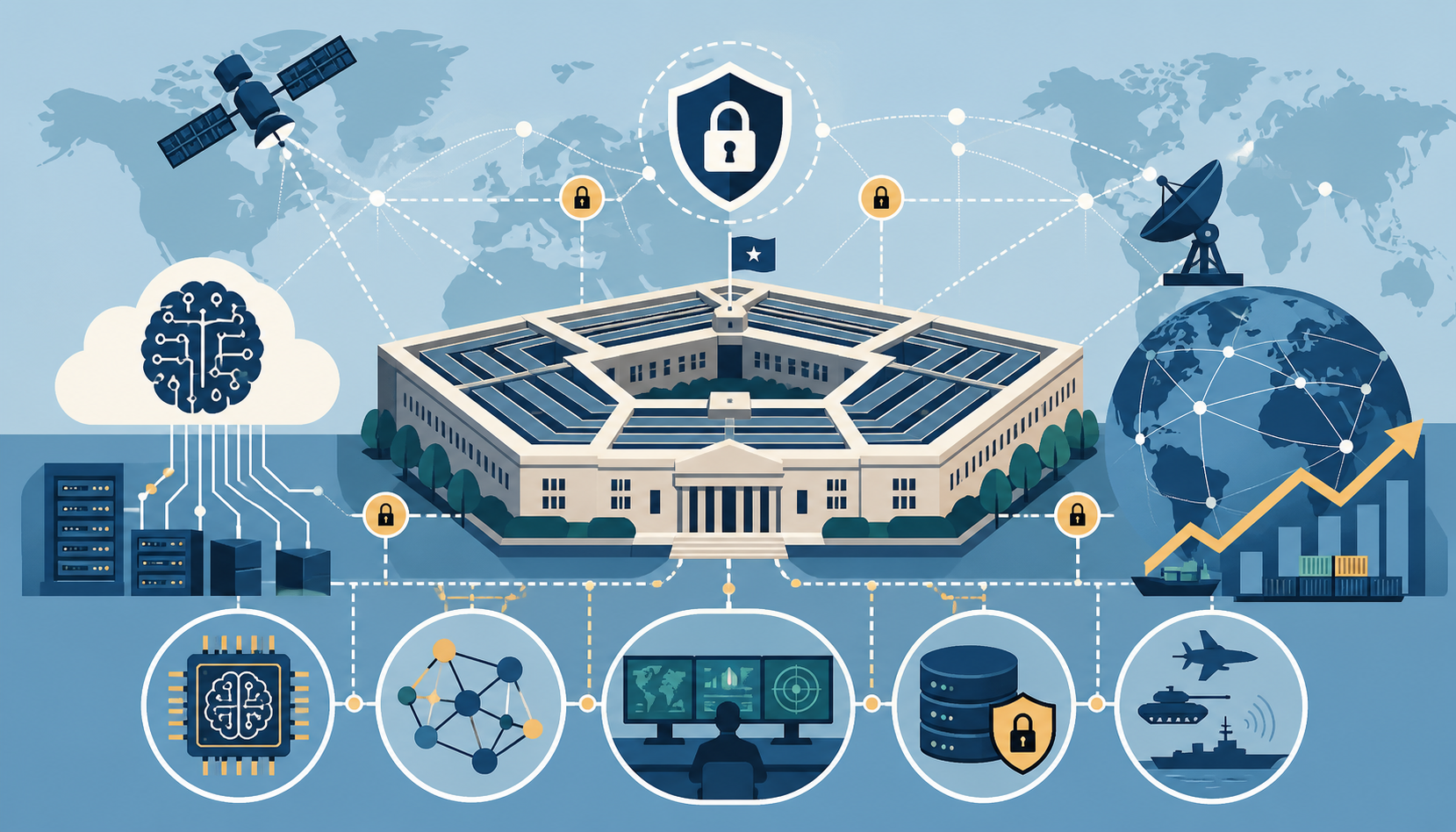
The eight-company architecture is best understood as a defense stack: chips at the bottom, secure cloud above them, classified networks layered on top, frontier models running inside, applications wrapped around the models, and military doctrine sitting on top of the whole thing. Each layer now has named American vendors. The diversification is the point. By contracting with multiple cloud providers, multiple model developers, and a deliberate mix of closed and open-weight systems, the Pentagon is trying to ensure that no single corporate decision — whether a refusal, a price hike, or an outage — can constrain its options.
For investors, the things to watch are not stock-tickers-of-the-week but procurement structure: the cadence of classified contract awards, the share of cloud revenue tied to IL6/IL7 workloads, GPU allocation to government customers, congressional appropriations and oversight hearings, and any new compliance or liability framework that emerges around military AI. Reputational risk is also a real variable for the consumer-facing AI firms now publicly tied to classified defense work.
A new phase, and a sharper question
The May 1 announcement closes a chapter that began with corporate AI ethics debates and pilot projects, and opens one in which frontier AI is treated as part of national-security infrastructure alongside satellites and submarines. The eight names on the official list are now defense suppliers, whether or not they describe themselves that way to their customers and employees.
The important question is no longer whether the U.S. military will use frontier AI. It is how quickly that use becomes routine — and who, inside or outside government, has the standing to set the limits once it does.