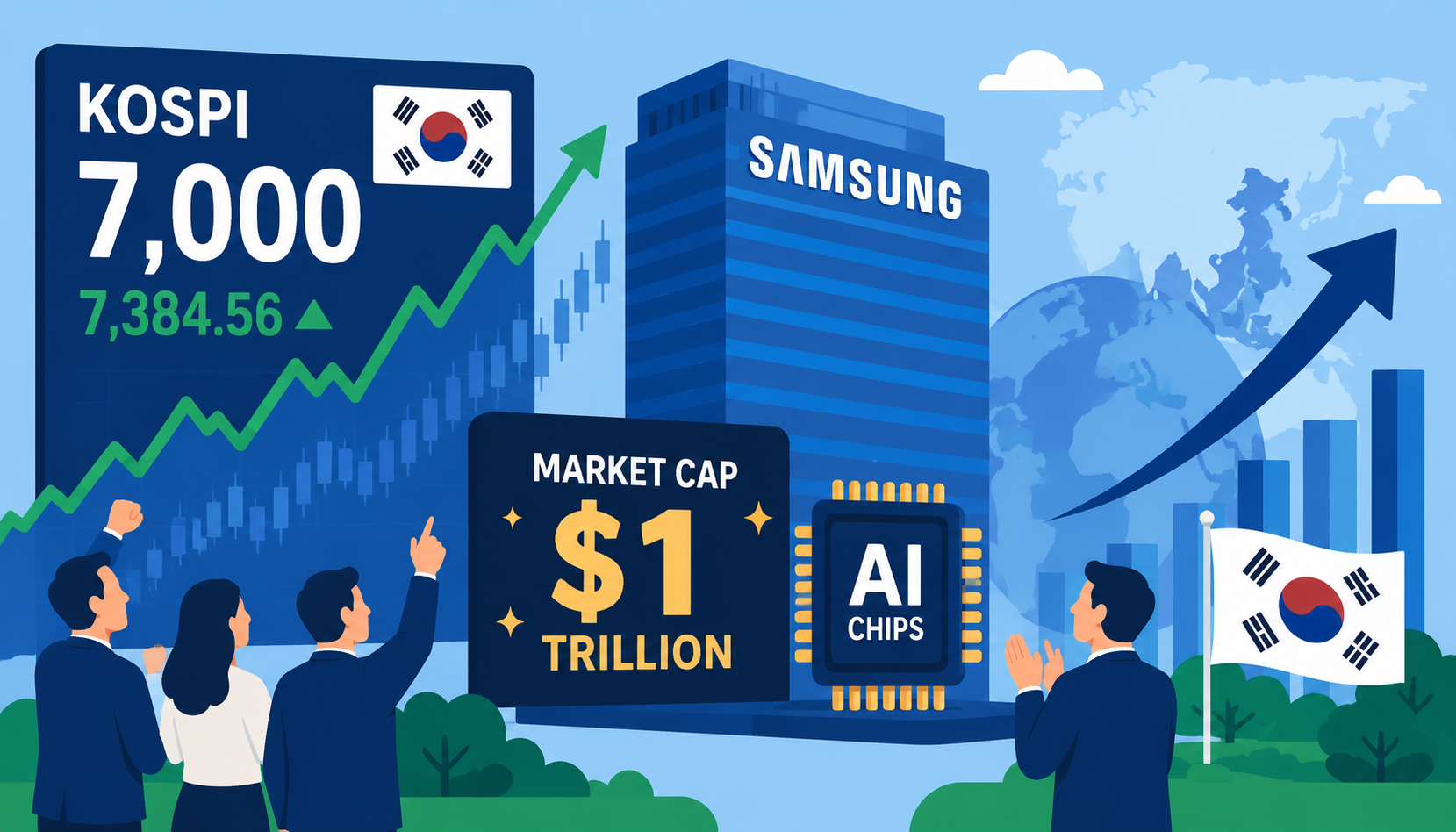
South Korea’s stock market just crossed a line that almost no one was forecasting a few years ago. The KOSPI broke through 7,000 for the first time and closed the session at 7,384.56, lifted by a sharp rally in semiconductor names. Samsung Electronics jumped 14.4% on the day. SK Hynix added 10.6%. By the close, Samsung’s market value sat near the $1 trillion mark — a level only one other Asian company, TSMC, has ever reached.
It is tempting to file this away as a single big day for Korean equities. That undersells what actually happened. The move was less about Korea catching up to a global story and more about global investors deciding that a meaningful chunk of the AI infrastructure trade now runs through Seoul.
A trillion-dollar club gets a second Asian member
Samsung is now the second Asian company to reach a $1 trillion valuation, joining TSMC. That sounds like a vanity metric, and in some ways it is. But the trillion-dollar threshold has become a rough proxy for the small group of companies considered systemically important to the global technology stack — names whose earnings, capital spending, and supply decisions ripple through markets well beyond their home indices.
Until recently, that club was almost entirely American: Apple, Microsoft, Nvidia, Alphabet, Amazon, Meta. Asia’s representation was effectively a single Taiwanese foundry. Adding a Korean memory and devices giant changes the picture. It says, in effect, that the AI hardware build-out is wide enough and durable enough that more than one Asian supplier deserves a top-tier valuation.
The AI trade is no longer just a Wall Street trade
For most of the past two years, the AI rally has been narrated almost entirely through U.S. tickers. Nvidia carried the headlines. Hyperscaler capex did the heavy lifting underneath. The Korean move is part of a broader rotation: investors are starting to price in the suppliers behind the suppliers.
Memory chips matter here in a way they did not in earlier tech cycles. Training and serving large AI models is brutally memory-intensive, and high-bandwidth memory — HBM, essentially DRAM stacks bonded together to feed AI accelerators at much higher speeds than conventional memory — has become one of the most valuable products in the entire chip stack. Samsung and SK Hynix, along with Micron, are the only companies that make it at scale.
WSJ reporting tied Samsung’s record first-quarter results directly to that demand, with the chip business contributing more than 90% of the company’s total earnings. When a single division dominates earnings to that degree, the equity story essentially becomes an HBM story. The Reuters reporting on the KOSPI day made the same connection from the market side: Korean chipmakers rallied alongside U.S. AI names, not as a separate trade.
Foreign capital comes back, in size
The other notable feature of the rally was who was buying. Foreign investors purchased a record 3.1 trillion won — about $2.13 billion — of Korean shares in a single session. That is a meaningful number on its own. It is more meaningful in the context of where Korean equities have traded for years.
The “Korea discount” has been a fixture of Asian market commentary for a long time: the idea that Korean companies, weighed down by governance concerns, cyclical exposure, and conglomerate structures, trade at lower valuation multiples than peers in other major markets. Foreign flows of this magnitude do not erase that discount in a day, but they do suggest that some of the structural skepticism is being set aside, at least for the names tied to AI infrastructure.
The won strengthened by as much as 1.7% against the dollar during the session — a clean tell for capital inflow. Currency moves of that size in a single day usually indicate that something has shifted in positioning, not just sentiment.
A rally with a very narrow base
Now the harder part. The same forces that produced this milestone also concentrate the index in ways that should make any honest reader uncomfortable.
Samsung and SK Hynix together account for roughly 44% of KOSPI’s total value. That is an extraordinary level of concentration for a benchmark index covering an entire economy. It means the KOSPI is, to a first approximation, a leveraged bet on global memory demand — wrapped in the framing of a broad national equity index.
This is not a Korea-specific phenomenon. The S&P 500 has been criticized for similar concentration in a handful of mega-cap names. But Korea’s case is sharper because the two stocks at the top are in the same industry, exposed to the same cycle, and selling into largely the same end customers. If AI accelerator demand softens, if hyperscaler capex pauses, if HBM pricing rolls over, the index does not have many places to hide.
What a strong won gives, and what it takes
A stronger currency is a double-edged thing for an export-led economy. On the helpful side, it eases the cost of imported energy and intermediate goods, which matters more than usual right now given oil-price volatility tied to Middle East tensions. It also dampens imported inflation pressure at the margin.
On the less helpful side, a stronger won pressures the export competitiveness of the very companies driving the rally. Samsung and SK Hynix sell into a global market priced in dollars; a meaningfully stronger won eventually shows up in reported earnings. The currency move was a symptom of the rally, but if it persists, it becomes a partial offset to the earnings tailwind that started it. Markets will eventually have to weigh those two effects against each other.
What could break the story
Three risks deserve attention, and the brief frames them well.
First, AI hardware demand will not grow in a straight line. Memory cycles are notoriously cyclical, and HBM, for all its current scarcity, is a product that suppliers are racing to expand capacity for. Inventory dynamics that look benign at the peak of a cycle can flip quickly.
Second, valuations can get stretched. A 14.4% single-day move in a company already worth close to a trillion dollars is, by definition, a re-rating rather than a fundamentals event. Re-ratings can hold if earnings catch up. They can also unwind.
Third, the macro backdrop is not as quiet as it sometimes looks. Reuters flagged Middle East tensions and oil-price pressure as part of the broader market context. Higher oil hits Korean industry through energy costs and through the global growth channel; geopolitical risk hits global risk appetite directly. Neither factor was front and center on the day Samsung crossed $1 trillion, but they are sitting in the background of every decision-maker’s risk model.
A symbolic level, and a real shift
KOSPI 7,000 is, in part, a symbolic marker. Round numbers always are. But behind the symbolism there is a real change in how Korea is positioned in the global equity hierarchy. For most of the past two decades, foreign investors thought of Korean equities as a cyclical export proxy — useful when global manufacturing was expanding, painful when it was not. The framing now is different: Korea as a core node in the AI infrastructure trade, with two of its largest companies sitting at the chokepoint of memory supply.
That framing is more flattering, and probably more accurate. It also raises the stakes. A market that earns the AI premium has further to fall when the AI thesis is questioned. The same concentration that makes Samsung’s $1 trillion possible is what would make the next correction sharper.
For now, though, the milestone stands. Korea is part of the trillion-dollar club, the AI trade has visibly broadened beyond U.S. names, and foreign capital has decided that the discount on Korean assets was, at minimum, too wide. None of that is small, even if it might not be permanent.