Nvidia’s AI boom is often told as a story about chips, data centers, and soaring demand. But the company’s reported $150 billion-a-year bet on Taiwan points to a deeper issue: the world’s most valuable AI supply chain is becoming more concentrated in one of the most geopolitically sensitive places on earth.
On May 27, 2026, at a launch celebration in Taipei for the company’s new headquarters, CEO Jensen Huang put a number on something the industry had long assumed but never quantified at this scale. Annual spending tied to Taiwan’s ecosystem had grown from roughly $10–15 billion four or five years ago to about $100 billion today, heading toward $150 billion. In Huang’s words, Taiwan is the “epicenter of the AI revolution.”
That phrase is marketing. The number is strategy. And the timing — a quarter in which Nvidia’s China business roughly halved while Taiwan-linked revenue surged — turns it into a country-risk story.
Why Nvidia’s Taiwan Bet Matters
A single company publicly committing $150 billion a year to one island is not a routine procurement update. It is a statement about where AI infrastructure, advanced manufacturing, and geopolitical exposure now overlap.
Nvidia is the central node of the AI hardware economy. Its most recent quarter showed record revenue of $75.2 billion, up 92% year over year, with data center compute alone at a record $60.4 billion. When a company of that weight anchors itself to a specific geography, the decision ripples outward — into supplier valuations, into national industrial policy, and into the risk models of anyone holding semiconductor exposure.
The Taipei announcement made the dependency explicit. It also made it permanent in a way a quarterly order book never could.
Taiwan as the Center of the AI Chip Economy
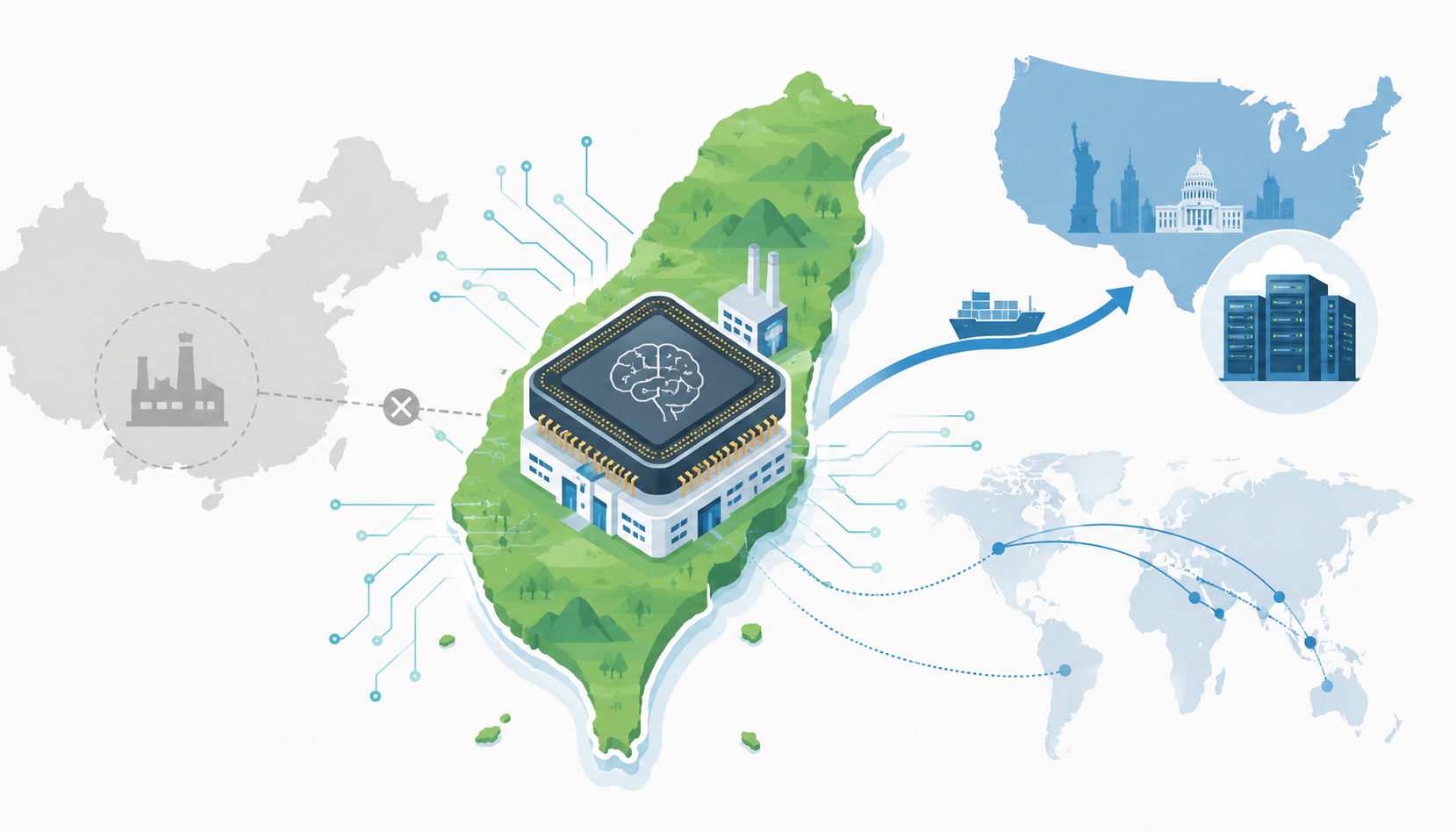
The answer to “why Taiwan” is largely one company: TSMC. Taiwan Semiconductor Manufacturing fabricates the most advanced chips in the world, and Nvidia’s GPUs depend on that fabrication and on the advanced packaging capacity that sits alongside it. Nvidia designs; Taiwan builds.
But it is more than TSMC. Huang named Foxconn, Wistron, and Quanta Computer as partners in the AI server and systems build-out. As he put it on stage, Taiwan is where the chips, the packaging, and the systems come together, and where AI supercomputers are made. The ecosystem isn’t a single fab. It’s a dense, geographically clustered network of design support, fabrication, packaging, testing, and assembly that would take years and enormous capital to replicate elsewhere.
The new commitment has a physical form too. Nvidia’s first overseas headquarters, named Constellation, will sit in the Beitou-Shilin Technology Park under a 50-year lease with the Taipei city government, extendable by another 20 years. Construction is slated to begin around mid-2026, with operations targeted for 2030 and roughly 4,000 employees — quadruple Nvidia’s current Taiwan headcount. A half-century land lease is not a hedge. It is a structural commitment.
China Becomes a More Complicated Market
The other half of the headline — “turns back on China” — needs care. Nvidia has not announced a clean exit. What the numbers show is a market shrinking under policy pressure rather than a deliberate walk-away.
In the most recent quarter, revenue from mainland China and Hong Kong roughly halved while Taiwan-linked revenue rose more than 50% year over year. More telling is Nvidia’s own forward guidance: the company is not assuming any data center compute revenue from China in its second-quarter outlook. That is the company effectively modeling China contribution at zero — a striking choice for what was once a meaningful growth channel.
So the accurate framing is a shift in relative emphasis driven mostly by U.S. export controls and strategic friction, not a voluntary divorce. The distinction matters for anyone modeling revenue: a constrained market and an abandoned one carry different risk profiles, and the difference shows up in how you treat any future Chinese demand — as upside optionality or as a regulatory variable best left out of the base case. Nvidia has chosen the latter.
The $150 Billion Figure: What It Actually Means
It is worth being precise about what the number is and is not. Based on Huang’s own framing, the $150 billion refers to Nvidia’s annual spending tied to Taiwan’s ecosystem — supply-chain procurement and production with partners like TSMC, Foxconn, Wistron, and Quanta — scaling up from roughly $100 billion currently. It is not a single capital investment, and it should not be confused with the cost of the headquarters campus itself, which is a separate and far smaller figure of roughly NT$40 billion, about $1.27 billion.
One more caveat: Huang did not specify how many years Nvidia intends to sustain the $150 billion pace. So the figure is best read as a forward run-rate ambition for supply-chain spend, anchored by a long-term physical presence — not a fixed multi-year contract.
Market Implications
The market reaction was immediate and revealing. Taiwan’s Taiex index climbed 1.7% to a record close on the announcement, led by semiconductor and supply-chain names; TSMC, MediaTek, and Delta Electronics all gained. Meanwhile, mainland Chinese chip stocks fell, with SMIC, Cambricon, and Hygon all sliding as the contrast in fortunes sharpened.
For investors, three threads are worth holding separately. First, the announced spend is a direct demand signal for the Taiwanese supply chain — TSMC and the smaller packaging and testing firms downstream stand to capture meaningful portions of it. Second, Nvidia’s own valuation now carries a more visible concentration overlay; the company has made its single-geography dependence explicit rather than implied. Third, the broader AI hardware complex is being repriced upward on demand even as its physical base narrows — note that SK Hynix and Micron both crossed the $1 trillion market-cap threshold on the same day.
The open question is whether investors begin to demand a higher geopolitical risk premium for names whose fortunes run through the Taiwan Strait. So far, the rally suggests demand optimism is winning. That balance can shift quickly.
Geopolitical and Country-Risk Dimension
Here is the paradox at the center of the story. The Taiwan ecosystem is simultaneously the most resilient and the most fragile foundation the AI industry could choose.
Resilient, because no other location offers the same combination of capacity, know-how, and integrated supplier density. Fragile, because that same concentration means a single disruption — cross-strait escalation, a natural disaster, a logistics shock, or a sharp policy turn in Washington or Beijing — would have outsized, system-wide consequences. By quantifying $150 billion in annual Taiwan-linked spend, Nvidia has effectively confirmed at scale a dependency the whole industry shares.
This is precisely why governments in the U.S., Europe, and elsewhere are pouring money into domestic fabrication. They increasingly treat AI infrastructure as a national-security question, not merely a commercial one. Nvidia’s deepening Taiwan footprint runs in the opposite direction of that diversification impulse — a rational bet on the best ecosystem available, made in defiance of the concentration risk that policymakers are trying to unwind.
Analyst’s View
From a risk-management and country-risk perspective, three implications stand out.
Concentration is migrating from an operational footnote to a valuation input. For years, “Taiwan risk” lived in the risk-factor section of filings as boilerplate. A publicly quantified $150 billion annual dependency, paired with a 50-year lease, makes it a line item that disciplined investors should be stress-testing directly. A credible cross-strait disruption scenario no longer affects one supplier — it affects the revenue visibility of the entire AI hardware chain at once. For portfolio construction, that argues for treating semiconductor exposure as more correlated than diversified, and for pricing tail risk accordingly.
China is shifting from a growth line to a policy variable. When a company guides to zero China data center compute revenue, it has stopped modeling that market as upside and started treating it as a regulatory unknown. For credit and sovereign analysts watching the U.S.-China technology contest, this is a useful tell: the constraint is now structural, embedded in the growth math rather than sitting beside it. Any reopening would be a policy event, not a commercial one — and should be modeled as a low-probability optionality rather than a base-case driver.
Taiwan’s systemic importance cuts both ways for the island itself. The same investment that strengthens Taiwan’s economic centrality also raises its strategic salience. A more indispensable Taiwan is, by some readings, both better protected by global stakes in its stability and more contested precisely because of them. For anyone assessing country risk on Taiwan — or on the trade and financial linkages that run through it — the Nvidia announcement raises both the upside (economic resilience, fiscal strength, deepened alliances) and the tail risk (the value of the prize) at the same time.
What to Watch Next
The signals worth tracking are concrete: Nvidia’s coming earnings calls and any change in its China assumptions; TSMC capacity and advanced-packaging updates; the next moves in U.S. export-control policy and any Chinese response; the pace of Constellation’s construction toward its 2030 target; and, underlying all of it, the temperature across the Taiwan Strait. Each is a variable in a single equation that the AI industry has now made unavoidably explicit — the world’s most important supply chain, and one of its most exposed.