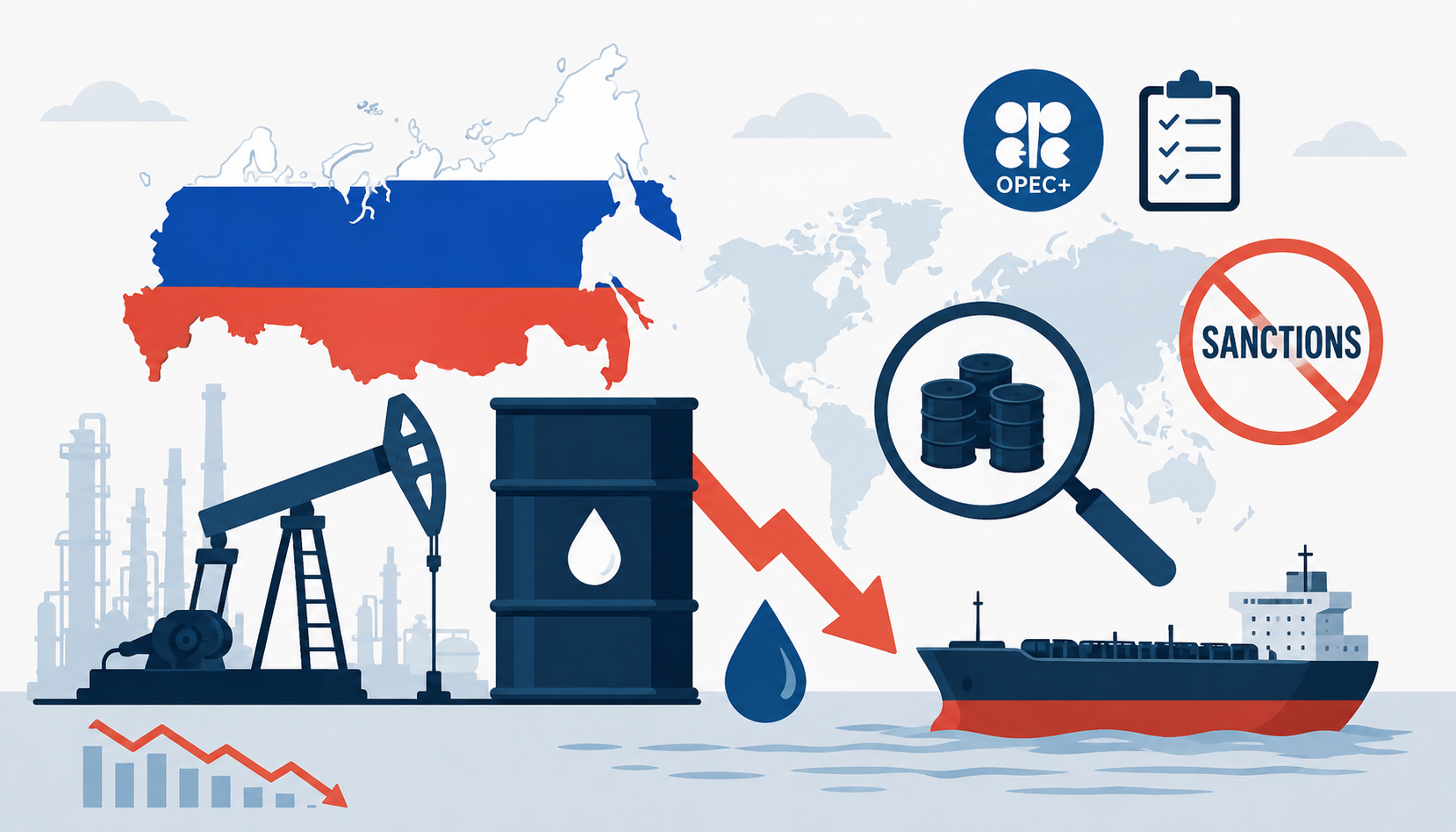
Russia has rarely offered a clear window into its oil production since it stopped publishing regular output data after the invasion of Ukraine. That makes Deputy Prime Minister Alexander Novak’s acknowledgment that output has fallen more than a routine energy-market headline. It may be an early signal that maintenance issues, sanctions pressure, and wartime infrastructure risk are beginning to show up in Russia’s core export machine.
Why Novak’s Admission Matters
Speaking on the sidelines of the St. Petersburg International Economic Forum on June 4, Novak told reporters that current output was running somewhat lower than at the start of 2026, blaming a wave of unscheduled refinery maintenance. He framed it as temporary, saying production would recover as plants returned to normal operation. The detail that matters is not the explanation but the admission itself: this is the first time a Russian official has publicly conceded that the country’s oil production has slipped this year.
That concession lands against an unusual information vacuum. Russia, the world’s third-largest oil producer, has not released official production figures since April 2023, a little over a year into its war with Ukraine. With Moscow no longer publishing the numbers, market participants have been forced to triangulate from tanker tracking, agency estimates, and the occasional ministerial comment. When the data source goes dark, a single sentence from a deputy prime minister carries weight it would not otherwise have.
Novak did not say what was behind the refinery outages. But the timing is hard to separate from the broader conflict: Ukraine has sharply intensified long-range drone strikes on Russian refineries and export infrastructure through the spring, and several outlets have linked the maintenance language directly to that campaign.
Russia’s Oil System Under Pressure
It is worth separating what is confirmed from what is inferred. Confirmed: output is lower, refineries are under repair, and exports are being pushed to maximum capacity. Inferred — though increasingly well-supported — is the chain of causation running from drone strikes to refinery downtime to a shift in how Russia disposes of its crude.
The pressure points stack up. Domestic refining has been hit hard enough that processing fell to multi-year lows, prompting authorities to ban jet fuel exports and signal curbs on gasoline and diesel. The International Energy Agency’s monthly data put Russian output at roughly 8.8 million barrels per day in April, down about 460,000 bpd from a year earlier. Crucially, that decline did not crush revenue: the IEA estimated Russia’s crude and product export earnings actually edged up to around $19.2 billion in April, helped in part by a temporary U.S. Treasury waiver on sanctioned Russian oil sold at sea.
The reason production weakness and resilient revenue can coexist is the same reason this story is more complicated than a simple supply cut. When refineries can’t run, the crude that would have been processed at home has to go somewhere — and that somewhere is the export market.
Crude Out the Door: The Export Pivot
The clearest evidence of that pivot showed up in May. According to industry sources cited by Reuters, shipments through Russia’s western ports of Primorsk, Ust-Luga, and Novorossiysk rose to 2.5 million bpd, up from 2.2 million bpd in April — an eight-month high, and the largest volume since September 2025, when drone attacks had similarly knocked out refining. Bloomberg’s tanker data told a parallel story, with seaborne crude exports averaging around 3.46 million bpd so far in 2026, a wartime high.
So the headline reads “output falling,” but the seaborne reality is “more crude on the water.” For anyone monitoring physical balances, sanctions enforcement, or freight flows, those are two different signals, and conflating them produces bad conclusions. Russia’s western export terminals also have finite capacity, and officials have acknowledged they cannot fully absorb every barrel that isn’t being refined — which is why the export ban on products is doing some of the balancing work.
Market Implications: Supply, Prices, and OPEC+
The wider backdrop is what gives Novak’s comment its edge. This is not a calm market. The IEA’s May report described global oil supply falling by 1.8 million bpd in April to 95.1 million bpd, with cumulative losses since February reaching nearly 13 million bpd as the closure of the Strait of Hormuz choked off Gulf flows. Novak himself called the situation in the global oil market unprecedented, arguing that consuming nations have so far been cushioned by drawn-down inventories rather than insulated by genuine supply.
In that environment, even a modest Russian production wobble matters more than it would in a well-supplied market. It also lands just as OPEC+ has lost a significant member: the United Arab Emirates exited the group effective May 1, removing roughly five million barrels per day of capacity from the coordination framework. Novak was careful to reaffirm that OPEC+ still plays an important stabilizing role despite the UAE’s departure — a statement that reads as much like reassurance as analysis.
Rather than forecasting a price, it is more useful to lay out the branches. If the maintenance is genuinely short-cycle, the production dip reverses and the export surge normalizes. If drone-driven refinery damage proves structural — parts shortages, repeated strikes, slow repairs under sanctions — then Russia’s ability to keep substituting exports for refining has a ceiling, and headline output weakness becomes a more durable feature. The market will price the difference between those two paths well before official data confirms either.
Sanctions and Transparency Risk
The absence of official Russian production data is not a footnote; it is part of the risk. Sanctions, the G7 price-cap mechanism, and the on-again, off-again U.S. Treasury waivers on seaborne Russian oil all shape how much crude actually moves and at what realized price. Independent monitoring — for example, the Centre for Research on Energy and Clean Air — has documented how a large share of Russian seaborne volumes now travels on shadow-fleet tankers, which complicates both enforcement and measurement. Less transparency means wider error bars on every estimate, and wider error bars are themselves a source of market and policy risk.
Analyst’s View
From a country-risk and credit perspective, the signal worth tracking is fiscal resilience, not the spot headline. Hydrocarbon receipts remain central to Russia’s external revenue, so the relevant question is durability: a brief maintenance cycle is a cash-flow blip, but sustained capacity impairment from repeated infrastructure strikes would erode the revenue base that underpins both the war effort and sovereign creditworthiness. The fact that April revenue rose even as volumes fell is a reminder that price and discount dynamics — not just barrels — drive the fiscal outcome, and those dynamics are currently distorted by the Hormuz shock.
For positioning, the practical discipline is to keep three numbers separate: crude production, refinery runs, and export flows. Right now they are diverging, with falling output and rising seaborne exports coexisting because refining is the bottleneck. Treating “production down” as automatically bullish for crude misreads the physical picture. The cleaner risk is asymmetric: in a market already short roughly 13 million bpd of Gulf supply, any incremental Russian impairment that cannot be offset by export redirection raises the tail risk of a sharper physical squeeze — and with it, renewed pressure on inflation expectations and on central banks contemplating easing.
The honest conclusion is that Novak told the market less than it wants to know and more than Moscow usually offers. Whether the line about temporary maintenance holds is the variable to watch over the coming months — in the refinery repair schedule, the pace of drone strikes, and the western ports’ capacity to keep absorbing crude that Russia can no longer process at home.