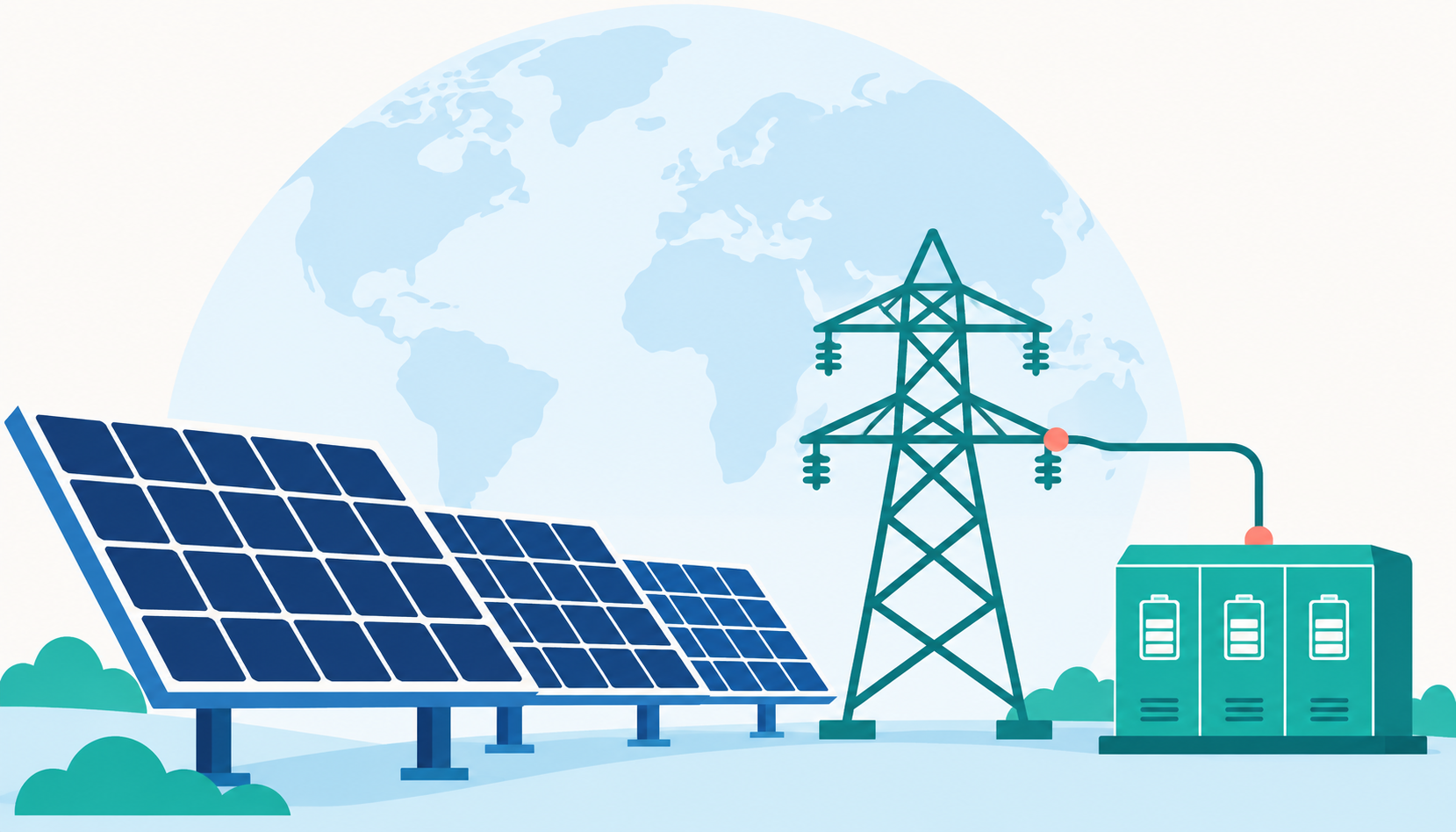
The International Energy Agency forecasts an 11 percent fall in new renewable power capacity additions in 2026, driven mainly by a slowdown in China’s solar deployment. Its Renewables 2026 report, released on November 6, describes a pause in the pace of installation alongside continued expansion over the longer term. The renewable electricity chapter says additions would still be the second-highest ever recorded.
The forecast concerns the amount of new capacity installed during the year. It does not mean that the world’s existing renewable capacity will shrink by 11 percent or that renewable electricity generation will fall by that amount. A weaker year for installations can affect equipment orders and project financing even as the installed fleet continues to expand.
China changes the near-term growth picture
The IEA reports that China’s solar capacity additions were almost 55 percent lower in the first nine months of 2026 than a year earlier. It links the decline to weaker project economics after a shift from fixed remuneration toward competitive auctions in June 2025. China has accounted for a large share of global deployment, so a change there can outweigh growth in smaller markets.
That policy transition changes the calculation facing a developer. Under a fixed remuneration arrangement, a project may have greater certainty over its revenue per unit of electricity. With competitive procurement, the price offered, the probability of securing a contract and the conditions attached to it become central to the investment decision. Those conditions need project-level examination; the IEA’s global outlook does not establish whether a particular plant can cover its debt.
A manufacturer faces a related but different problem. Lower installation demand can weaken orders for equipment, while fierce price competition can limit revenue even where shipments remain high. A developer buying cheaper panels might benefit from the same market conditions that put pressure on its supplier’s margins. The two businesses should therefore be assessed separately.
The longer-term forecast still shows expansion
In its announcement accompanying the report, the IEA projects almost 4,800 gigawatts of renewable power capacity growth during 2026–2031. That would be almost 60 percent more than was added in the preceding six years. Solar is expected to provide more than three-quarters of the increase, followed by onshore wind.
The agency expects capacity added in emerging and developing economies outside China to match that added in advanced economies over the forecast period for the first time. It identifies India as the second-largest growth market after China, with stronger deployment also spreading across Southeast Asia, Africa and the Middle East. Energy security concerns and consumers seeking more reliable electricity are important drivers.
These forecasts describe a geographical shift as well as an increase in total capacity. A supplier heavily exposed to Chinese projects could face weaker demand while another serving a growing market sees more opportunities. Moving between markets, however, requires more than redirecting a shipment. Financing arrangements, product requirements and customer relationships can differ. A large global opportunity can coexist with a difficult transition for individual firms.
The forecast also needs to be read over its stated horizon. Almost 4,800 gigawatts is the projected increase across six years, not the installation target for 2026 alone. A weak first year and a strong multi-year outlook can both be true if additions subsequently recover.
A growing market can still produce financial distress
The report’s executive summary highlights strain in the solar manufacturing industry. More than 90 percent of major Chinese solar manufacturers have reported losses in 2026, according to the IEA, as excess capacity and falling prices have squeezed margins. It also describes India as an emerging alternative source of supply, while noting that production remains concentrated in China.
For lenders, the distinction between sector growth and borrower cash generation is essential. A producer can sell into an expanding market and still lose money if the price received fails to cover operating and financing costs. Its position also depends on when customers pay, whether inventories retain their value and how much capital it needs to maintain production.
Buyers need to examine the other side of that exposure. A low equipment price can reduce construction costs, but the developer may still depend on the supplier for delivery, replacement parts and warranty support. Supplier distress could create expenses later in the project. The report does not quantify those costs for a particular buyer; they belong in a contract and counterparty review.
A more dispersed manufacturing base could reduce some concentration risks over time. It would also require new facilities to achieve dependable quality, delivery and economics. Forecast diversification is therefore different from having a fully interchangeable supplier available today.
Grid access determines when capacity starts earning
The IEA announcement says advanced-stage renewable and storage projects waiting for grid connections reached 3,000 gigawatts worldwide, an increase of 60 percent over the past year. The scale of that queue directs attention to the infrastructure and approvals needed between project development and commercial operation.
For a hypothetical solar project, buying equipment and completing construction do not guarantee that electricity can be delivered and sold on the expected date. If connection is delayed while interest and other costs continue, the sponsor could need additional cash before revenue starts. The relevant review would identify the connection agreement, remaining construction milestones and which party bears the cost of delay.
The executive summary also points to curtailment and lower revenues during hours when solar output is abundant. Curtailment occurs when potential output cannot be used or delivered. An analyst should therefore distinguish a project’s technical ability to generate from the amount it can sell and the price it receives during those hours.
Storage and more flexible demand can help, but they bring their own costs and contracts. A battery may allow some electricity to be sold later, subject to its operating limits and the prices available. Project forecasts need to account for the cost of the combined assets and the revenue each can earn, rather than assuming that adding storage preserves the original financing plan.
Energy security extends beyond the installation count
The report’s energy security analysis estimates that global fossil fuel demand in 2025 would have been around 8 percent higher without renewable energy growth since 2010. This is a comparison with a scenario in which that growth did not occur, rather than an observed 8 percent decline in fossil fuel use. The chapter notes that fossil fuel supply also increased as total energy demand rose.
For an importing economy, domestic renewable generation can reduce exposure to fuel deliveries and international prices. The financial benefit depends on what generation it replaces, the investment needed and whether the electricity system can use the additional supply. A country cannot infer its fuel import savings from the global capacity forecast alone.
Households and businesses may also value more dependable electricity. For a firm facing outages, the comparison can include the cost of interrupted production or backup generation, alongside the price of a solar installation. That business case differs from one based solely on selling electricity to a national grid.
Analyst’s View
Credit risk. Separate manufacturers, developers and electricity buyers. Manufacturers face selling-price and inventory risks; developers face connection, financing and power-sale risks. A strong growth forecast is useful context, while signed orders, available liquidity and enforceable revenue arrangements provide the evidence needed to assess a borrower.
Sovereign and country risk. Examine the balance between reduced fuel exposure and the cost of delivering new capacity. Grid investment, electricity tariffs and the strength of local power purchasers affect whether projects can attract finance without creating additional fiscal pressure. More installations can support energy security, but their budget implications depend on the contracts and funding structure.
Market positioning. The 2026 slowdown and the expansion through 2031 describe different periods. Follow commissioning, procurement and grid-connection evidence before treating a project pipeline as operating capacity. For equipment suppliers, geography and profitability matter alongside shipment volume. The IEA’s forecast supports a broader market for renewable investment; the return available to a particular investor still depends on the price, timing and risks of the assets financed.