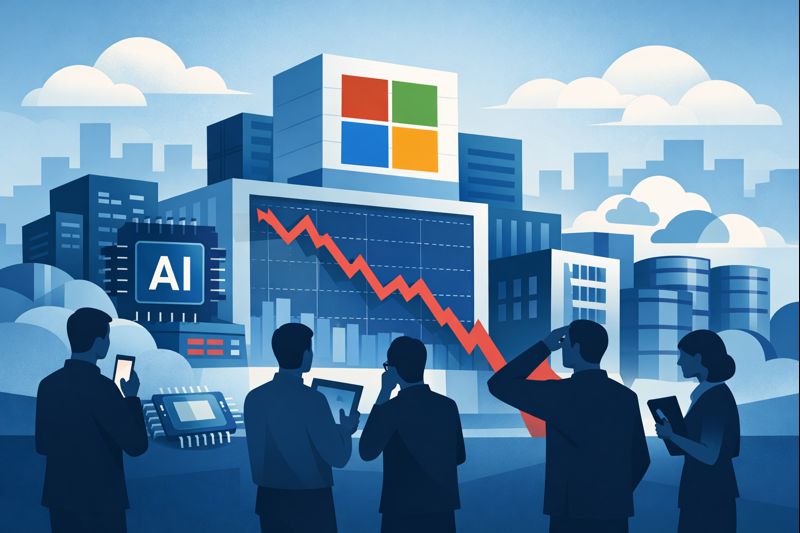
Microsoft’s sudden loss of $360 billion in market capitalization is more than a single-stock selloff—it may mark the moment when investors began questioning whether the AI revolution is delivering returns fast enough to justify its soaring costs.
What Happened
On January 30, 2026, Microsoft Corporation experienced one of its most dramatic single-day declines in years, with shares plummeting approximately 10% and erasing roughly $360 billion from its market capitalization. The selloff, which persisted into the following trading session, marked the company’s steepest drop since the COVID-19 pandemic panic of March 2020. Trading volume surged to 126.5 million shares—366% above the three-month average—signaling broad investor capitulation.
The paradox was striking: Microsoft had actually beaten Wall Street estimates. Revenue climbed 17% to $81.27 billion, exceeding the consensus forecast of $80.27 billion, while adjusted earnings per share hit $4.14, surpassing expectations of $3.97. Yet the market’s reaction was unequivocal and severe.
The selloff triggered immediate ripple effects across AI-linked equities. ServiceNow dropped 10% despite beating earnings, while the broader software sector experienced significant pressure. The episode underscored a fundamental shift in investor sentiment: from AI enthusiasm to AI scrutiny.
Why AI Spending Is Under Scrutiny
The immediate trigger for Microsoft’s collapse lay in two interconnected concerns: decelerating cloud growth and accelerating capital expenditures.
Azure and other cloud services revenue growth slowed to 39% from 40% in the prior quarter, narrowly missing StreetAccount’s 39.4% consensus. While this represented only a modest deceleration, it was the third consecutive quarter of slowing growth—a trend that investors interpreted as ominous given the context of surging investment.
More alarming was the scale of capital spending. Microsoft’s quarterly capital expenditure hit $37.5 billion, up 66% year-over-year, with roughly half allocated to GPUs and CPUs for data centers. This represented a quarterly run rate that extrapolates to approximately $150 billion annually. Chief Financial Officer Amy Hood acknowledged capacity constraints from AI chip allocations, stating that if all newly acquired GPUs had been allocated to Azure, growth “would have been over 40%.”
The fundamental tension became clear: Microsoft was spending at unprecedented levels to build AI infrastructure, yet the immediate revenue gains from these investments remained modest relative to the scale of spending. Gross margins narrowed to just over 68%—the tightest in three years—raising red flags about returns on the AI buildout.
Microsoft as a Bellwether
Microsoft’s significance in the AI investment narrative extends far beyond its own financial performance. The company occupies a unique position as both a primary AI infrastructure investor and a key barometer of enterprise AI adoption.
Through its strategic partnership with OpenAI, Microsoft has become central to the generative AI ecosystem. The company disclosed that OpenAI accounts for 45% of its cloud backlog—a staggering concentration that amplified investor concerns. This dependency raises questions about the sustainability and profitability of Microsoft’s AI-driven cloud growth.
Microsoft’s demand backlog reached $625 billion, up 110%, including a $250 billion cloud agreement with OpenAI during the period. While impressive in scale, this backlog must now be converted into actual revenue growth—a process constrained by the very capacity limitations that Microsoft is spending billions to address.
The company’s role as an enterprise AI platform amplifies its importance. CEO Satya Nadella emphasized during the earnings call that investors should evaluate performance across the entire AI enterprise—Azure, Microsoft 365 Copilot, GitHub Copilot, and Security Copilot. Yet this comprehensive view only underscores the challenge: massive investments across multiple product lines, with monetization timelines that remain uncertain.
Investor Concerns
The market’s harsh verdict on Microsoft reflects deeper anxieties about the AI investment cycle. Three primary concerns emerged:
Return-on-Investment Timelines: Hyperscalers are now spending 45-57% of revenue on capital expenditures—ratios historically associated with industrial or utility companies, not technology firms. Microsoft’s capex intensity has reached levels that demand clear, near-term evidence of returns. The market is no longer willing to accept “build it and they will come” narratives.
Margin Pressure: Microsoft’s gross margin compression to three-year lows suggests that AI infrastructure costs are outpacing pricing power. This raises fundamental questions about the unit economics of AI services. If margins continue to compress as infrastructure scales, the path to profitability becomes increasingly uncertain.
Capacity Constraints as Double-Edged Sword: Microsoft’s capacity constraints reveal a troubling paradox. The company is spending tens of billions on infrastructure, yet still cannot meet demand. This suggests either inadequate planning, supply chain bottlenecks, or demand that is accelerating faster than any realistic buildout can accommodate. None of these scenarios provides comfort to investors seeking predictable returns.
The contrast with Meta Platforms proved particularly instructive. Meta’s shares jumped 8% the same day despite announcing plans to spend $115-135 billion in 2026—nearly double its 2025 spending. The difference? Meta demonstrated that its AI investments were driving tangible revenue growth, with ad revenue up 24% and strong first-quarter guidance. As Reuters noted, investors are “willing to overlook soaring spending on artificial intelligence if it fuels strong growth, but are quick to punish companies that fall short.”
Broader Market Implications
Microsoft’s experience signals potentially far-reaching consequences for the broader technology sector and AI investment thesis.
Big Tech Valuation Reassessment: The “Magnificent Seven” technology companies collectively plan to spend over $600 billion on AI infrastructure in 2026, up 36% from 2025. Roughly 75% of this spending—approximately $450 billion—targets AI infrastructure specifically. This represents an extraordinary concentration of capital in a single technological bet.
If Microsoft, with its diversified revenue streams and enterprise dominance, cannot satisfy investors on AI returns, the implications for pure-play AI infrastructure companies become severe. The repricing has already begun: Oracle has seen its shares halved from September 2025 highs, erasing nearly $463 billion in value amid concerns about funding its massive data center commitments.
The Infrastructure-to-Revenue Disconnect: The fundamental economic challenge is stark: hyperscalers committed nearly $400 billion in capital expenditure during 2025, while enterprise AI generated approximately $100 billion in actual revenue. This 4:1 ratio of spending to revenue represents an unprecedented mismatch in the technology sector.
A recent MIT study found that 95% of generative AI pilot programs fail to achieve business value, and only 5% of enterprises report significant EBIT impact from AI investments, despite 78% of organizations using AI in some capacity. This disconnect between adoption and value creation has become impossible for investors to ignore.
Supply Chain and Semiconductor Implications: The AI infrastructure buildout has created extraordinary demand for semiconductors, data center equipment, and power infrastructure. NVIDIA derives 85% of revenue from six customers, with the top four accounting for nearly 60% of sales. This concentration creates binary risk: any capital expenditure pullback from Microsoft, Amazon, Google, or Meta would cascade through NVIDIA’s results and broader AI supply chains.
The interdependencies extend deeper. OpenAI has made approximately $1.4 trillion in commitments to procure energy and compute capacity, yet its revenue barely crossed $20 billion in 2025. Investors increasingly criticize what they describe as “circular” deals involving the industry’s biggest players—Microsoft investing in OpenAI, OpenAI contracting with Microsoft Azure, NVIDIA investing in OpenAI while supplying chips to Microsoft.
Debt Market Dynamics: The scale of AI infrastructure investment is transforming how technology companies fund growth. Hyperscalers raised $108 billion in debt during 2025 alone, with projections suggesting $1.5 trillion in debt issuance over the next five years. Capital expenditure now exceeds internal cash generation for several major technology companies, forcing them to debt markets with unprecedented frequency.
This represents a fundamental shift in the technology sector’s financial model. Bank of America estimates that AI-related capital expenditures will reach 94% of operating cash flows (minus dividends and share repurchases) in 2025 and 2026, up from 76% in 2024. As one credit strategist noted, this means companies are approaching the limit of how much AI capex they can fund purely from cash flows.
Is This a Reality Check or a Temporary Setback?
The divide between AI bulls and bears has never been sharper, with Microsoft’s selloff serving as a catalyst for both camps to sharpen their arguments.
The Case for Long-Term AI Optimism
Defenders of the AI investment thesis point to several structural differences from previous technology bubbles:
Fundamental Strength: Unlike the dot-com era, today’s leading AI investors are highly profitable companies with strong balance sheets. The average 2-year forward price-to-earnings ratio for the biggest AI data center spenders—Microsoft, Alphabet, Amazon, and Meta—is approximately 26 times, far below the 70 times multiples seen at the peak of the dot-com bubble.
Real Demand, Not Speculation: AI-related capital spending contributed 1.1% to U.S. GDP growth in the first half of 2025, actually outpacing consumer spending as an engine of expansion. This represents real economic activity, not purely financial engineering. Data center construction hit a record $40 billion annual rate in mid-2025, up 30% year-over-year.
Supply Constraints Validate Demand: The persistent capacity constraints that troubled Microsoft investors actually validate the strength of underlying demand. Companies are racing to build infrastructure precisely because customer demand is real and growing. Alphabet’s Gemini reported a 130-fold increase in AI token consumption over 18 months, while Meta said its compute needs have “expanded meaningfully” beyond expectations.
Historical Precedent: Every major technology transition—electricity, railroads, telecommunications—involved years of heavy infrastructure investment before delivering transformative economic value. The fiber-optic cable infrastructure built during the dot-com era ultimately proved essential for Web 2.0’s dominance, even though most capacity remained “dark” for years and many investors lost money.
The Case for Caution
Skeptics counter with equally compelling arguments:
Valuation Concentration: By late 2025, 30% of the S&P 500 and 20% of the MSCI World index was concentrated in just five companies—the greatest concentration in half a century. This creates systemic risk and vulnerability to any shift in sentiment.
Monetization Evidence Remains Weak: Over half of 4,454 CEOs surveyed by PwC reported no revenue or cost gains from AI investments. The gap between AI adoption (78% of organizations) and AI value creation (5% reporting significant EBIT impact) represents a fundamental challenge to the investment thesis.
Circular Financing and Off-Balance Sheet Risk: The complex web of cross-investments and long-term commitments among AI players—Microsoft, OpenAI, NVIDIA, Oracle, AMD—creates opacity and potential systemic fragility. Oracle’s credit default swap spread recently spiked to nearly 180 basis points, trading at levels comparable to sovereign emerging market debt.
Technological Disruption Risk: Breakthroughs in chip design, quantum computing, or AI model efficiency could render current infrastructure investments obsolete before they generate returns. Just as fiber-optic innovations during the dot-com era made existing capacity redundant, similar disruptions could strand billions in AI data center investments.
What Investors Will Watch Next
The coming quarters will prove decisive in determining whether Microsoft’s selloff represents a temporary correction or the beginning of a broader AI investment reassessment. Several key metrics demand attention:
Azure Growth Trajectory: Can Microsoft stabilize or reaccelerate Azure growth rates while managing capacity constraints? The company guided for 37-38% growth in the January-March quarter. Missing this guidance could trigger another selloff.
Margin Trends: Will gross margins stabilize as AI infrastructure reaches scale, or will continued compression validate concerns about unit economics? This single metric may prove most important for long-term investment viability.
Capex Efficiency: How quickly can Microsoft convert its $625 billion backlog into actual revenue? The capacity constraints that limited Azure growth must be resolved, but investors will scrutinize whether the additional spending actually translates to improved financial performance.
Competitive Positioning: The divergent market reactions to Meta (up 8%) and Microsoft (down 10%) on the same day suggest investors are becoming more discriminating. Companies must demonstrate not just AI spending, but AI results.
Broader Economic Indicators: AI-related capital spending has become a significant economic driver, accounting for over 1% of GDP. If this spending wave slows, it could have broader macroeconomic implications beyond the technology sector.
Conclusion
Microsoft’s $360 billion market value loss represents more than a quarterly earnings disappointment. It marks a potential inflection point in the AI investment narrative—from uncritical enthusiasm to rigorous evaluation of returns.
The fundamental question confronting investors is whether current AI infrastructure spending represents prescient investment in the next technological revolution, or the largest capital misallocation in market history. Microsoft’s experience suggests the market is no longer willing to accept investment on faith alone.
For global equity investors, the message is clear: the AI boom continues, but the rules of engagement have changed. Companies must now demonstrate tangible returns on their massive infrastructure investments, not merely promise future value. Margin pressure, capacity constraints, and monetization timelines have moved from acceptable growing pains to critical performance metrics.
The next phase of the AI investment cycle will likely be characterized by greater volatility and selectivity. Winners will be those companies that can demonstrate sustainable unit economics, convert infrastructure spending into revenue growth, and navigate the complex transition from AI infrastructure buildout to AI value creation.
Microsoft’s sharp decline serves as a cautionary tale: in the new AI investment regime, execution matters more than vision, and cash flow trumps narrative. Whether this represents a healthy reality check or the beginning of a broader reassessment will depend on how effectively companies convert unprecedented spending into demonstrable returns over the coming quarters.