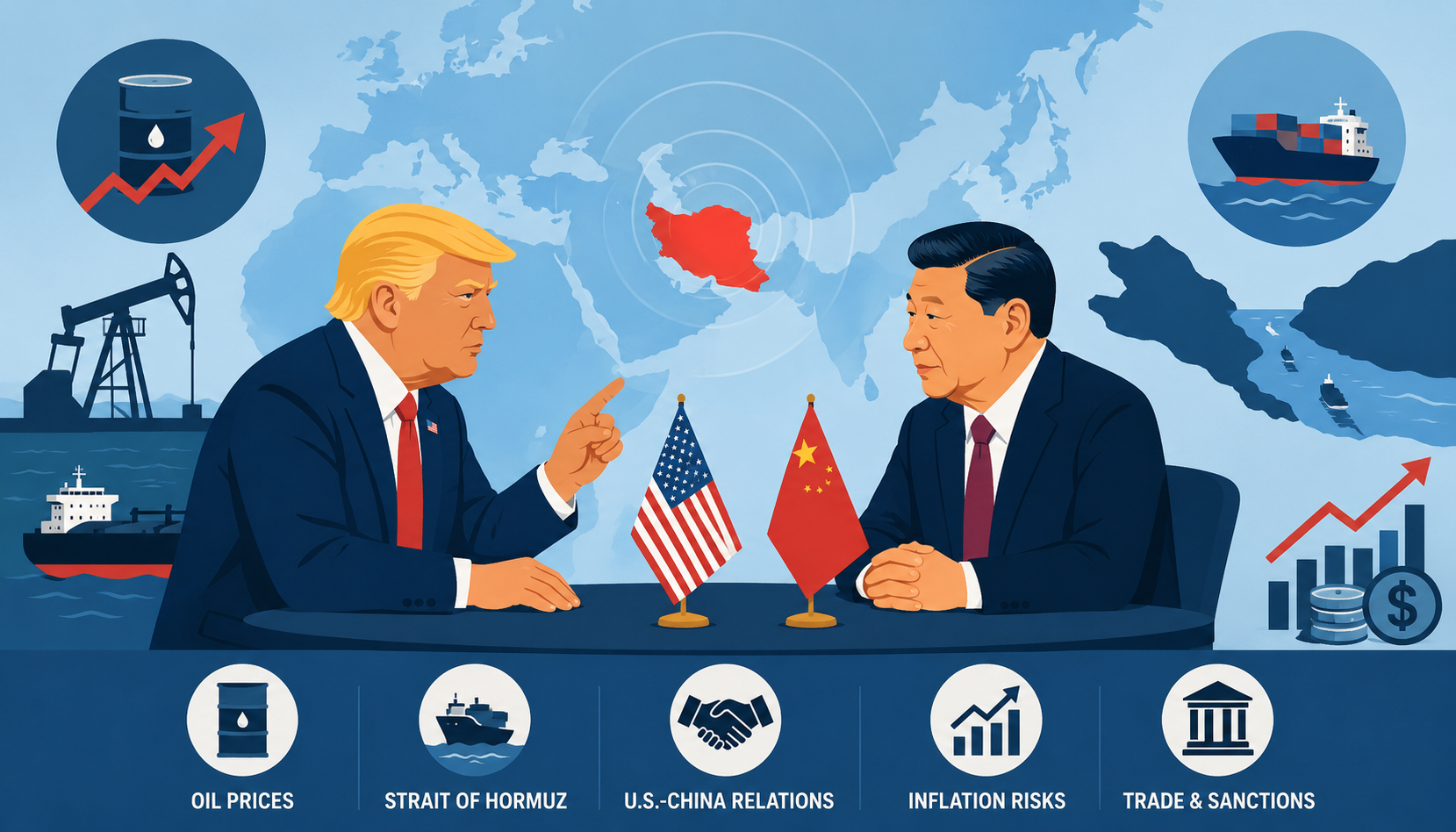
Why the Iran war has moved to the center of U.S.–China economic diplomacy — and what markets will be watching in Beijing on May 14–15.
For years, U.S.–China summits have been built around a familiar cast of issues: tariffs, semiconductors, Taiwan, technology controls. The meeting between Donald Trump and Xi Jinping in Beijing on May 14 and 15 was supposed to fit that pattern. It will not.
The Iran war, now in its third month, has reshaped the agenda. Treasury Secretary Scott Bessent has already confirmed publicly that Iran will be a central topic of the talks. Reuters and the Financial Times report that Trump is expected to press Xi to use Beijing’s leverage over Tehran. According to Bloomberg, U.S. officials are particularly focused on China’s continued purchases of Iranian crude, which help replenish Tehran’s budget, and on Washington’s concerns about possible Chinese supplies to Iran’s military.
That single shift — from a trade summit to something closer to a crisis-management summit — is what makes this meeting matter for markets, not just diplomats.
A summit reshaped by war
The Beijing meeting was originally scheduled for March. It was delayed when the United States became drawn into the war that began in late February, after Israeli and U.S. strikes triggered Iranian counter-attacks and effectively shut the Strait of Hormuz to most commercial traffic. The Strait is the world’s most important oil chokepoint, carrying roughly a fifth of global seaborne crude. When it closes, supply does not simply fall; it disappears from the routes that refiners and traders rely on.
That is why the war has bled so quickly into the economic agenda. Bessent has urged China to “join us in this international operation” to help reopen the waterway. Less than two weeks before the summit, China hosted Iranian Foreign Minister Abbas Araghchi in Beijing — the first such visit since the war began. That move was read in markets as a possible step toward a deal, and oil prices eased on the news.
But the U.S. and China are not approaching the Iran issue from the same direction. Washington wants Beijing to apply visible pressure. Beijing wants to be seen as a stabilizing power without appearing to take instructions from the United States. Those are not the same thing, and the gap between them is the most important variable going into the summit.
What Trump wants from Xi
The American ask is unusually specific. Trump’s team wants China to lean on Iran in three ways: reduce purchases of Iranian crude that finance Tehran’s war effort, stop any flows of dual-use components or weapons, and use political influence to push Iran toward accepting a ceasefire framework and a reopening of Hormuz.
In effect, the U.S. is asking China to act as a crisis manager in a region where, until recently, Washington had insisted on primacy. That request carries a tension Trump may not fully resolve in two days of talks: treating Beijing as part of the solution implicitly concedes that Beijing has become indispensable to it.
China has its own incentives to want the war to end. A prolonged Hormuz disruption raises its own import bill, complicates its Belt and Road exposure across the Gulf, and squeezes the demand picture in its largest energy-consuming customers in Asia. But Beijing has been careful to keep its actions wrapped in its own language. Its foreign ministry has said it wants to inject “more stability and certainty into a volatile and intertwined world” — phrasing that signals readiness to engage without endorsing any U.S. framing of the crisis.
Beijing’s position: stability, but not submission
Two days before the summit, the gap is visible in concrete disputes. Reuters reports that China has formally opposed U.S. sanctions on three China-based companies that Washington accuses of supporting Iranian military operations, calling the measures illegal and unilateral and pledging to protect the firms involved. There are also reports that Beijing has ordered Chinese companies not to comply with U.S. sanctions on Iranian oil.
This is the pattern to watch. China appears willing to talk about Iran, hosts Iran’s foreign minister, signals interest in stability — and at the same time refuses to police its own firms on Washington’s terms. The summit will not erase that contradiction. The realistic question is whether the two sides can manage it.
Why markets care: Hormuz, oil, and the inflation channel
Oil markets have been moving in step with every shift in the diplomatic signal. After violent clashes in the Strait in early May, Brent briefly traded above $114 a barrel, before falling back to around $100 as ceasefire talk returned. U.S. WTI has been moving in a similar range, settling in the mid-to-high $90s in recent sessions. For context, Brent was near $70 per barrel before the war began in late February, so even at current levels the market is pricing in roughly a $30 war premium.
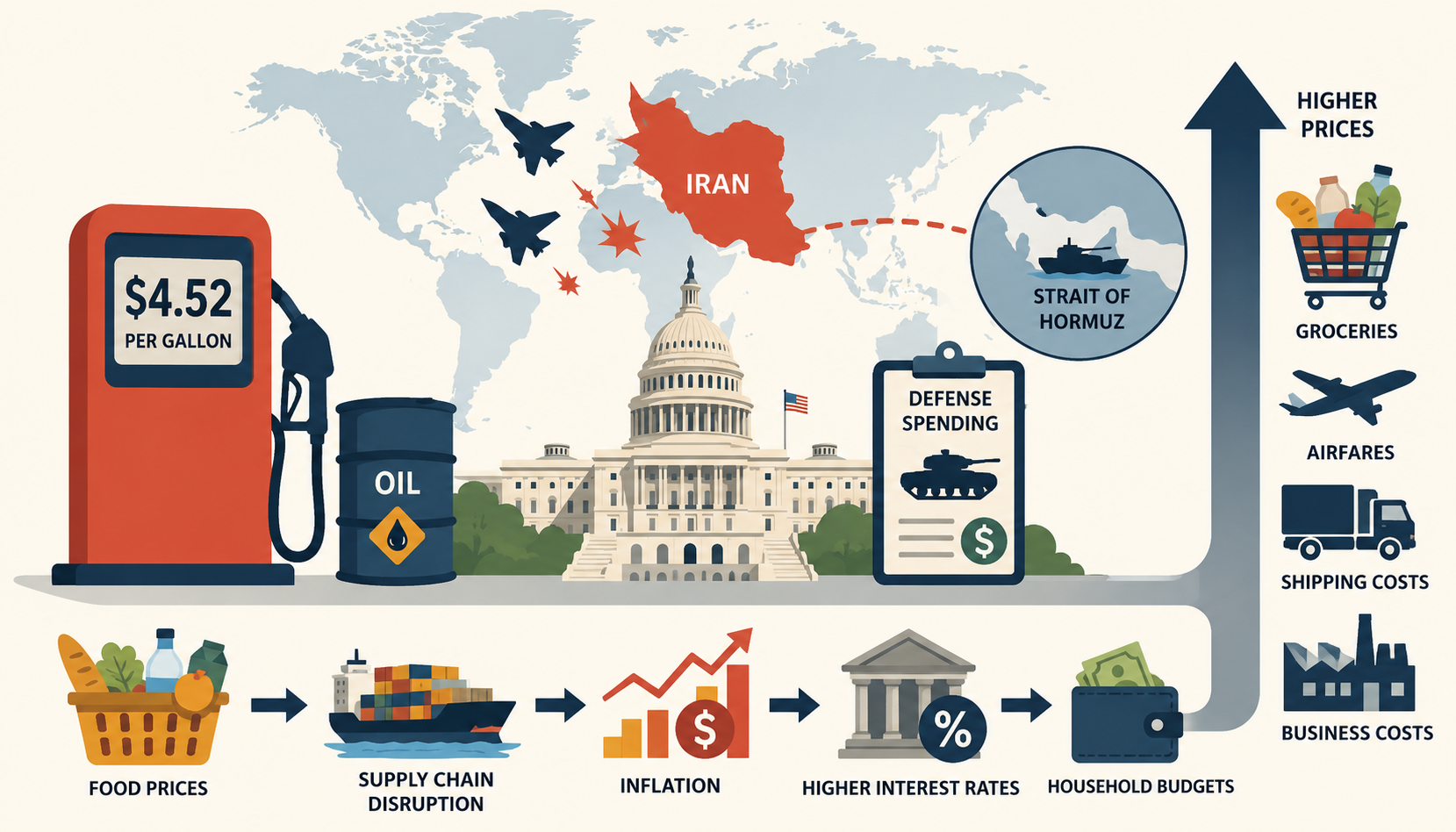
The transmission from oil to the real economy is not abstract. Higher crude feeds into diesel, jet fuel, shipping rates, and petrochemical inputs such as naphtha and LPG. From there it moves into food (through fertilizer and freight), into consumer goods (through transport), and eventually into headline inflation and wage expectations. The International Energy Agency has warned that the conflict is taking a significant share of global supply offline. Goldman Sachs has flagged that buffers of refined products — particularly the feedstocks that keep petrochemical and aviation supply chains running — are being drawn down faster than headline crude inventories.
For central banks already navigating sticky services inflation, an energy shock layered on top is a difficult policy problem. It is supply-driven, so rate hikes do little to address the underlying cause; but if it feeds into expectations, doing nothing risks losing credibility. The Beijing summit matters to that calculation because any credible signal of Hormuz reopening — even a partial, phased one — changes the path of expected inflation in Asia and Europe almost immediately.
There is a sentence worth keeping in mind: the market is not just pricing barrels of oil. It is pricing the risk that a regional war becomes a global inflation shock.
Trade talks, running in parallel
The summit is not happening in isolation. Chinese Vice Premier He Lifeng is meeting U.S. counterparts in South Korea on May 12 and 13 — the two days immediately before the Beijing meetings — to discuss economic and trade issues. The sequencing is deliberate. Both governments want to bank what progress they can on the trade track before the leaders sit down, so the summit itself can focus on the harder political questions.
The risk is contamination across tracks. If Iran talks go badly, the U.S. could harden its line on sanctions enforcement, including against Chinese refiners buying Iranian crude. If the trade talks stall, Beijing has fewer incentives to be visibly cooperative on Iran. Analysts at political risk firm Teneo have noted that recent escalations — U.S. sanctions on Chinese refiners, Chinese countermeasures on rare earths and semiconductors — could derail the truce reached at last October’s Trump–Xi meeting in Busan if they are not contained.
A limited trade thaw becomes harder if the Iran issue worsens. A visible diplomatic gesture on Iran creates space for economic concessions. The two tracks are now linked whether the leaders want them to be or not.
The backdrop: Taiwan, AI, rare earths
Iran will dominate the headlines, but the summit’s agenda is broader than any one issue. Reporting from Reuters, Bloomberg, and CNBC indicates the leaders are also expected to discuss artificial intelligence cooperation and security, the framework for managing trade tensions, agricultural exports, Taiwan, and China’s rare earth export controls — which since their tightening last year have rippled through European, Japanese, and Korean auto and electronics supply chains.
None of these will be resolved in two days. The realistic test is whether the two governments can manage several crises in parallel without letting one of them contaminate the others. That is a lower bar than a grand deal, but it is the right one for a relationship at this level of strain.
What to watch after the summit
A few specific signals will tell observers more than the formal communiqué.
The first is language on Hormuz. Any joint reference to freedom of navigation, ceasefire support, or a phased reopening of the waterway would matter to oil markets within hours.
The second is how China handles Iran in public versus in private. If Beijing signals visible pressure — adjusting its public stance on Iranian oil purchases, for example — that would be a substantive shift. If the pressure remains entirely behind the scenes, the market reaction will be more muted.
The third is the sanctions front. Any U.S. softening on the three China-based companies, or any tightening on Chinese refiners buying Iranian crude, will be read as a barometer of whether the Iran channel is producing concessions.
The fourth is the trade track. Watch the readout from the He–Bessent meetings in South Korea on May 12 and 13. Substantive movement there would give both leaders something to point to in Beijing.
The fifth, and most direct, is the oil price reaction. Brent and WTI will move on the smallest credible hint that the Hormuz disruption is winding down — or that it is not.
The summit’s success will not be measured by a grand bargain. It will be measured by whether oil markets calm, trade channels stay open, and Washington and Beijing avoid turning Iran into another front in the U.S.–China rivalry. On the evidence of the last week, that is still very much in play.