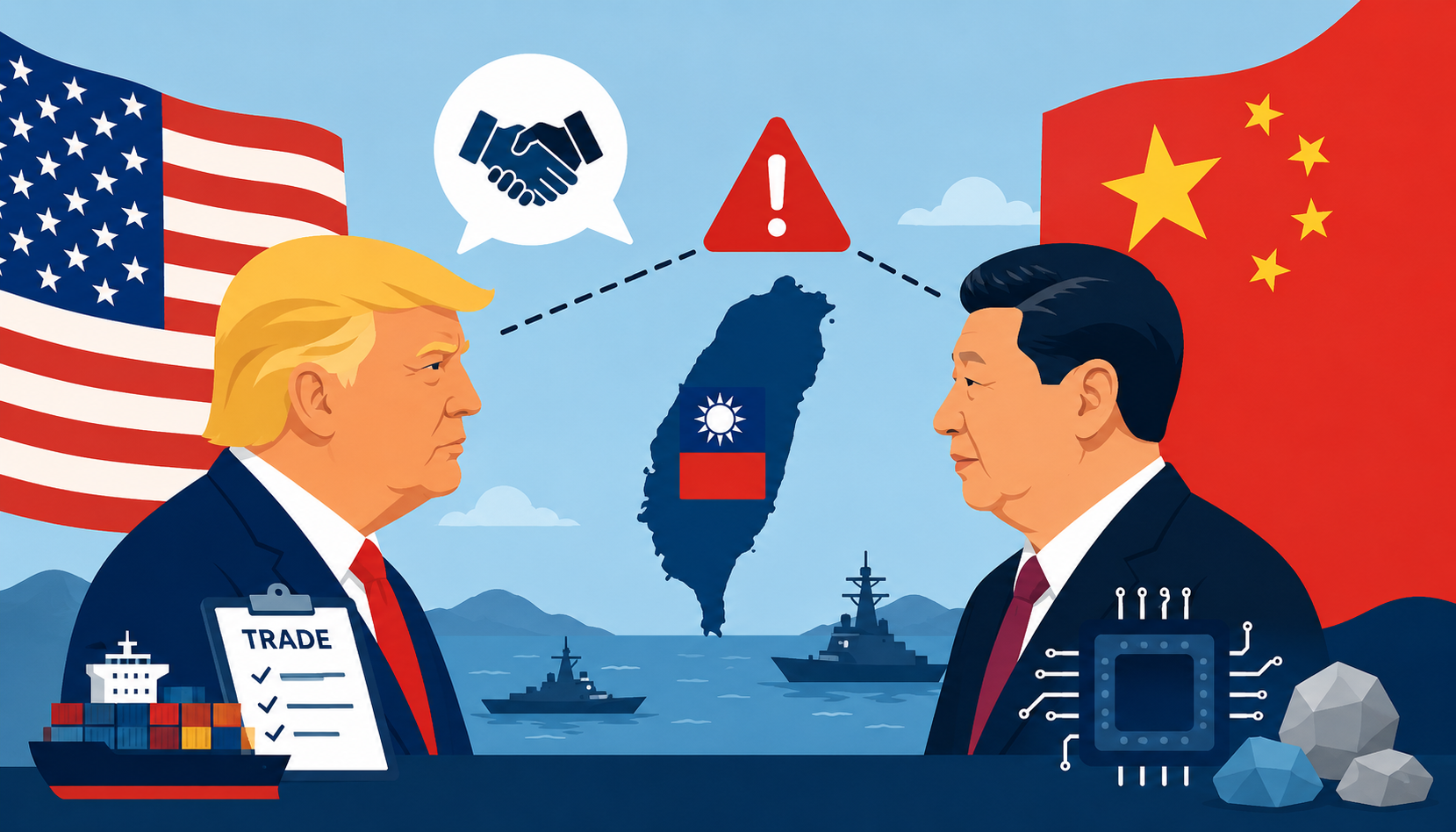
Donald Trump and Xi Jinping spent more than two hours together in Beijing on Thursday, walking past honor guards and children waving flags, exchanging public compliments about a relationship Trump called “extremely positive.” Markets read the choreography the way markets usually do — as a sign that the world’s most important bilateral relationship is, for now, being managed rather than allowed to drift. Yet behind the cordial staging, Xi delivered the sharpest line of the day. Mishandling Taiwan, China’s foreign ministry said he told Trump, would lead to “clashes and even conflicts, putting the entire relationship in great jeopardy.” That sentence is the one investors should keep on their desks.
This is the first visit to China by a sitting U.S. president in nearly a decade, and it builds on the Busan trade truce both leaders agreed to last October. The framing from Beijing has been notably structural. Chinese officials have described what they call a “new positioning” in U.S.-China ties, a phrase meant to signal a more orderly relationship — less open-ended hostility, more managed competition over the next three years and beyond. In plain English, both sides appear to be trying to put guardrails around their rivalry rather than end it. Whether those guardrails hold is the real question hanging over the summit.
A summit shaped by two scripts
There were effectively two summits running in parallel on Thursday. One was visible: the lavish welcome, Trump’s invitation to Xi for a reciprocal visit to Washington on September 24, the talk of soybeans and aircraft and a fragile but functional trade truce. The American readout focused on trade and the Iran war and made no mention of Taiwan at all. The other summit lived inside the Chinese readout, where Taiwan was placed at the center as the “most important issue” in the relationship — a deliberate signal that everything else is contingent on it.
This split is itself the story. Markets tend to price what is said publicly. Strategists tend to price what is said privately. When the two readouts diverge, the gap is information.
What “new positioning” actually means
The phrase is doing real work. It suggests Beijing wants predictability while it deals with a slowing domestic economy, sustained capital outflows, and the unfinished project of moving up the technology value chain. Washington, for its part, wants visible wins — trade, agriculture, aircraft orders, fentanyl concessions — and a quieter Pacific while it remains militarily engaged against Iran and indirectly committed in Ukraine.
Neither side is backing away from core strategic interests. Both sides have reasons to lower the short-term temperature. That is the deal lurking behind the diplomatic language, and it explains why even a meeting that produced no grand bargain can still be read as constructive. The Busan truce, with its one-year suspension of Chinese rare earth export controls and the U.S. halving of fentanyl-linked tariffs, gave both sides a working template. Beijing is now offering to extend that template into something more durable, on the condition that the United States understands where the limit is.
Taiwan: the hard limit
Taiwan is not just another diplomatic dispute, and treating it as one is the surest way to misread this summit. The island sits at the intersection of Chinese sovereignty claims, U.S. arms commitments under the Taiwan Relations Act, the world’s most concentrated supply of advanced semiconductors, the shipping lanes through which most of East Asia’s energy and trade flow, and the alliance architecture that links Japan, South Korea, the Philippines, and Australia to Washington. No other issue in the U.S.-China file touches all of those wires at once.
Xi’s warning was not new in substance — Beijing has long held that Taiwan is the red line. What was new was the placement. By delivering it inside an otherwise warm summit, Xi made the rhetorical pairing explicit: cooperation is on offer, but it is conditional. Secretary of State Marco Rubio said afterward that U.S. policy on Taiwan was “unchanged,” which is the standard Washington answer and tells you almost nothing about how the next twelve months will unfold. Strategic ambiguity — the long-standing U.S. posture of declining to say outright whether it would defend Taiwan militarily — is meant to deter both an invasion and a unilateral declaration of independence. It works only as long as both sides believe the other might mean it.
The risk, then, is not that war becomes likely. It is that Taiwan remains the issue most capable of overwhelming everything else if either side miscalculates, and that the summit did nothing to change that.
The market channels
For investors, the practical question is how this filters into prices. Several channels are worth tracking.
Equities first. Taiwan, Japanese, and South Korean shares are the most exposed to any sharp deterioration in cross-strait sentiment, with semiconductor names and their suppliers carrying the heaviest load. U.S. tech firms with meaningful China revenue — chip designers, capital equipment makers, consumer hardware — sit in the same risk bucket.
Semiconductors deserve their own line. Taiwan produces the overwhelming majority of the world’s most advanced logic chips, and any rise in perceived conflict risk reprices not just the affected stocks but global AI capex assumptions, hardware roadmaps, and inventory behavior across the supply chain. This is the channel where small probability shifts can produce large valuation moves.
Currencies are the third channel. The Taiwan dollar, the offshore yuan, and the yen tend to move with Asian risk appetite, and a credible escalation scare would pull capital toward dollar and Swiss franc safe havens. Trade and tariffs sit on a different timeline: a more stable U.S.-China framework genuinely does reduce near-term tariff uncertainty, which is why traders going into the summit were positioned for a truce extension and Boeing purchase announcements. But that optimism can be overridden quickly if Taiwan moves to the front of the news cycle.
Commodities and shipping form the fourth. The summit is unfolding against the backdrop of the Iran war and the disrupted Strait of Hormuz, which Rubio confirmed Trump raised directly with Xi. China’s stated opposition to militarizing the strait was a useful signal, but it underlines a broader point: the world is already carrying one major geopolitical risk premium. Layering Taiwan risk on top of Hormuz risk is the scenario that would force a serious repricing of energy, freight, and safe-haven assets simultaneously.
Rare earths sit slightly outside these channels but matter enormously. Chinese export volumes are still running roughly half their pre-restriction levels even under the truce, and Beijing’s licensing system from April 2025 remains in force. The CFR has noted that the U.S. is “still far from true resilience” in rare earth supply chains, with billions committed to emergency financing but limited refining capacity at scale. Any movement on rare earth licensing volumes coming out of Beijing this week is therefore worth more than the headline trade language suggests.
The Trump factor
Trump’s instincts are transactional, and the summit reflected that. Soybeans, Boeing aircraft, tariff relief, fentanyl chemicals, a possible expansion of the working frameworks already sketched out — these are the kinds of deliverables a U.S. president can put on television. They are also the kinds of deliverables that can calm markets in the short term without resolving the underlying strategic tension. The risk in transactional diplomacy is not that it fails to produce wins. It is that the wins create an illusion of progress on issues that have not actually moved.
Markets like deals. Beijing values red lines. Taiwan is where those two logics are most likely to collide.
What to watch next
The summit’s signal will be clearer in the follow-through than in the communiqué. A few things are worth watching closely. Any U.S. statement on Taiwan arms sales over the coming weeks, and how carefully it is worded. Chinese military activity in and around the Taiwan Strait, particularly the tempo and scale of any exercises. The detail, if it emerges, of an extended trade framework — including whether rare earth licensing volumes actually rise. Movement on AI chip export controls. The September 24 invitation: whether Xi accepts, and what conditions get attached. And, on the market side, how Taiwan equities, regional chip names, and the Asian FX complex trade through any incremental news.
What this summit clarified is not that U.S.-China relations are improving. It is that both governments are willing to manage the surface of the relationship without touching what lies beneath it. That is genuinely useful for short-term stability. It is also the reason the next Taiwan-related headline — whatever it is — will matter more than the next trade announcement.