Global imbalances are back at the centre of the policy conversation. Speaking in Paris on June 23, Bank of Canada Governor Tiff Macklem argued that the world’s widening current-account gaps are no longer just a trade story — they are increasingly a financial-stability story, transmitted through capital flows, stretched asset prices, and a fast-moving non-bank financial system that regulators struggle to see into. His core worry: that the same lopsided cross-border flows that preceded the 2008 crisis are reassembling, this time inside a financial plumbing that is bigger, faster, and less transparent.
Why Macklem’s warning lands now
The timing is deliberate. Macklem delivered the remarks to Paris Europlace and the France-Canada Chamber of commerce, against the backdrop of a renewed G7 push on imbalances that began under Canada’s 2025 presidency and continues under France this year. He noted that G7 finance ministers and central bankers had met in Paris roughly six weeks earlier, with the Middle East conflict dominating discussion, and welcomed the recently signed US-Iran agreement and the softening in energy prices that followed.
But the medium-term concern he flagged is structural, not geopolitical. After narrowing for much of the post-crisis decade, global imbalances are widening again — and Macklem’s argument is that the financial system has changed underneath them in ways that make the next adjustment potentially more violent.
What “global imbalances” actually mean
At its simplest, a global imbalance is the persistent gap between what an economy saves and what it invests, which shows up as a current-account surplus or deficit. The flip side of any trade balance is a capital flow: a country running a deficit must, by accounting identity, import capital to fund it.
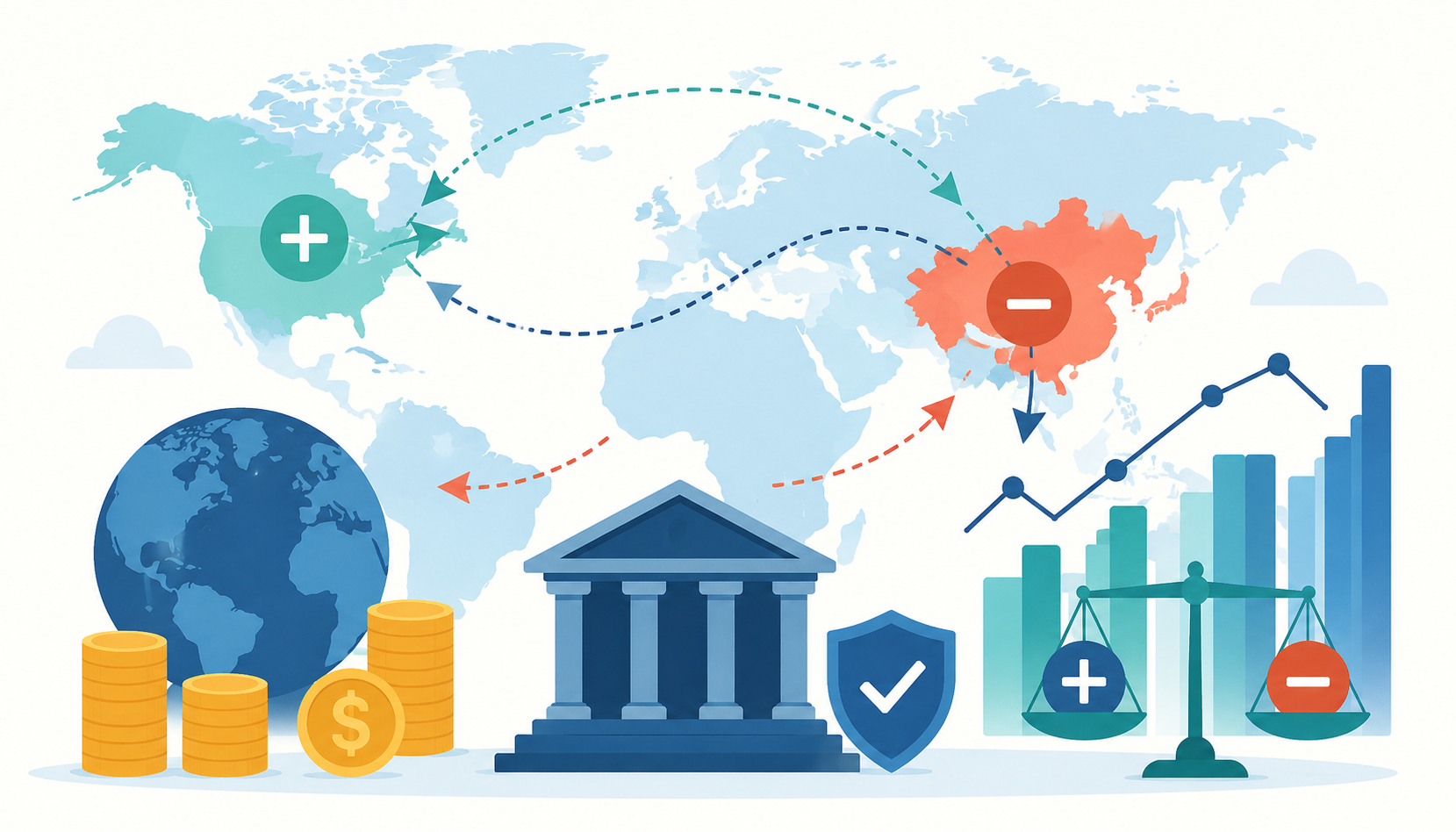
The IMF’s 2025 External Sector Report, which Macklem cites directly, puts numbers on the shift. Global current-account balances widened by 0.6 percentage points of world GDP in 2024, rising from a post-pandemic low near 3 percent to about 3.6 percent. The Fund judges that roughly two-thirds of that widening reflects excess imbalances — the largest such increase in a decade — driven by China (+0.24 percent of global GDP), the United States (−0.20 percent), and, more modestly, the euro area (+0.07 percent).
The mechanics behind those figures are familiar but worth restating. China saves far more than it invests, so capital flows out; years of overinvestment in manufacturing have left excess capacity and deflationary pressure. Europe invests modestly relative to its savings, so capital also flows out. The United States does the opposite — strong consumption and large fiscal deficits mean it saves less than it invests, and foreign inflows fill the gap. The cumulative result, Macklem noted, has pushed the US net international investment position to a historically large negative balance.
How imbalances become a stability risk
This is the heart of the speech. Cross-border finance, Macklem stressed, is fundamentally useful — it moves savings to where they earn the highest return. The problem is excess. When flows become too large and too one-directional, his warning was blunt: “Capital gets misallocated. Pressures cumulate and financial stability risks increase.”
Three transmission channels stand out.
Misallocation and asset bubbles. When a wall of global savings pours into one destination, valuations can detach from fundamentals. Macklem drew an explicit parallel between the pre-2008 run-up and today’s AI-investment boom, suggesting one-way capital flows may again be inflating asset prices. (He framed this as a risk, not a forecast — a distinction worth preserving.)
A migration into the shadows. Post-crisis reforms made banks safer, but risk did not vanish — it moved. Non-bank intermediaries (hedge funds, private credit, pension funds, other asset managers) now do much of the lending and market-making, yet face lighter reporting and supervision. Hedge funds in particular have become major buyers of government debt; their leveraged, short-term-funded, cross-currency strategies can make sovereign bond markets more fragile and raise the odds of cross-border contagion when positions unwind.
Faster reversals. New money rails — including US-dollar stablecoins increasingly used for cross-border transactions in emerging markets — let capital exit more quickly, often beyond the sight of regulators and the reach of capital controls. The IMF report underscores the same point about pace: the dollar fell about 8 percent in the first half of 2025, its largest half-year decline since 1973, even after a multi-decade high.
Macklem distilled the danger into two scenarios: that large inflows into the US get misallocated and set up a painful correction in equities and credit, or that those inflows reverse abruptly. Either way, the stress would not stay inside US borders.
Why central banks are watching
For a small, trade-dependent economy like Canada, the concern is exposure rather than authorship. Macklem was explicit that Canada is not a source of excess imbalances — but said it could be knocked by trade tensions and sideswiped if financial-stability risks crystallise. The Bank’s own 2026 Financial Stability Report judged the domestic system to be functioning well while flagging rising vulnerabilities in a more turbulent global environment.
His diagnosis aligns with a broader consensus. A March 2026 memo by economists Bai, Gopinath, Rey and Weber, prepared for the G7, locates the root of global imbalances in domestic imbalances within the largest jurisdictions. The prescribed remedy is symmetrical and well-worn: China should consume more, the United States should save more, and Europe should invest more — ideally in coordinated fashion, so adjustment is gradual rather than forced.
What it means for investors and policymakers
Macklem’s policy agenda rests on three words — openness, investability, transparency. The investability point has the sharpest market implication: because so much global savings is funnelled into US assets, he argued the world needs more credible alternatives, which means deepening capital markets, building safe assets, and improving payments infrastructure outside the dollar bloc. For policymakers, the transparency push targets exactly the blind spots — non-bank intermediaries, FX markets, and cross-border flows — that move fastest under stress.
Analyst’s View
From a country-risk and credit perspective, the actionable signal here is not the headline warning but the structure of the vulnerability.
Sovereign and funding risk. The economies most exposed are not the surplus giants but the deficit borrowers that rely on continued foreign inflows. A sudden reassessment of dollar exposure — the IMF already documents the start of one — raises refinancing risk for any sovereign or corporate dependent on external funding, particularly those with thin reserve buffers or currency mismatches on their balance sheets. For portfolios with emerging-market sovereign exposure, the watch items are external financing requirements, reserve adequacy, and the share of debt held by leveraged, fast-money holders rather than sticky institutional investors.
Market risk. The concentration of global savings in US equities and credit is itself the position to stress-test. If the AI-driven inflow either misallocates or reverses, the correction would propagate through correlated risk assets globally, not just in US names. Hedging dollar exposure and scenario-testing for a disorderly repricing — rather than assuming the usual flight-to-dollar safe-haven reflex — is the prudent posture, especially given how quickly stablecoin and non-bank channels can amplify a reversal.
The supervisory blind spot is the real tail risk. For a credit practitioner, the most useful takeaway is Macklem’s point that risk has migrated to where visibility is weakest. Counterparty and contagion risk now sits disproportionately in lightly monitored intermediaries, which means traditional bank-centric early-warning indicators will understate true system fragility. The 2008 lesson Macklem keeps returning to is that adjustment delayed becomes adjustment imposed — and imposed adjustments are the ones that break portfolios.
The honest caveat: none of this is a timing call. Imbalances can persist for years before they snap, and the dollar’s reserve status has repeatedly let pressure build longer than models predict. The risk is not that a reversal is imminent — it is that the system has quietly become more combustible while everyone was watching the tariffs.