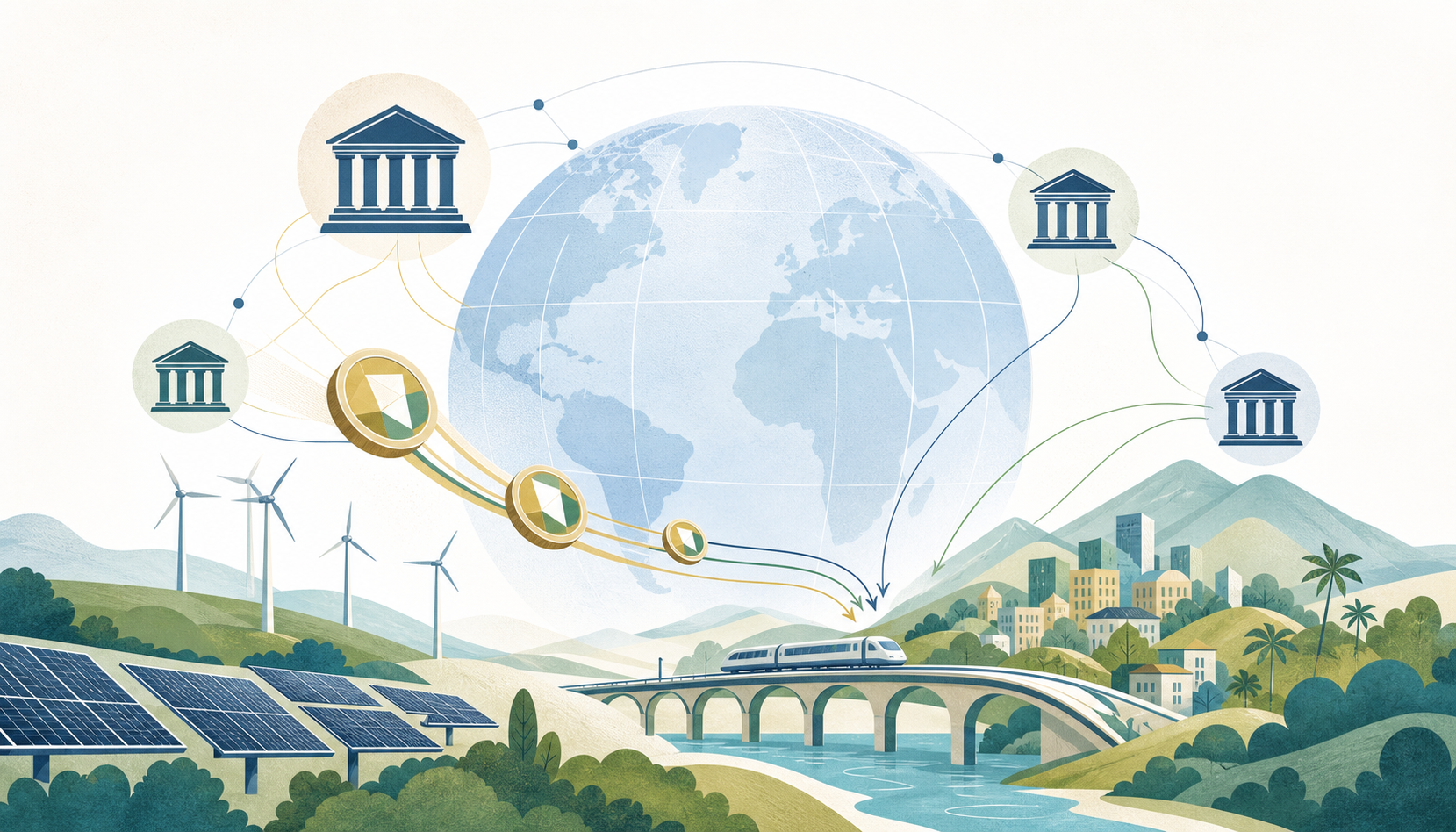
Multilateral development banks committed a record US$163 billion in climate finance in 2025, according to their latest joint report. The headline number matters because these institutions sit at the intersection of sovereign borrowing, infrastructure investment and private-capital mobilisation. It also arrives as governments face tighter fiscal room, higher debt-service costs and a more fragmented policy environment.
The total covers all countries in which the banks operate. Within low- and middle-income economies, climate finance rose 21% from the previous year to US$103 billion. That increase was not confined to one type of investment: mitigation finance reached US$68 billion and adaptation finance US$35 billion. The data were published on 13 July by the European Bank for Reconstruction and Development, which helped prepare the 2025 Joint Summary Report on Multilateral Development Banks’ Climate Finance.
A larger pool of climate-linked lending
The scale-up is important for borrowers whose growth prospects are increasingly shaped by energy security, disaster resilience and access to affordable long-term capital. For many low- and middle-income countries, an MDB loan, guarantee or co-financing package can lower the perceived risk of a project enough to bring in commercial lenders. The report says private-sector mobilisation in these economies reached US$35 billion in 2025.
That mechanism is central to the economics of climate finance. Public and multilateral capital does not need to fund every dollar of a power grid, transport corridor or water system. It can instead absorb selected risks, extend maturities or provide technical preparation that private lenders would otherwise price too aggressively. Whether that mobilisation converts into completed projects will depend on country pipelines, procurement quality, currency risk and the durability of local regulation.
Adaptation finance deserves particular attention. The US$35 billion reported for low- and middle-income economies was 31% higher than a year earlier, while mitigation finance rose 16%. The distinction is material for sovereign credit analysis. Mitigation projects can generate identifiable revenue streams or savings, such as renewable generation and energy efficiency. Adaptation investments often prevent losses rather than produce direct cash flow, but can still protect tax bases, infrastructure and external balances from climate shocks.
Targets are closer, but execution risk remains
At COP29 in 2024, MDBs said they aimed to provide US$120 billion a year in climate finance for low- and middle-income countries by 2030, including US$42 billion for adaptation, while mobilising an additional US$65 billion annually from private sources. The 2025 figures put the group closer to those goals, but they do not make the path automatic. The report itself frames the 2025 result as evidence that the banks are on track, not as proof that future lending will keep rising at the same pace.
For investors, the relevant question is not only the gross volume of commitments. It is how funds are allocated across countries and instruments, how quickly projects disburse, and whether the financing structure reduces or merely shifts risk. Foreign-exchange exposure remains a practical constraint for local-currency revenues financed with hard-currency debt. Political changes can also slow permitting, alter tariffs or weaken the contractual protections that enable private co-financing.
The report records US$53 billion of mitigation finance and US$7 billion of adaptation finance in high-income economies, alongside US$80 billion of private finance mobilisation. Those figures illustrate the breadth of MDB activity, but they should not obscure the financing gap in economies with higher borrowing costs and thinner domestic capital markets. A dollar of concessional support can have a different credit effect in a country with limited fiscal buffers than in a mature market with deep local-currency funding.
What the record means for markets
The immediate market implication is constructive for issuers and sectors that can translate MDB participation into bankable investment. Grid upgrades, resilient transport, water systems, clean generation and industrial efficiency are likely to remain prominent channels. Project sponsors may benefit from lower financing costs when an MDB guarantee or anchor investment improves senior-lender confidence. Conversely, a record aggregate figure does not eliminate project-specific risks around construction, demand, regulation and currency.
For sovereign investors, MDB involvement can be a modest positive when it supports investment without worsening debt sustainability. The key test is additionality: whether financing unlocks productive assets, strengthens resilience and improves access to private funding, rather than crowding out viable domestic capital. Countries with credible fiscal frameworks and clear project preparation are better placed to convert commitments into durable growth benefits.
Analyst’s View
The US$163 billion record is a meaningful signal that MDBs can scale climate-related finance even in a difficult geopolitical setting. The more consequential story will be whether the next stage of mobilisation reaches countries and projects where the financing gap is widest. Investors should watch disbursement rates, guarantee usage, local-currency solutions and the distribution of adaptation funding—not only annual commitment totals. Those indicators will show whether the headline number is becoming a broader reduction in financial and physical climate risk.
Sources: EBRD: Multilateral development banks increase climate finance to record US$163 billion in 2025; 2025 Joint Summary Report on Multilateral Development Banks Climate Finance.