The United States has imposed an additional 50% ad valorem duty on selected products from Canada, effective August 19, 2026. The White House proclamation directs that the covered products are those listed in its Annex II, and says the duty applies in addition to other applicable duties, taxes, fees and charges. The measure does not apply to products already subject to Section 232 duties or to articles covered by the WTO Agreement on Trade in Civil Aircraft.
The decision places a new cost at a border that supports a deeply integrated vehicle industry. It also gives customs classification, origin documentation and the scope of the annex immediate importance for automakers, suppliers, dealers and lenders. Canada has described the new tariffs as unjustified and said it plans dollar-for-dollar counter-tariffs from September 8, alongside support for affected businesses and workers.
What the U.S. proclamation does
The July proclamation uses the President’s authority under Section 338 of the Tariff Act of 1930, together with other cited authorities, to amend the Harmonized Tariff Schedule. Its operative provision is narrow in one important respect: the 50% rate applies to certain Canadian products set out in Annex II, rather than automatically to every Canadian vehicle or component. Importers therefore need to identify the precise tariff classifications and any applicable exclusions before treating an entry as covered.
For covered goods entered for consumption, or withdrawn from warehouse for consumption, on or after 12:01 a.m. Eastern time on August 19, the additional duty is in force. The proclamation says goods admitted to a U.S. foreign-trade zone after that date must be given privileged foreign status if they are subject to the duty. It authorizes Customs and Border Protection, working with Treasury, Commerce and the Office of the U.S. Trade Representative, to issue implementation guidance and make technical changes where necessary.
That administrative detail matters. A tariff headline describes the policy direction; invoices, customs entries and origin records determine its cash effect. The financial impact will vary by product code, the share of Canadian content, the destination of the finished vehicle and the treatment of existing tariffs. Businesses should avoid applying a simple 50% assumption to an entire cross-border supply chain.
A supply chain built across the border
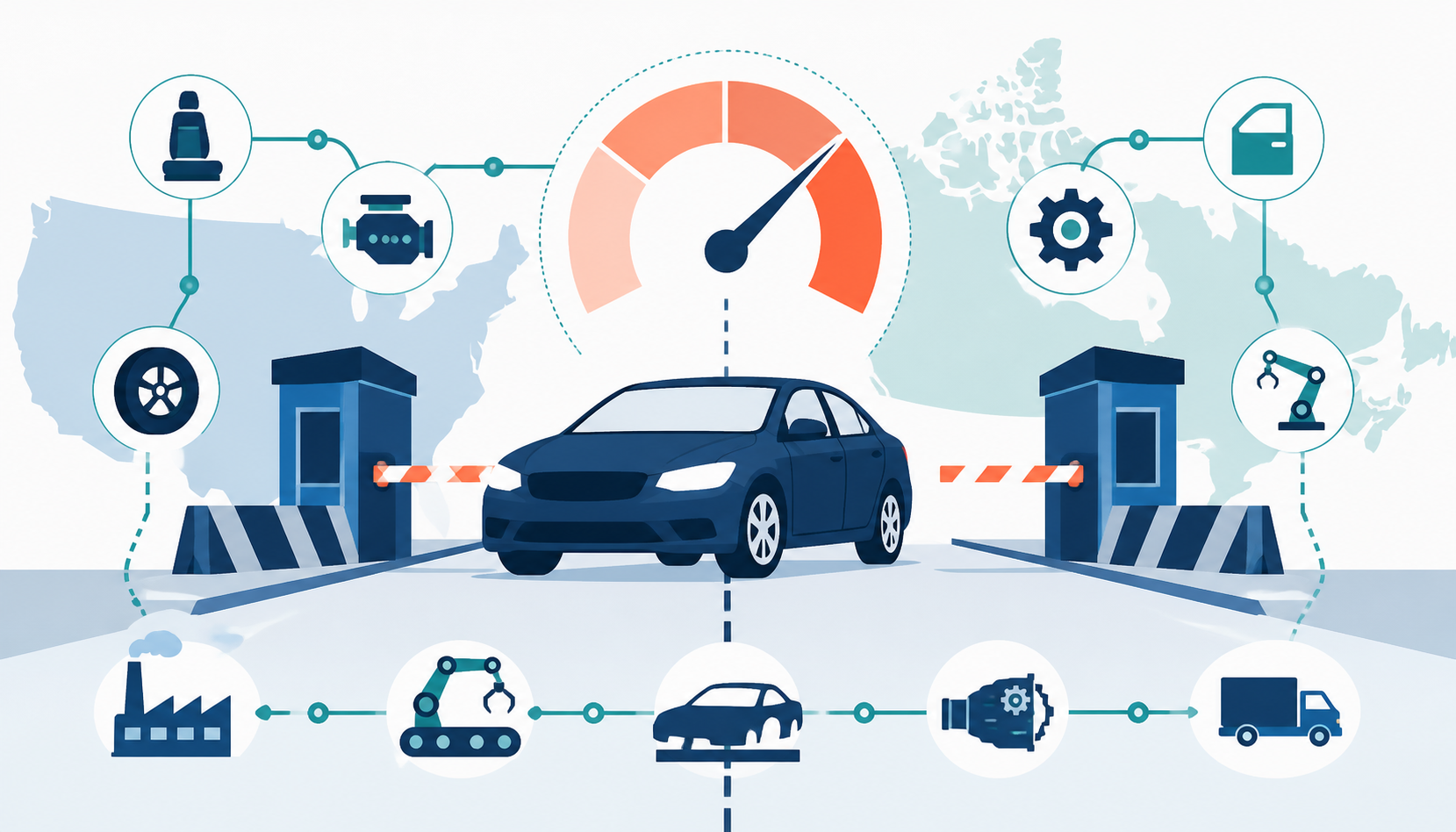
The U.S. Trade Representative’s 2024 report on USMCA automotive trade described the North American auto sector as highly integrated. It cited an industry model under which about 50% of the content of vehicles built in Canada originated in the United States. The figure is not a measure of every vehicle’s bill of materials, yet it illustrates the circular trade patterns that make country-by-country tariff analysis incomplete.
Parts can cross the border more than once before final assembly. Engines, transmissions, electronics, stamped metal, seats and tooling move through plants in both countries. A duty aimed at imported Canadian products can therefore affect U.S. suppliers with Canadian customers, Canadian plants using U.S. inputs, and dealers selling vehicles whose production path spans the two countries.
Official U.S. Census Bureau data show the scale of the relationship. In the first six months of 2026, U.S. goods imports from Canada totaled $200.2 billion and exports totaled $175.8 billion, on a nominal, not seasonally adjusted basis. Those totals cover far more than autos, but they underline why disruptions to a major bilateral trade corridor can reach freight, inventories and working-capital needs beyond the factories named in public debate.
Canada prepares a response
Canada’s Department of Finance said on August 25 that federal and provincial finance ministers discussed the suspension of trade negotiations with the United States and a response to the newly imposed tariffs. According to the department, Finance Minister François-Philippe Champagne said dollar-for-dollar counter-tariffs would take effect on September 8 and that a support package for businesses and workers would be announced.
The response leaves several commercially significant questions open. Canada has not, in the cited readout, published a complete product list for the new counter-tariffs. Nor does the announcement establish how firms will handle contract repricing, shipment timing or inventory already in transit. Those details will shape the burden on individual firms more than broad political statements.
Canada already maintains automobile-related countermeasures from the previous phase of the dispute. Its tariff information page states that, since April 2025, Canada has applied a 25% tariff to non-CUSMA-compliant vehicles imported from the United States and to non-Canadian and non-Mexican content of CUSMA-compliant vehicles imported from the United States. The page also describes remission relief designed to encourage Canadian production and investment. The new U.S. measure adds another layer to an already complex policy environment.
Immediate operating issues for companies
Automakers and suppliers face a practical sequence of decisions. First, they need to map covered harmonized tariff codes against shipments scheduled after the effective date. Second, they need to test certificates of origin, supplier declarations and bill-of-materials data. Third, they need to estimate the cash tied up in duties while a vehicle or component moves through assembly and distribution.
For companies with thin inventory buffers, the timing of customs entry can be as important as the published rate. A shipment in a bonded warehouse, a foreign-trade zone or a port queue may have a different treatment from goods already entered for consumption. Treasury teams also need to distinguish a customs cost from an accounting estimate of the final economic burden. The duty may be absorbed by a supplier, passed through to an assembler, reflected in wholesale prices or shared across contracts. Contract language and market conditions will decide that allocation.
Dealers and fleet buyers may see a second-round effect rather than a direct customs bill. Vehicle availability, incentives and model mix depend on decisions made by manufacturers and distributors. A price change in one segment can redirect demand toward substitutes, including U.S.-assembled vehicles, used vehicles and imports from other countries. That adjustment takes time and may differ sharply by region.
What to watch next
The first checkpoint is implementation guidance from U.S. Customs and Border Protection. Companies need confirmation of covered classifications, documentation rules and the treatment of goods in foreign-trade zones. The second is Canada’s September 8 counter-tariff list and any accompanying relief or support program. The third is whether U.S.-Canada negotiations resume and produce changes to the current measures.
Investors should also watch production schedules, supplier commentary and credit metrics. Tariffs can turn a routine logistics decision into a working-capital event. A supplier that must finance additional duties before receiving payment from an assembler may face pressure even when end-market demand is steady. Firms with diversified plants, stronger liquidity and transparent origin data may manage the adjustment better than smaller suppliers with concentrated customers.
Analyst’s View
For credit risk, the main exposure is not the headline rate alone. It is the gap between when a company pays a duty and when it can recover that cost through contracts or prices. Analysts should examine liquidity, receivables terms, inventory days and the concentration of cross-border revenue before drawing conclusions about a supplier’s resilience.
For sovereign and regional risk, the dispute raises the chance of weaker investment in border-dependent manufacturing areas if the measures persist. Canada has announced an intention to support affected workers and businesses, while the United States has given agencies authority to issue implementing rules. Fiscal support can soften the immediate shock, yet it does not remove uncertainty around future trade access.
For market positioning, the useful distinction is between exposure that is demonstrably covered by the U.S. annex and exposure that is merely associated with the auto sector. Companies with specific covered imports, limited pricing power and short liquidity runways warrant closer attention. Broad claims about all North American auto producers would outrun the evidence available before the detailed implementation record is complete.
The next weeks will show whether the tariffs become a durable cost of doing business or a negotiating tool that is modified through further government action. Until then, the most defensible approach is product-level analysis, careful tracking of official notices and clear separation between confirmed duty obligations and estimated commercial effects.