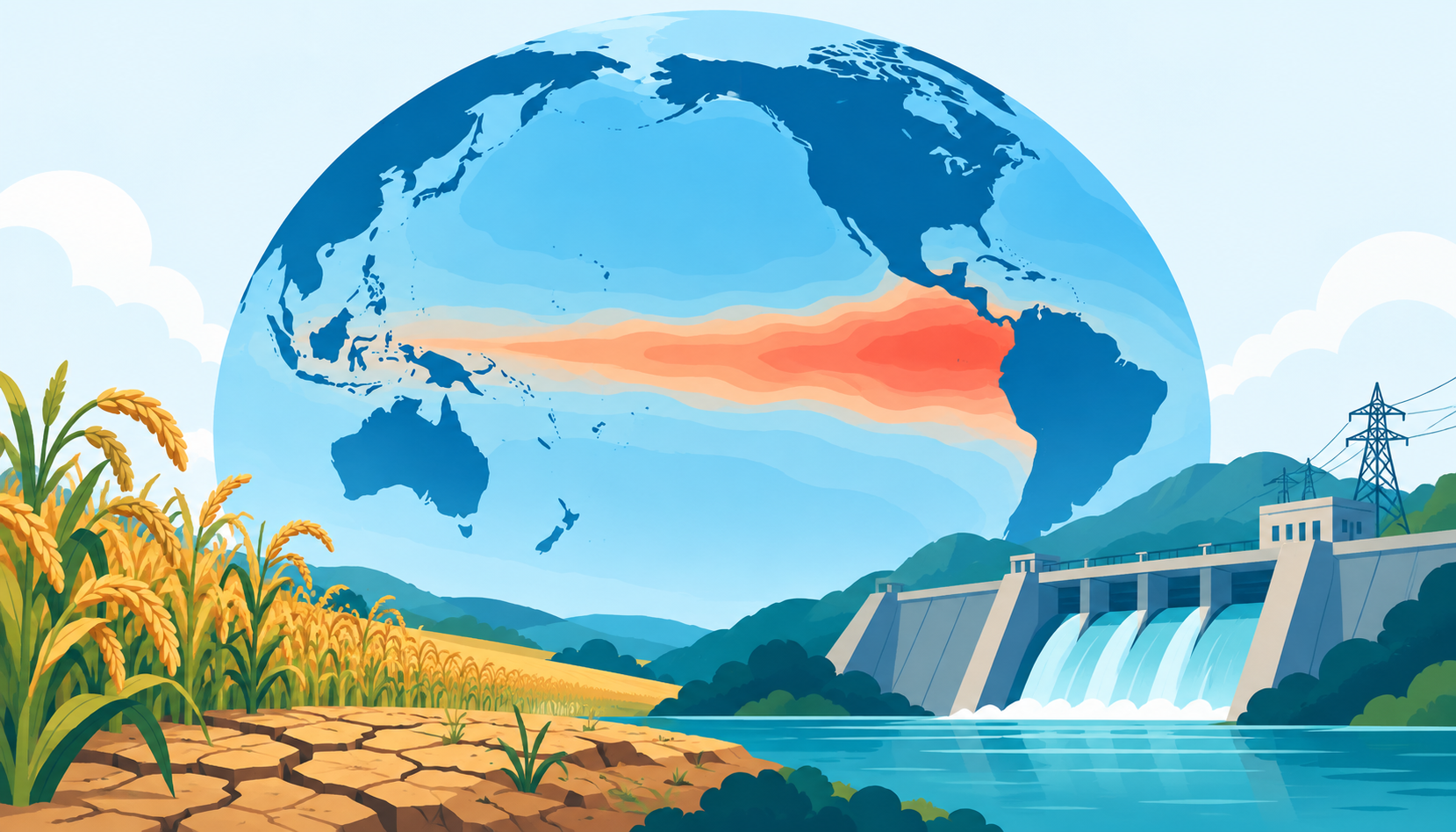
The World Meteorological Organization said on October 8 that El Niño will strengthen toward a projected December peak, with a near-100% likelihood of continuing through February 2027. Its latest announcement warns of hotter conditions across much of the world and shifts in rainfall that increase drought and flood risks. For businesses and governments, the immediate task is to assess exposure across the coming planting, harvest and electricity-demand seasons.
The economic consequences will depend on where rain falls, which crops enter vulnerable growth stages and how much financial room households and governments have. A seasonal forecast cannot establish future commodity prices or default rates. It can help lenders and buyers decide which exposures deserve closer monitoring before physical losses appear.
A strong climate signal, with local uncertainty
WMO’s October–December seasonal update projects an average Niño 3.4 sea-surface temperature anomaly of approximately 3.7°C for that three-month period, with warming peaking around December. The same outlook projects a positive Indian Ocean Dipole, averaging about 0.5°C over the season, alongside warmer-than-normal tropical Atlantic waters. These are forecasts of ocean conditions. The Niño 3.4 figure is neither a global temperature forecast nor a measurement of crop losses.
In its September 10 diagnostic discussion, the US Climate Prediction Center assigned a greater-than-90% probability to a very strong El Niño during the Northern Hemisphere autumn and winter of 2026–27. It cautioned that associated regional impacts remain uncertain. That earlier assessment supports the direction of WMO’s warning; it should retain its September date when used alongside the new October release.
For a borrower with farms in several districts, a national average rainfall forecast may hide the exposure that matters. Analysts need local rainfall guidance, crop calendars and irrigation access. A lender financing a harvest due in early 2027 should also test repayment after that harvest, even if the climate event begins to weaken in February.
Food risk begins with the harvest calendar
The Food and Agriculture Organization’s June 2026 agricultural risk assessment identified vulnerable areas across the Sahel, Southern Africa, South and Southeast Asia, and Central America’s Dry Corridor and the Caribbean. Its analysis used 41 years of satellite observations to locate agricultural areas exposed to drought during strong El Niño events. These are risk maps prepared earlier in the year, rather than confirmed October production losses.
A food processor should establish how much of its contracted supply comes from exposed farms during the next delivery window. A modest reduction in output could require purchases from another region. If replacement supplies cost more, the processor’s margin would depend on its ability to adjust selling prices and on the timing of those adjustments. It could preserve its annual profit forecast while still needing more cash to finance inventories.
Higher commodity prices would also create different outcomes within the same supply chain. A producer with an intact harvest could receive more revenue, while a producer suffering a failed crop might have little output to sell. An importer could face a larger bill without any offsetting export income. Credit analysis therefore needs volume assumptions as well as price assumptions.
Stocks and substitution deserve equal attention. Buyers should examine available inventory, storage losses, alternative origins and existing purchase commitments before assuming a shortage. WMO’s forecast does not provide those commercial details. Claims about an impending rise in rice, wheat or palm-oil prices would require separate evidence from crop assessments and commodity markets.
Electricity exposure can extend beyond utilities
IMF researchers described the links between El Niño, agricultural supply and energy in their 2016 analysis of the global economy. Their historical work found that economic effects varied across countries and that lower hydroelectric output could increase demand for other fuels. The study provides a transmission mechanism, rather than a numerical prediction for the present event.
A utility facing low reservoir inflows could need to purchase replacement generation or fuel. Under a fixed retail tariff, that extra cost could weaken cash flow until the regulator approves an adjustment. If the government compensates the utility, the exposure could migrate to the budget. Those outcomes remain conditional on local water conditions, generation capacity and tariff arrangements.
Manufacturers should ask a different set of questions. Backup generation could protect production while raising costs. Interruptions could delay orders, leaving receivables uncollected and inventories unfinished. A business that appears insulated from agriculture might still face weather exposure through electricity or a water-dependent supplier. Mapping those dependencies is more useful than assigning the same loss assumption to every company in an affected country.
After rain returns, a utility could still face depleted reservoirs or unpaid compensation. Loan reviews should follow reservoir readings and the payment schedule, extending beyond the projected peak of the climate event where necessary.
Inflation and fiscal pressure require separate tests
The IMF’s historical analysis found inflation pressure in many economies following El Niño shocks, with differences linked partly to food’s weight in consumer spending. It also found that some economies benefited through other channels. Treating that research as a current forecast would overlook changes in inventories, exchange rates and policy since the study period.
As an analytical scenario, a government could face higher food-import costs alongside requests for household support. Subsidies or tax relief could reduce the immediate burden on consumers while increasing public financing needs. A government with ample budget reserves would have a different response capacity from one already struggling to refinance debt. The relevant indicators are the import bill, usable reserves, near-term debt payments and the terms of any assistance.
Central banks would need to distinguish a food-price increase from broader persistence in inflation. Wage settlements, expectations and price adjustments outside food and energy could help establish whether the initial supply disruption is spreading. This article makes no prediction about a specific central bank decision: the climate outlook alone cannot establish that a rate increase will follow.
Emergency preparation also has a financing dimension. FAO and the World Food Programme’s joint anticipatory appeal sought $202 million to protect 8.8 million people across 22 high-risk countries. FAO described support such as early cash assistance and help for farmers and pastoralists. That appeal is a preparation target; it does not establish how much funding has arrived or quantify eventual economic losses.
Analyst’s View
Credit risk: test the borrower’s cash cycle. Lenders should run a lower-output scenario and a higher-input-cost scenario, then examine their combined effect where both exposures exist. The decisive questions concern cash available at the repayment date, insurance coverage and access to committed funding. For agricultural borrowers, collateral values deserve attention if crop or livestock losses would reduce both income and recoverable assets. Scenario results should remain conditional until local observations confirm the stress.
Sovereign risk: identify who absorbs the bill. Country analysts should trace the potential cost of food support, emergency imports and utility compensation through the budget. An announced support package needs a funding source and a payment timetable. Existing spending commitments, reserve adequacy and refinancing requirements would determine how much room a government has to respond. Regional climate exposure is a starting point for that assessment, with public accounts supplying the financial evidence.
Market positioning: demand evidence of exposure and protection. Investors evaluating food, power or agricultural companies should compare sourcing diversity, hedging coverage and price-adjustment rights. A higher selling price offers limited protection if a firm cannot deliver its contracted volume. Conversely, an unaffected producer could benefit from tighter supply elsewhere. The distinction requires company disclosures and operating data; a broad commodity view cannot substitute for those checks.
Indicators to follow into early 2027
For the next review, lenders and purchasing teams can pair local rainfall and reservoir observations with crop-condition reports, inventory availability and supplier delivery performance. Government analysts can track import payments and assistance commitments. Investors can look for changes in corporate cash-flow guidance and borrowing needs. Together, these observations would help distinguish a worsening physical disruption from a forecast that has yet to translate into losses.
The near-certainty of El Niño continuing through February gives decision-makers a planning window. It leaves the size and distribution of economic damage unresolved. Preparing now means locating exposed cash flows, testing feasible replacements and arranging funding before a borrower or public agency needs it. Any later claim about prices, defaults or fiscal costs should follow the evidence as the season develops.