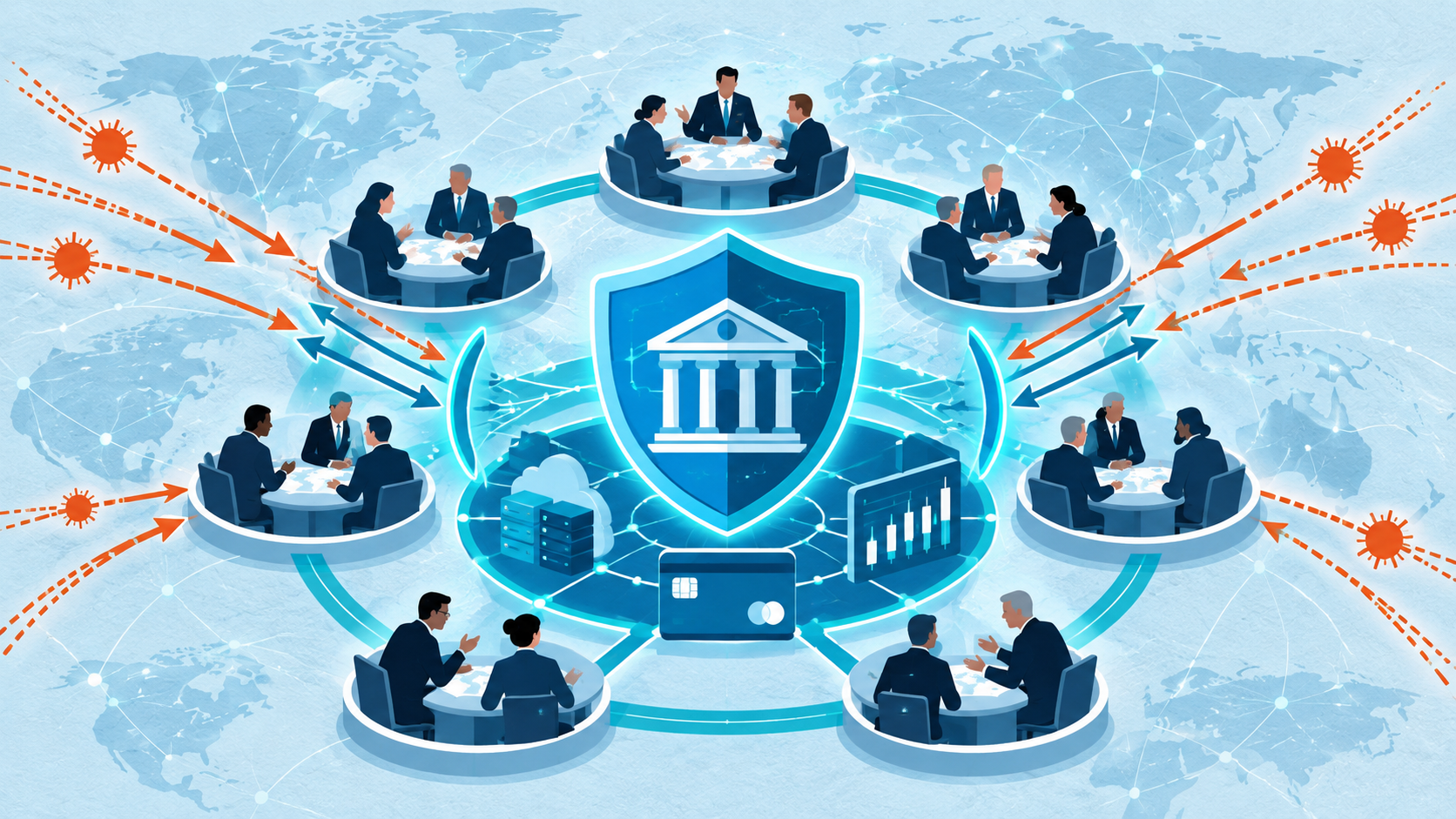
The Group of Seven will run tabletop exercises on artificial-intelligence cyber risks, moving its financial-security work from general warnings toward rehearsed responses. Japan’s finance minister confirmed the decision after G7 finance ministers and central-bank governors met in Bangkok alongside the annual meetings of the International Monetary Fund and World Bank.
In an official October 16 press conference, Finance Minister Satsuki Katayama said the G7 had agreed to conduct tabletop exercises as part of its response to risks created by AI. The public statement confirms the commitment but does not give a date, identify participating private institutions, or describe the attack scenarios.
That boundary matters. The decision is a preparedness initiative, not evidence that an AI-driven attack is imminent or that a new binding standard has been adopted. Its significance lies in what exercises can reveal: whether authorities can communicate across borders, preserve critical financial services, contain disruption, and recover when events move faster than established manuals assume.
From policy discussion to operational rehearsal
The G7 already has a structure for financial-sector cyber cooperation. Its Cyber Expert Group brings together finance ministries, central banks, supervisors, and market authorities. In May, the group simulated a large-scale attack across all G7 jurisdictions, then announced a long-term strategy to increase the frequency and consistency of such exercises.
The official 2026 Cross-Border Coordination Exercise summary says the sessions tested incident response, recovery, and crisis communication. The scenario involved a major attack affecting the financial sector across the seven jurisdictions. Authorities used it to examine how they would coordinate and share information during a disruption with international consequences.
The new AI-focused exercises should be understood as an extension of that operating model. AI changes the pace and scale of cyber risk, while the institutional challenge remains familiar: identify what has happened, decide who leads, protect essential services, communicate without creating panic, and restore systems safely.
A tabletop exercise does not attack live infrastructure. Participants work through a simulated event, make decisions as new information arrives, and compare those decisions with existing protocols. The value comes from exposing gaps before a real crisis, including unclear authority, incompatible reporting formats, slow escalation, missing contact information, and recovery plans that depend on the systems affected by the incident.
Why AI changes the timing of a cyber crisis
The G7’s own statement on AI and cybersecurity identifies several ways AI can reshape financial-sector risk. Malicious actors may use it to find and exploit vulnerabilities more quickly. Increasingly autonomous systems may introduce new weaknesses. Concentration among AI and technology providers can also turn a problem at one company into a disruption affecting many institutions.
Speed is the most immediate operational problem. A process built around analysts reviewing alerts, managers approving actions, and institutions reporting through separate channels may struggle when vulnerabilities are discovered and exploited at machine speed. The first hours of an incident become more important because containment decisions can determine whether a local breach remains manageable or spreads through shared services.
Scale is the second problem. Banks, exchanges, payment systems, insurers, and asset managers often rely on common cloud platforms, software libraries, identity systems, telecommunications networks, and data providers. If AI makes it easier to identify the same weakness across many users, attackers may hit several institutions in a narrow window. That can create correlated outages rather than a series of isolated losses.
The third issue is ambiguity. AI can help produce convincing phishing messages, impersonation attempts, false incident reports, and manipulated media. During a crisis, authorities may have to verify information while markets and the public demand immediate answers. Exercises can test how officials authenticate messages, separate confirmed facts from claims, and coordinate public communication across time zones and languages.
Financial stability depends on continuity and confidence
Cybersecurity is no longer only an information-technology problem for individual firms. The financial system depends on continuous access to payments, deposits, trading, clearing, settlement, and market data. Disruption at a critical provider can affect liquidity and confidence even when direct financial losses initially appear limited.
The IMF’s June analysis of AI and financial-sector cybersecurity argues that AI can increase the speed, frequency, and breadth of vulnerability discovery and exploitation. It highlights shared infrastructure, common service providers, and machine-speed attack and defense as channels through which operational problems can become systemic.
The IMF recommends controls that limit the blast radius of a breach, robust response and recovery capacity, machine-speed defenses, public-private collaboration, and stronger international coordination. Those priorities point toward what a useful G7 scenario should test. Authorities need to know whether essential services can continue in a reduced mode, whether firms can isolate compromised systems, and whether recovery can proceed without reconnecting an infected network.
The Fund’s October Global Financial Stability Report also places cyber incidents among the risks that could disrupt financial services or weaken confidence. Confidence matters because customers, counterparties, and investors react to uncertainty. If they cannot determine whether balances are accurate, payments will settle, or markets will reopen, precautionary behavior can amplify the original technology failure.
The hardest tests cross institutional boundaries
An exercise limited to one bank’s security team would miss much of the systemic risk. Useful G7 drills should connect technical decisions with liquidity management, market operations, supervision, public communication, and international coordination. They should also include service providers whose infrastructure supports several institutions.
One scenario could begin with rapid exploitation of a software vulnerability used by banks in several countries. Participants would need to decide when to disconnect systems, how to authenticate emergency communications, and how to prioritize payments. A second scenario could involve an AI-enabled impersonation campaign that spreads false instructions from an authority. A third could test a failure at a shared cloud or model provider while markets remain open.
Each case raises trade-offs. Disconnecting a compromised institution can contain an attack but also interrupt payments and liquidity. Disclosing technical details can help other firms defend themselves but may assist attackers or create unnecessary alarm. Reopening too early can spread contamination, while remaining offline can deepen economic damage.
Recovery is therefore as important as defense. The G7’s work on reconnection emphasizes assessment, remediation, assurance, and phased restoration after a material incident. Exercises can reveal whether institutions have clean backups, alternative communication channels, manual workarounds, and evidence strong enough to support a safe return to service.
What banks and technology providers should expect
The G7 announcement does not create a direct compliance obligation. It does, however, signal the direction of supervisory attention. Financial institutions should expect questions about AI-specific threat models, third-party dependencies, crisis decision rights, and the ability to operate when normal technology channels are unavailable.
Boards and senior managers will need more than a list of security tools. They should know which services are critical, how long those services can be unavailable, which external providers are irreplaceable, and who has authority to isolate or restore systems. Contracts with cloud, software, and AI providers should support timely incident information and coordinated recovery.
Technology providers also have a role in exercises. A bank cannot test recovery realistically if its most important vendors are absent. Providers may need to demonstrate how they notify customers, separate affected environments, preserve forensic evidence, and restore service when many clients request help at once.
Smaller institutions could face a resource gap. They may use many of the same services as large banks but have fewer specialists and less negotiating power with vendors. Sector-wide playbooks, shared exercises, and clear official communication can reduce that disadvantage. International coordination is also important for emerging markets that rely on infrastructure or providers based in G7 countries.
Analyst’s View
The new exercises matter because they can convert broad concern about frontier AI into observable decisions and measurable improvements. The strongest programs will define what success looks like before a scenario begins: time to detect, time to escalate, continuity of critical services, speed of cross-border notification, and confidence in recovery.
Investors and credit analysts should watch for evidence that exercises change operating practices. Rewritten manuals, tested backup communications, clearer authority, stronger vendor obligations, and remediation deadlines would show that the program is producing more than a policy signal. Repeated exercises should also test whether earlier weaknesses were actually fixed.
The main macro-financial risk is not simply a larger cyber loss at one company. It is a fast, correlated disruption that reaches several institutions through common technology and weakens confidence in payments or markets. G7 coordination cannot remove that risk, but realistic rehearsals can reduce confusion and shorten recovery when defenses fail.
The immediate announcement remains limited: the G7 has committed to tabletop exercises, while the schedule, scenarios, participants, and reporting arrangements are still unannounced. Those details will determine whether the initiative becomes a durable resilience program. The shift from discussing AI cyber risk to practicing a joint response is nevertheless a practical step toward protecting an increasingly interconnected financial system.
