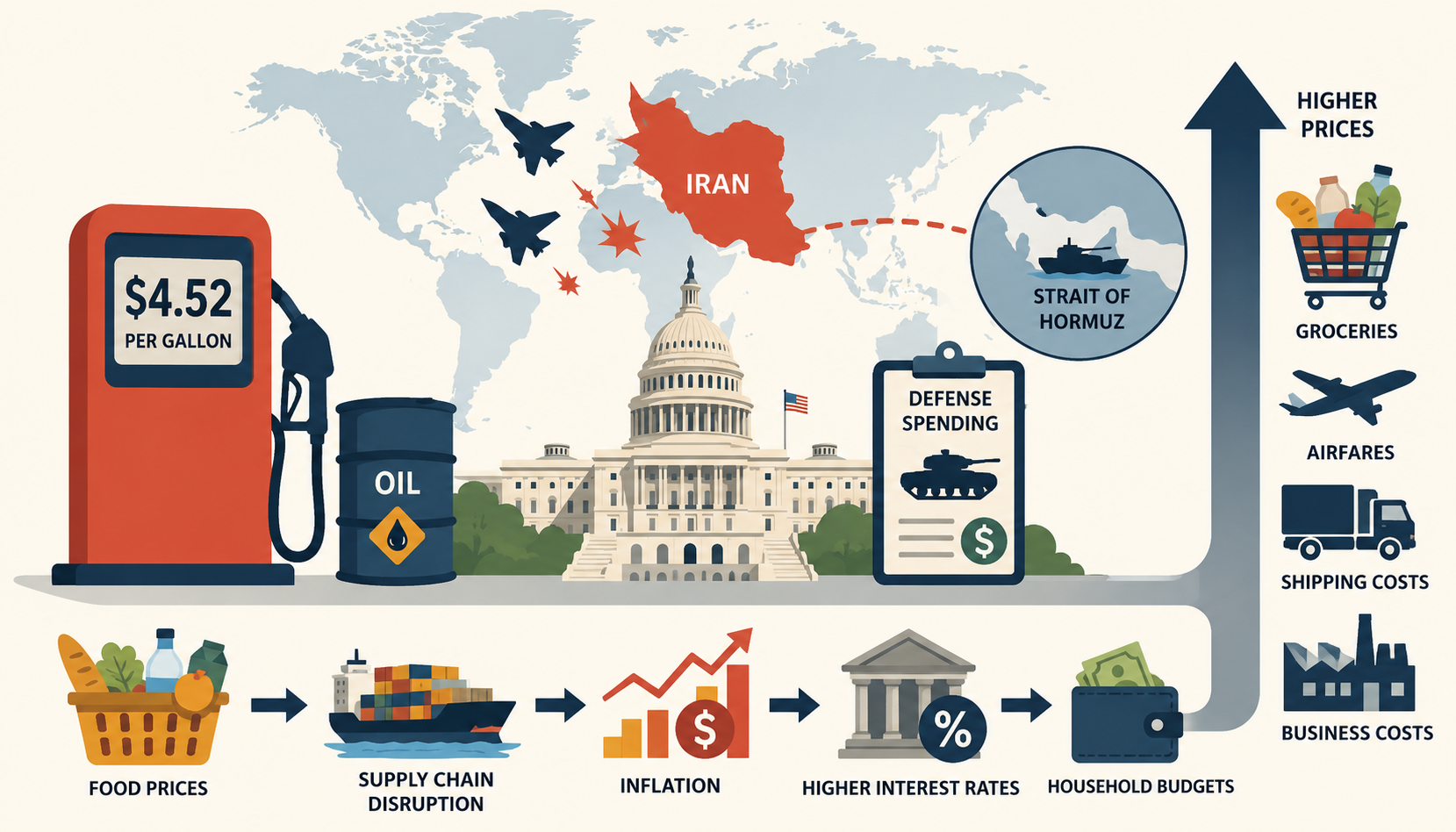
The first signs of the Iran war’s economic cost showed up where Americans always feel a foreign crisis first: at the gas pump. As of May 11, the national average for regular gasoline sat at $4.52 a gallon, the highest level since 2022. But the pump price is no longer the headline. It is the leading edge of a chain reaction now moving through airline balance sheets, grocery aisles, factory floors, bond markets, and the Federal Reserve’s policy room.
Wars rarely arrive as a single line item in a government budget. The Trump administration’s early direct-cost estimate for the Iran campaign sits at roughly $25 billion, a number that sounds large but, as the Financial Times notes, captures only the Pentagon’s invoice. Harvard’s Linda Bilmes calls that figure “just the tip of the iceberg.” Once fuel costs, higher borrowing costs, supply-chain bottlenecks, and lost output are added in, economists tracking the conflict put the true burden into the hundreds of billions.
That gap — between what the war costs the Treasury and what it costs the economy — is the real story.
Fuel: the first transmission channel
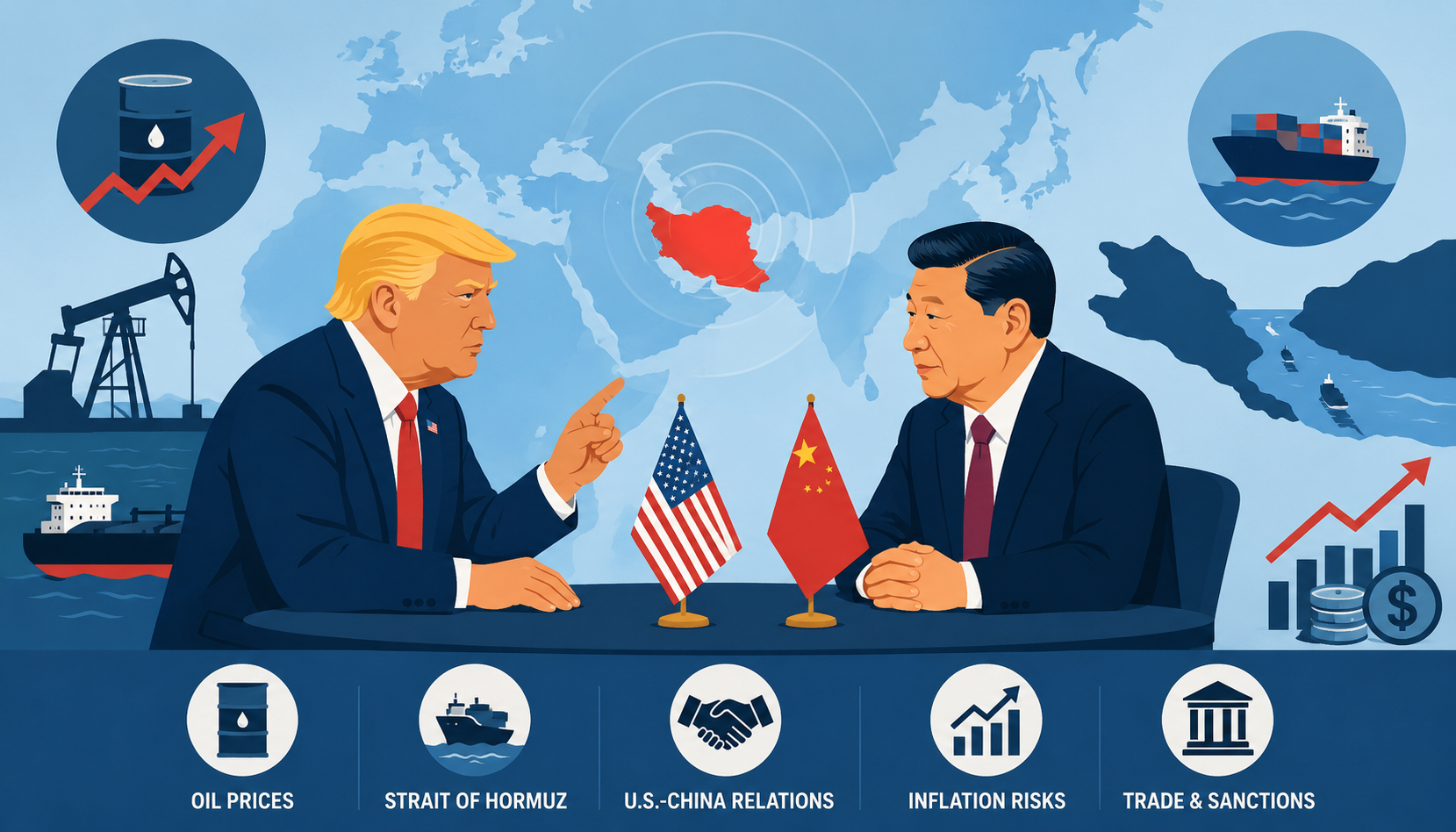
The Strait of Hormuz is the reason a regional war shows up so quickly in American wallets. The chokepoint between Iran and Oman traditionally carries about 20% of the world’s oil. With shipping through the strait effectively paralyzed since the U.S.–Israeli campaign began, every barrel that does not move has to be replaced from somewhere else, at a higher price, and often after a longer voyage.
The shock fans out in three directions. Gasoline hits households directly, and the political pain of $4.52 a gallon is the most visible piece of that. Diesel is the quieter problem: it powers trucking, rail, farm equipment, and construction, which means a diesel spike eventually shows up in food prices, building costs, and the price of almost anything that travels on a highway. Jet fuel is the third pressure point, and it is already drawing blood. Low-cost carriers have asked Washington for a $2.5 billion bailout. Spirit Airlines ceased operations on May 2, with management blaming jet fuel costs for making its restructuring plan unworkable.
A bankrupt airline is not yet a recession. But it is a useful early indicator of which businesses are most exposed when energy stays expensive for longer than their hedges can absorb.
A policy response with real limits
The administration’s first moves have been aimed at the visible price, not the underlying disruption. President Trump has said he supports suspending the federal gasoline tax — 18.4 cents a gallon on gasoline, 24.4 cents on diesel — though any waiver would require Congress to act. The Treasury and Energy Department are also moving on supply: a planned loan of 53.3 million barrels from the Strategic Petroleum Reserve, the federal emergency stockpile held in salt caverns along the Gulf Coast, is now being arranged with energy companies to help calm physical markets.
Both measures will do something at the margin. Neither solves the core problem. Bob McNally of Rapidan Energy Group put the limits of the tax cut bluntly: if Hormuz stays disrupted, “consumers will barely notice.” A gas-tax holiday saves a driver a few dollars per tank. A blocked chokepoint can add far more than that to the cost of every gallon refined from imported crude.
The SPR loan is similarly bounded. Reserves are large but finite, and lending barrels now means smaller buffers later. They buy time, not a solution.
Inflation and the second-round problem
April’s inflation reading made clear that the fuel shock is no longer contained to fuel. Consumer prices rose 0.6% on the month and 3.8% from a year earlier, the biggest annual increase in nearly three years. Energy did most of the heavy lifting in that print. But what worries economists more are the second-round effects — the way an initial energy spike works its way into food, freight, airline tickets, restaurant menus, and eventually wage demands as workers try to recover lost purchasing power.
That process takes months, not weeks. Diesel feeds into trucking contracts that reprice on a lag. Jet fuel feeds into airfare a quarter or two later. Food prices respond to higher input costs through a long chain of intermediate processors. The April CPI captured the first wave. The second is the one that will tell whether this remains an energy story or becomes a generalized inflation problem.
The Fed’s dilemma
For the Federal Reserve, this is the worst kind of inflation: the kind that arrives from outside the U.S. economy and does not respond to interest rates. Higher rates do not produce more oil. Yet allowing fuel-driven inflation to seep into expectations could force the Fed into precisely the kind of demand-crushing tightening it has spent the last cycle trying to avoid.
The benchmark overnight rate currently sits in a 3.50%–3.75% range, and futures markets have pushed the next cut out into 2027. Chicago Fed President Austan Goolsbee captured the institutional mood when he said the war “has just been an inflationary shock” — not yet a stagflationary one. The distinction matters. An inflationary shock is something a central bank can wait out. A stagflationary shock, where inflation rises while output falls, is the scenario every postwar Fed chair has feared most.
Households should read the Fed’s caution clearly: cheaper mortgages and lower credit-card rates are now further away than they were six months ago. That is part of the war’s cost too, even if it never shows up on a Pentagon ledger.
Defense spending: stimulus with a catch
The other side of the ledger is the spending itself. Munitions production, shipyard contracts, and supplemental appropriations move money into specific industrial pockets, and parts of the defense base are running hot. There is a real multiplier effect — the way an initial dollar of government spending circulates through wages, suppliers, and local businesses to generate additional activity.
But every dollar deployed to replace a Tomahawk or expand a missile-defense battery is a dollar not deployed to a bridge, a classroom, or a tax rebate. With the federal deficit already wide and Treasury yields rising, the financing cost of the war is itself part of its economic cost. This is not a moral argument about defense spending. It is an allocation question, and one that becomes harder the longer the conflict runs.
The politics of a price shock
Voters do not experience geopolitics through cable-news maps. They experience it through receipts. With the November midterms now six months out, $4.52 gasoline and a 3.8% CPI print are turning into a domestic political problem for an administration that came into office promising to bring prices down. The pressure to be seen doing something — hence the gas-tax push and the SPR loan — is real, even when the available tools are blunt.
The risk for the White House is straightforward: the longer fuel and food prices stay elevated, the more the public conversation shifts from Iran to affordability. Foreign policy victories are hard to sustain politically when borrowing costs are up, airfares are up, and grocery bills are up.
The temptation in covering a war is to keep score in military terms — strikes launched, ships repositioned, barrels off the market. But the more durable measure of this conflict is going to be economic. The Iran war’s bill is being paid in fuel receipts, delayed rate cuts, airline insolvencies, higher grocery prices, and weaker household purchasing power. Most of it never reaches a Pentagon ledger. That, more than the headline cost estimate, is what makes hundreds of billions of dollars a plausible number — and what makes the next CPI print, not the next strike package, the data point worth watching.