For much of the past year, the working assumption across global markets was simple enough: inflation had peaked, central banks were nearly done, and the next big move in interest rates would be down. This week, that assumption cracked.
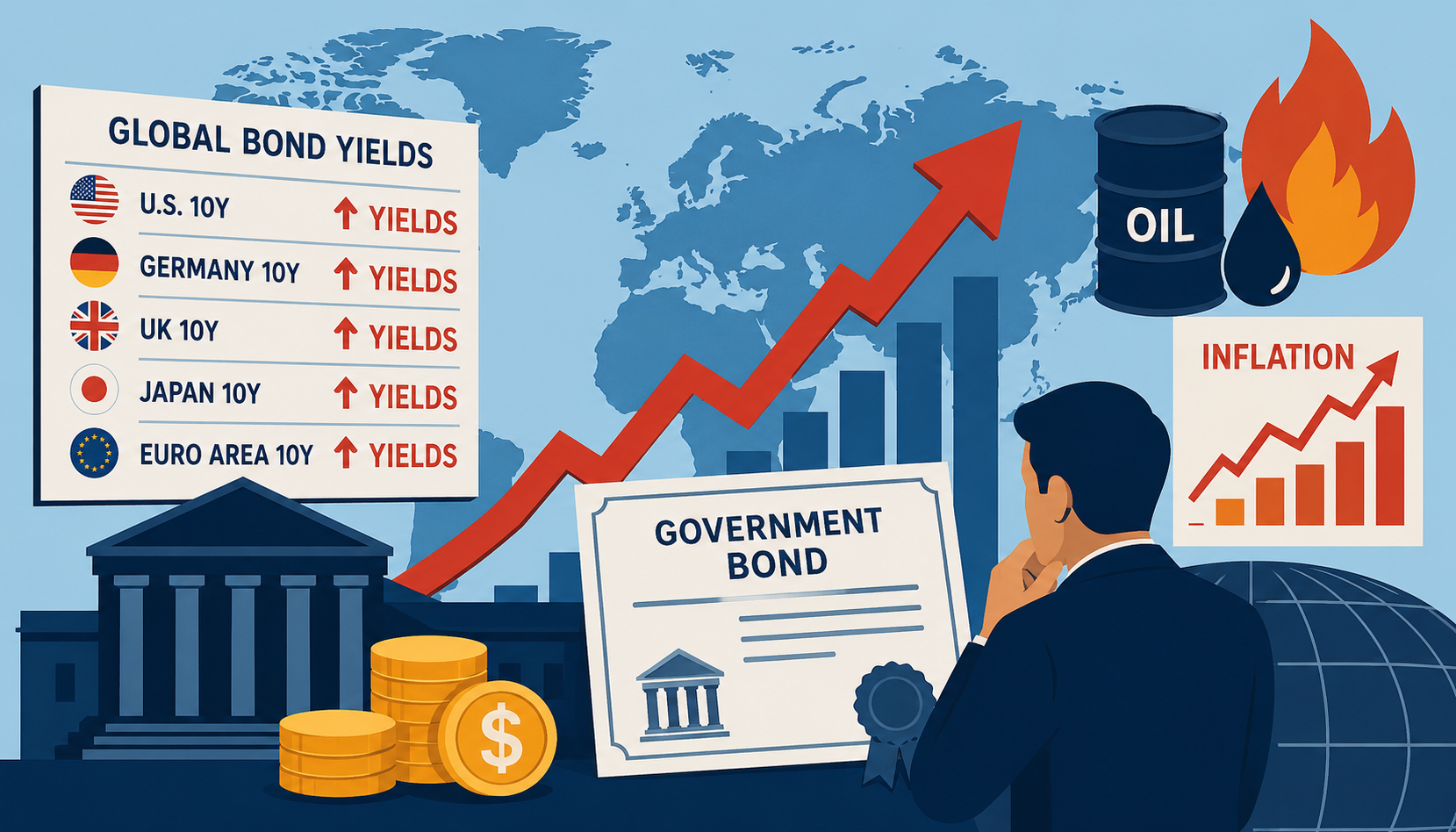
From U.S. Treasuries to German Bunds, from UK gilts to Japanese government bonds, yields climbed in unison. The selloff was sharp enough, and broad enough, that it is no longer plausible to dismiss it as a technical wobble or a country-specific story. What investors appear to be doing is repricing the world economy — and, in particular, repricing the idea that inflation is yesterday’s problem.
The trigger is energy. The deeper issue is something larger: fiscal deficits, central-bank credibility, and the risk premium investors demand to hold long-dated government debt in a world where geopolitical shocks now arrive on a regular schedule.
What actually happened in the markets
A quick refresher for readers who do not live on a trading desk. Bond yields move inversely to bond prices: when investors sell government bonds, prices fall and yields rise. Rising yields then feed into everything that is priced off government debt — mortgages, corporate borrowing costs, government interest payments, and, eventually, equity valuations.
This week, almost every major sovereign bond market moved the wrong way at once.
U.S. Treasury yields pushed to around one-year highs. UK gilt yields reached levels not seen in decades. Japanese government bond yields hit record highs — a notable development in a market that spent years anchored near zero by the Bank of Japan. Italian 10-year yields climbed roughly 11 basis points to around 3.89%, while German Bund yields rose almost 7 basis points to around 3.12%. Across the G7, 10-year yields rose by an average of 17 basis points on the week.
That kind of synchronization matters. When several major sovereign markets sell off together, it usually signals a global macro repricing rather than a story about any single country’s fiscal politics or central-bank meeting. Investors are not adjusting to a piece of U.S. data or a European auction. They are adjusting their view of the world.
The inflation trigger sitting underneath all of it
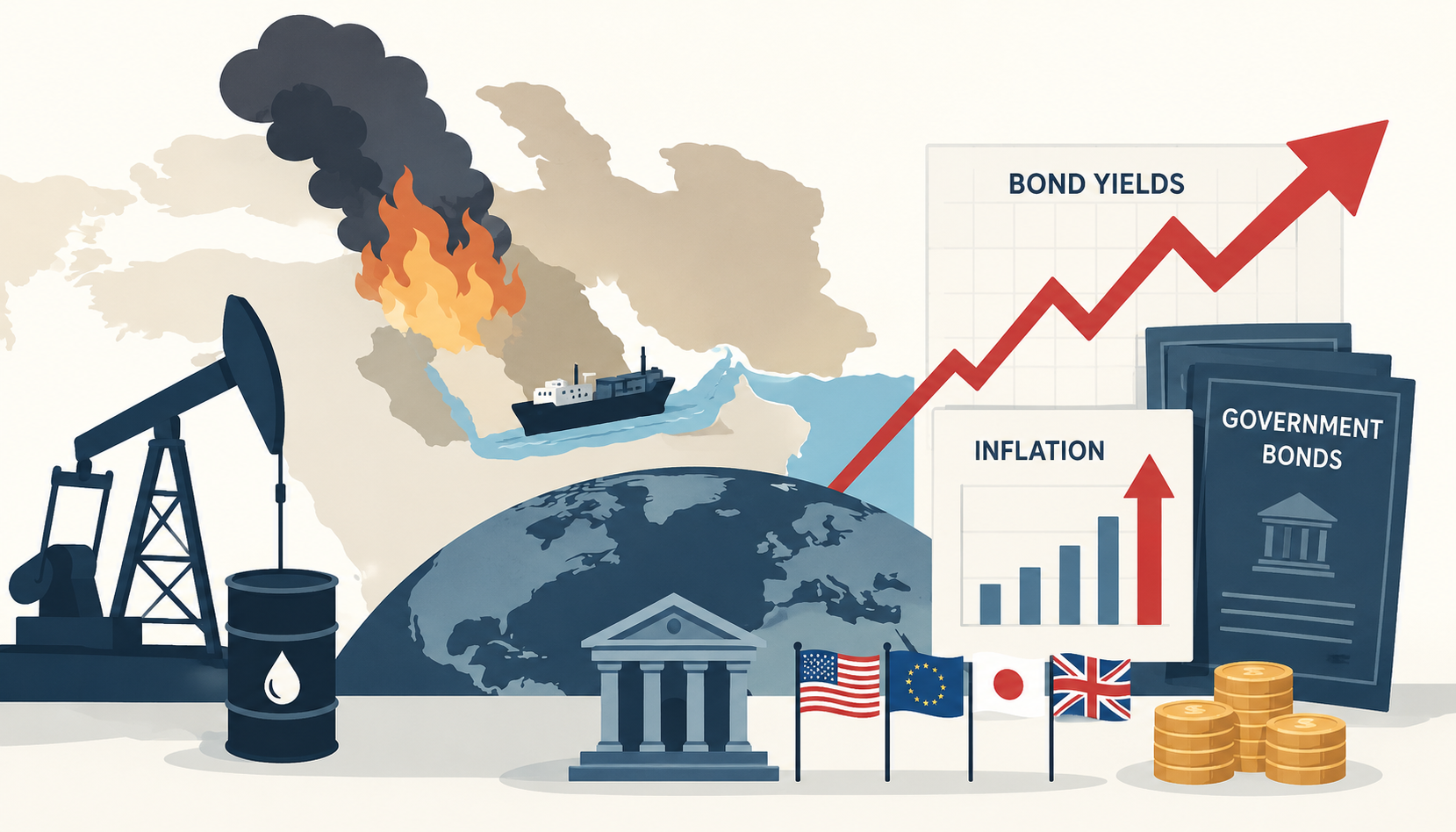
The most direct cause is energy. Crude oil prices have risen by more than 50% since the Iran war began disrupting flows through the Gulf, and that surge is now starting to show up in the price data that central banks watch most closely. Consumer and producer price indicators have been moving in the wrong direction, and inflation expectations — both the survey-based and the market-implied versions — have followed.
Energy shocks are uniquely awkward for central banks. They push inflation up and growth down at the same time. Tightening policy can damp the inflation impulse but risks deepening the slowdown; loosening policy can cushion growth but lets inflation expectations drift. There is no clean answer, which is precisely why bond markets struggle with this kind of shock. The range of plausible policy outcomes widens, and investors demand more yield to compensate for that uncertainty.
This is the practical meaning of the phrase “risk premium.” It is what the market charges for not knowing what comes next.
Rate-cut hopes have quietly evaporated
The most striking shift is in what money markets are now pricing.
Before the Iran war, traders had built in at least two Federal Reserve rate cuts for this year. As of this week, money markets are assigning roughly a 60% probability to a Fed rate hike in 2026 — a stunning reversal in a matter of weeks. According to LSEG data cited by Reuters, only four of the world’s 24 major central banks now have a meaningful chance of cutting rates this year.
That is the regime change. The market narrative has flipped from “inflation is cooling and cuts are coming” to “inflation risk is back, and central banks may need to stay restrictive — or do more.”
It is worth being careful here. Market pricing is not policy. Central banks have not, by and large, signaled an appetite to resume tightening, and they are unlikely to react to a single month of energy-driven inflation data. But the gap between what markets are pricing and what officials have said is itself the news. Either markets are wrong and will reprice back, or central banks will, slowly and reluctantly, be dragged toward a more hawkish stance.
A credibility test for central banks
The Fed, ECB, Bank of England, and Bank of Japan all face a version of the same problem: how to talk about energy-driven inflation without spooking markets further, while preserving the option to act if it becomes embedded in wages and services prices.
The policy dimension is now explicit. Japan’s Finance Minister Satsuki Katayama said this week that recent bond-market volatility in Japan, the U.S., and Britain appeared to be reinforcing one another, and that the issue would likely be on the agenda when G7 finance ministers meet in Paris. It is unusual for a senior finance official to flag global bond volatility as a coordination topic. That alone tells you how seriously policymakers are taking the synchronization.
For the Bank of Japan in particular, the situation is delicate. Record-high JGB yields put pressure on a balance sheet that still holds a vast stock of government debt, and on a yen that has been buffeted by both rate differentials and energy import costs. For the ECB, markets have now moved to price in more than two rate hikes, with the first expected as early as June.
The fiscal dimension nobody wants to talk about
Underneath the inflation story is a less discussed factor: fiscal deficits. Governments across the G7 are running large deficits while inflation is rising — and several are under political pressure to soften the blow of higher energy prices through fuel subsidies, tax cuts, or transfer payments.
The logic of bond markets here is unforgiving. When governments need to borrow more at the same moment inflation is eroding the real value of existing debt, investors will demand higher yields to compensate. That, in turn, raises debt-service costs, which can force further borrowing — a self-reinforcing cycle that the late-1970s and the 2022 UK gilt episode both showed can move faster than policymakers expect.
Analysts at GlobalData TS Lombard described this week’s move as a reset of the global bond risk premium, and that phrase is more useful than it sounds. It captures the fact that what is being repriced is not just inflation, but the entire compensation investors demand for holding long-dated sovereign debt in a more uncertain world.
Cross-asset spillovers
Bonds do not move alone. European equities fell sharply on the same set of fears, with the STOXX 600 down 1.4%, while oil prices gained more than 1%. Tech and growth-heavy indices tend to be especially sensitive to yield spikes, because higher discount rates reduce the present value of future earnings, and because government bonds at 4-5% start to look like a real alternative to equity risk.
Currencies are the other channel to watch. Higher U.S. yields would normally support the dollar, but a Fed forced to confront stagflation risk is a more complicated story. The yen, the euro, and sterling have all been moving on shifting rate expectations rather than on growth signals.
What to watch from here
For readers tracking how this evolves, a few markers are worth following. Oil prices and Strait of Hormuz shipping flows remain the upstream variable — almost everything in this story runs through energy. Incoming U.S. and European inflation prints will tell us whether the energy shock is staying contained or feeding into broader price pressures. Communications from the Fed, ECB, Bank of England, and Bank of Japan will reveal how seriously officials are taking the market’s repricing. Sovereign debt auctions, particularly in countries with stretched fiscal positions, will show whether buyers are still willing to absorb supply at current yields. And the G7 finance discussion will indicate whether policymakers see a need for coordinated messaging.
None of this is yet a crisis. Yields are high, but functioning markets have absorbed them. Credit spreads have widened modestly but are not flashing distress. The point is more subtle: the comfortable assumption that the inflation episode of the early 2020s was a closed chapter no longer holds.
Markets are not predicting another inflation surge. They are doing something more interesting — and arguably more important. They are pricing in the fact that the path back to low rates is no longer a straight line, and that energy, geopolitics, and fiscal policy now sit much closer to the center of the global rate outlook than they did six months ago. For governments, central banks, and investors, that is the warning embedded in this week’s bond selloff. It is not the noise. It is the signal.