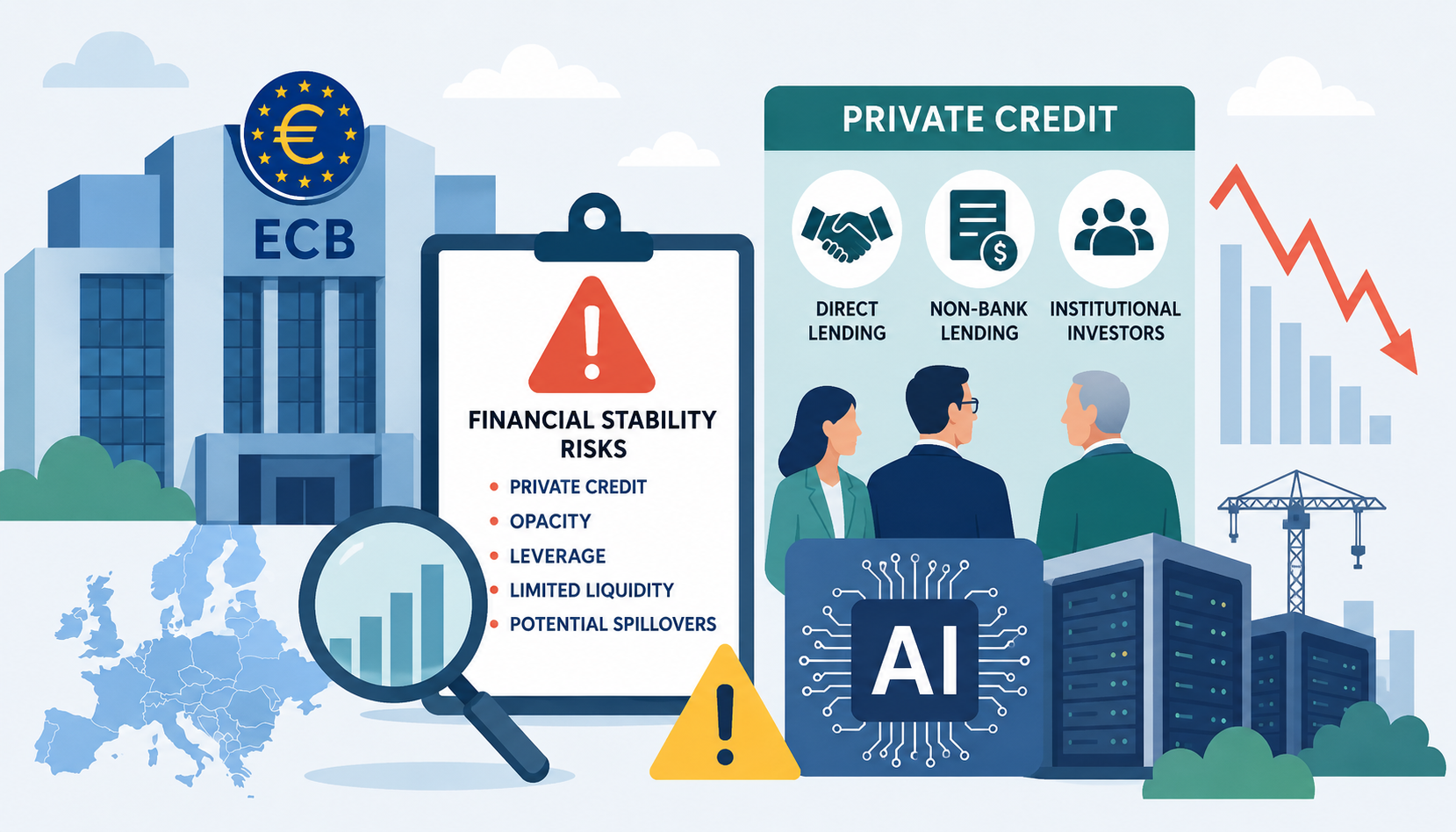
The AI boom is usually framed as a story about chips, data centers, and productivity. The European Central Bank is pointing to a less visible question: who is financing that boom, how transparent are the loans, and what happens if investor confidence turns?
That question runs through the ECB’s May 2026 Financial Stability Review, published on 27 May, and especially through one of its four special features — a dedicated study of how the euro area financial system is exposed to private credit. The ECB’s conclusion is carefully hedged, and worth quoting in full before unpacking it: private credit “in isolation is unlikely to threaten financial stability in the euro area at present.” But the same study spends most of its pages explaining why that reassurance comes with conditions attached.
Why the ECB warning matters now
The trigger for the ECB’s renewed attention was not a euro area event. It was stress in the United States. Since autumn 2025, the ECB’s special feature notes, several defaults tied to private credit — the auto-parts maker First Brands and the subprime auto lender Tricolor among them — exposed how weak underwriting and opacity can pass losses around the financial system. Some of those cases may involve outright fraud. But they also showed how quickly leverage can build up in a part of the market where outsiders see very little.
Then came the redemptions. Through early 2026, US business development companies — semi-liquid vehicles that lend to mid-sized firms — faced sizeable withdrawal requests. Some met them; others capped redemptions at a contractually agreed share of assets. The episode rattled confidence enough to push down the share prices of listed private-market firms, whose fee income tracks the size of the funds they manage.
The AI angle sits underneath all of this. Investors have grown uneasy about private credit’s heavy exposure to the software sector — the largest slice of the IT industry — precisely because better AI models could disrupt the business models of the very software firms that have borrowed. That is the uncomfortable feedback the ECB is flagging: the technology driving the investment boom is also a threat to some of the borrowers financing it.
What private credit actually is
Strip away the jargon and private credit is reasonably simple to describe. It is lending that happens outside both traditional bank loans and public bond markets — typically directly originated, non-syndicated loans from non-bank investors to mid-sized companies that often carry no public credit rating.
The appeal for borrowers is speed and flexibility: bespoke terms, faster execution, less disclosure than a public bond would demand. The trade-off is exactly that lower transparency. Because the loans rarely trade, there is no market price to mark them against, so valuations lean on model assumptions and a fair amount of discretion. The Financial Stability Board, in its own May 2026 report on private credit, put the global market at roughly $1.5–2 trillion in assets at the end of 2024, heavily concentrated in a handful of jurisdictions — and stressed that a market this size has never been tested through a prolonged downturn.
The borrower profile reinforces the point. According to Fitch data cited in the FSB report, private credit borrowers cluster around a single-B credit rating, with around three-quarters reporting EBITDA below $100 million. Reported leverage runs at five to six times EBITDA, but once earnings adjustments are stripped out, UBS Credit Research — also cited by the FSB — puts the real figure closer to seven times. This is lending to small, leveraged, mostly unrated companies, valued largely on judgment.
The AI financing channel
Here is where the AI boom and private credit meet. AI investment — data centers above all — needs enormous amounts of long-dated, capital-intensive funding, and the cash flows that would service that debt lie years in the future and remain genuinely uncertain.
For most of the past few years, big US tech firms funded their AI build-out from their own operating cash flow. That is no longer enough. The BIS bulletin “Financing the AI boom: from cash flows to debt”, published in January 2026, makes the shift its central finding: the scale of anticipated investment will force firms to move from internal cash flow toward debt, with private credit playing a rapidly growing role. The BIS judged the macro-financial risks “moderate” — but tied the boom’s sustainability explicitly to AI firms hitting high earnings expectations, and noted that equity prices have run well ahead of what debt markets are pricing in.
The ECB’s special feature puts a number on the funding gap it could fill. Citing market intelligence, it notes that up to 30% of the roughly $3 trillion that AI data center build-outs are expected to need over the coming years could come from private credit. A BIS Quarterly Review box from March 2026 describes the mechanics bluntly as “shadow borrowing” — obligations economically equivalent to debt but kept largely off hyperscalers’ balance sheets, serviced by data-center lease income and held by private credit funds and other institutional investors.
The ECB’s worry is not that this is happening, but that it could scale fast. If private credit becomes a major AI funding channel and those expected AI cash flows disappoint, the market — and euro area exposure to it — could become a far more material source of credit risk than it is today.
Why non-banks matter
So who holds this risk in the euro area? Mostly not banks.
The ECB’s exposure estimates are the most concrete numbers in the report, and they are reassuringly small in aggregate. Euro area banks’ worldwide private credit exposures total around €62.5 billion — 0.2% of total assets, or 2.5% of equity. Insurers carry roughly €211 billion, about 2.3% of total assets. Pension funds hold around €52 billion, or 1.4%. Private credit funds managed from euro area headquarters held only about €100 billion in assets under management in 2025 — a fraction of US scale, even after growing at an average 14% a year since 2010.
But two caveats matter. First, those exposures are, in the ECB’s words, highly concentrated in a small number of large institutions — so the aggregate masks pockets of real concentration, with insurers in Germany, France and the Netherlands carrying notably more. Second, non-banks are precisely the channel through which a shock would travel. Insurers, pension funds and investment funds can transmit stress through redemptions, forced asset sales, margin calls, and a weaker appetite for high-yield credit — even when their direct private credit holdings look modest.
The ECB ran a deliberately severe simulated shock to test this. The result is instructive. Direct losses on private credit loans themselves stay manageable; banks’ losses never exceed 1.3% of equity, thanks to the seniority of their lending. The damage instead comes in the third stage — broader second-round market revaluations, with a modeled 30% drop in equity prices and heavy outflows from high-yield bond and semi-open private credit funds. That is where insurers and pension funds take the largest hit, driven mainly by their equity holdings. The ECB’s framing here is important: the problem is not the private credit loan book; it is the market reaction to stress in it.
Spillover risk from the United States
This is fundamentally an imported-risk story. Euro area direct exposure is limited, but the euro area is not insulated.
The cross-border links are extensive. Euro area investors send roughly 60% of their private credit allocations to foreign funds, and euro area companies receive about 70% of their private credit funding from non-euro area funds. So sentiment toward US private markets — BDC redemption stress, software-sector defaults, AI valuation wobbles — does not stop at the Atlantic. It feeds into euro area private credit pricing and into high-yield bond markets, where the same borrowers and the same investors often overlap. The transmission is through confidence and market pricing rather than through large direct holdings, which is harder to monitor and easier to underestimate.
Market implications
For market participants, the ECB’s analysis points to a fairly specific watch list. Credit spreads on AI-linked debt are the obvious one — a widening there would be the early signal that debt markets are catching up to the caution equity markets have so far ignored. Redemption terms and gating at semi-open private credit vehicles deserve attention, since liquidity mismatch is where retail-oriented structures are most fragile. US BDC stress remains a useful leading indicator for euro area sentiment. And euro area bank and insurer disclosures on non-bank exposures will matter more as supervisors push for better data.
The scenario worth guarding against is a feedback loop: AI earnings disappoint, private credit marks adjust, risk appetite tightens, financing conditions for AI build-outs deteriorate, and the disappointment becomes partly self-fulfilling. None of that is a forecast. But it is the mechanism the ECB is implicitly asking the market to price.
Analyst’s View
From a country-risk and credit-risk practitioner’s seat, three points stand out.
On credit risk, the real exposure is duration and intangibility, not the AI label itself. The question is not whether a portfolio “has AI exposure” — it is whether lenders have correctly priced long-duration, intangible-heavy projects whose cash flows are genuinely uncertain. Private credit’s valuation practice makes this worse: illiquid loans marked on model assumptions tend to adjust slowly, then abruptly. For anyone running expected-loss frameworks, that argues for treating private-credit-funded AI exposure as a candidate for qualitative overlay rather than relying on smooth, model-driven marks. The absence of a repricing signal is not the absence of deterioration.
On systemic transmission, the channel is non-bank, and so is the blind spot. Euro area banks look well insulated — senior in the capital structure, small in exposure, well capitalized. But insurers and pension funds sit lower in seniority and are the ones the ECB’s stress test flags. The transmission runs through redemptions, forced sales and weaker high-yield appetite, and crucially through concentration: aggregate numbers near 2% of assets are comforting until you remember they are clustered in a few large institutions in a few countries. Concentration risk hidden inside a benign-looking average is a familiar failure mode.
On positioning, the data gap is itself the risk. Both the ECB and the FSB return repeatedly to the same theme: opacity, inconsistent definitions across jurisdictions, and missing fund- and loan-level information mean direct exposures may be underestimated. For risk managers, the practical conclusion is to treat private credit exposure estimates as lower bounds, not point estimates — and to watch the second-round channels (high-yield spreads, fund liquidity terms, listed private-market equity) at least as closely as the direct holdings, because that is where the ECB’s own scenario says the losses actually land.
The ECB’s message is not that the AI boom is dangerous, or that private credit is the next subprime — it explicitly rejects that comparison, noting that private credit leverage is lower, funding longer-term, and run risk smaller than the 2006 mortgage market. The message is narrower and more useful: a fast-growing, opaque market is moving closer to the center of how a generational investment cycle gets financed, and the tools to see inside it have not kept pace. Monitoring, in central-bank language, is rarely an idle word.