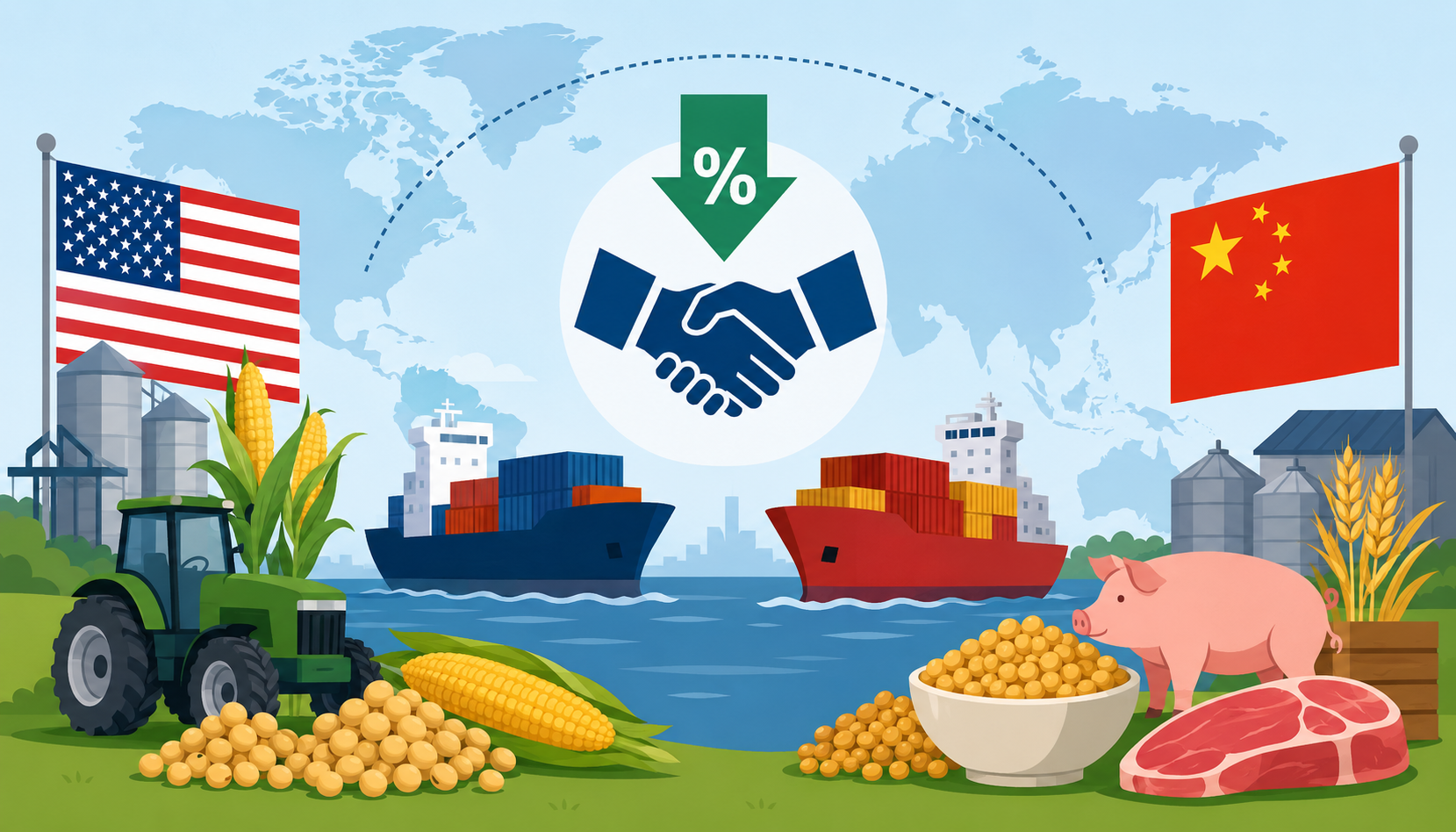
On July 2, 2026, China’s Ministry of Commerce did something it had avoided for most of the trade war: it put agricultural tariffs explicitly on the table. Spokesperson He Yadong told reporters that, following recent consultations, Beijing and Washington had set guiding targets for two-way farm trade and “agreed in principle” to fold relevant agricultural products into a reciprocal tariff-reduction framework (MOFCOM via Xinhua). He added the usual caveat—companies would still trade independently, based on demand and market conditions.
It is a limited signal, not a breakthrough. But for farmers, grain handlers, commodity desks, and anyone modeling China-US supply chains, the direction of travel matters more than the words. A tactical thaw in the most politically loaded corner of the trade relationship could ripple through soybean basis, freight rates, and commodity-linked currencies well before any rate actually changes.
Why agricultural tariffs carry outsized weight
Agriculture is the trade category where politics and economics collide most directly. China is by far the world’s largest soybean buyer, and soybeans alone made up roughly 47% of US farm exports to China in 2024. When that flow stops, it stops loudly: US agricultural exports to China peaked near $41 billion in 2022, slid to about $27 billion in 2024, and then collapsed in 2025 as tit-for-tat tariffs bit (American Farm Bureau Federation). For five straight months last year, China bought no US soybeans at all—an almost unprecedented gap.
The tariff math explains the paralysis. Even after Beijing removed retaliatory duties on 740 US farm commodities in November 2025 (USDA Foreign Agricultural Service), US soybeans still landed in China carrying roughly a 13% duty—a 3% most-favored-nation tariff plus a 10% levy left over from the April 2025 retaliation. Brazilian beans, by contrast, face only the 3% MFN rate. That ~10-point gap is enough to keep private Chinese crushers on the sidelines, leaving state trader COFCO to do most of the buying. Purchases have technically resumed, but they look like policy, not commercial demand.
What the framework signals—and what it doesn’t
The July 2 statement sits on top of an architecture built over the past nine months. The October 2025 Busan truce restarted soybean flows and set purchase commitments—12 million metric tons in late 2025, then at least 25 MMT a year through 2028. The May 2026 Beijing summit layered on a pledge of $17 billion in additional annual farm purchases and what USTR Jamieson Greer called “double-digit billions” of aggregate agricultural buying over three years (USTR). In late June, both sides agreed to stand up a U.S.-China Board of Trade to negotiate reciprocal tariff cuts on roughly $30 billion of “non-sensitive” goods each, with USTR soliciting industry input through a July 10 comment window (MOFCOM via Xinhua).
Read together, this is tactical easing, not normalization. Agriculture is being used as the low-risk release valve—a place where both sides can show progress without touching semiconductors, rare earths, or Taiwan. That is precisely why it moves first, and precisely why it should not be mistaken for strategic reconciliation.
Market channels to watch
Soybeans and grains. This is where confirmation would land fastest. Yet the market is not pricing much optimism today: CBOT soybean futures were hovering near four-month lows around $11 per bushel in late June, weighed down by larger USDA stock estimates, rising 2026 acreage, and a firm dollar (Trading Economics). Corn traded near multi-month lows in the low-$4 range. The early-year data does show a rebound—US soybean exports to China jumped nearly 80% in the first two months of 2026 versus 2025—but off a devastated 2025 base. Notably, China still bought essentially no US corn, wheat, or sorghum for much of the period, so any framework that broadens beyond beans would matter for the grain complex specifically.
Freight, fertilizer, and food inflation. A durable return of bulk China buying would tighten Gulf and Pacific Northwest export logistics, support rail volumes, and feed through to fertilizer demand. The transmission to food inflation is second-order and ambiguous: cheaper access for China does not automatically lower US retail food prices.
Commodity-linked currencies. The clearest FX read-through runs through Brazil. If US soybeans regain Chinese share, the Brazilian real loses a structural tailwind—Brazil now supplies close to 60% of global soybean exports against roughly 22-23% for the US. The Australian and Canadian dollars are more marginal, but sensitive to any broad thaw in China trade sentiment.
The geopolitical ceiling
Here the caution has to be explicit. The détente is partial and conditional by design. Greer has pointedly declined to commit to a specific tariff rate on Chinese goods and has kept open the option to raise duties back toward Busan-deal levels. Ongoing Section 301 investigations—into industrial overcapacity, forced labor, and China’s compliance with the Phase One agreement—could still generate fresh tariffs (USTR). Agriculture can thaw while the technology and security relationship stays frozen. Those two tracks are only loosely coupled.
The Phase One precedent is the cautionary tale. China committed to $80 billion in farm purchases over two years and delivered roughly $60 billion before quietly redirecting demand to Brazil and Argentina. Purchase pledges are political instruments; enforcement is weak, and diversification, once started, tends to stick.
Risks and uncertainties
Three specific gaps stand out. First, the July 2 language is “agreed in principle”—no product list, no rate schedule, no timeline. Second, reversal risk is high, tied to unresolved Section 301 probes and the broader tariff-legal architecture. Third, execution depends on private Chinese buyers, who will not move at scale while US beans carry a ~10-point tariff penalty versus Brazil. Until that spread narrows or the levy is cut, “commitments” and “commercial demand” remain different things.
Analyst’s View
From a country-risk and IFRS 9 standpoint, the July 2 statement is a watch item, not a trigger. It does not, on its own, justify revising any forward-looking assessment.
Credit risk. Lower tariffs would improve revenue visibility for US agribusiness exporters, grain handlers, rail freight, fertilizer, and farm-equipment names. But the prudent base case discounts the headline numbers heavily: the $17 billion and 25 MMT figures are non-binding pledges, and the current buying is state-directed (COFCO) rather than durable private demand. In ECL terms, this belongs in the scenario narrative, not the central forecast—until bookings and shipments confirm it. Treat COFCO-led purchases as a weaker signal of underlying cash-flow strength than headline volumes imply.
Sovereign and country risk. The genuinely useful signal is institutional: the two sides are now managing friction through standing channels—a Board of Trade and a consultation mechanism—which modestly lowers the near-term tail risk of a renewed tariff spiral. That is marginally supportive for emerging-market sovereigns and corporates plugged into the China-US corridor. But structural rivalry remains the dominant factor, and agriculture is explicitly the low-stakes lever. Reversibility is high; the correct posture is Chesterton’s caution in reverse—don’t tear down your risk premium because the release valve opened.
Market positioning. The payoff profile is asymmetric. Soybeans and grains sit near multi-month lows with commitments providing a soft floor, so downside looks contained—while upside is gated entirely on concrete implementation: a published product list, a defined rate cut, a credible timeline. The market is currently discounting the political noise, which is rational given how little is binding. The trade to watch is not the announcement but the confirmation—specifically, the first sign that private Chinese crushers, not just COFCO, re-enter at the tariff-adjusted price. That is the moment the framework stops being rhetoric and starts being flow.