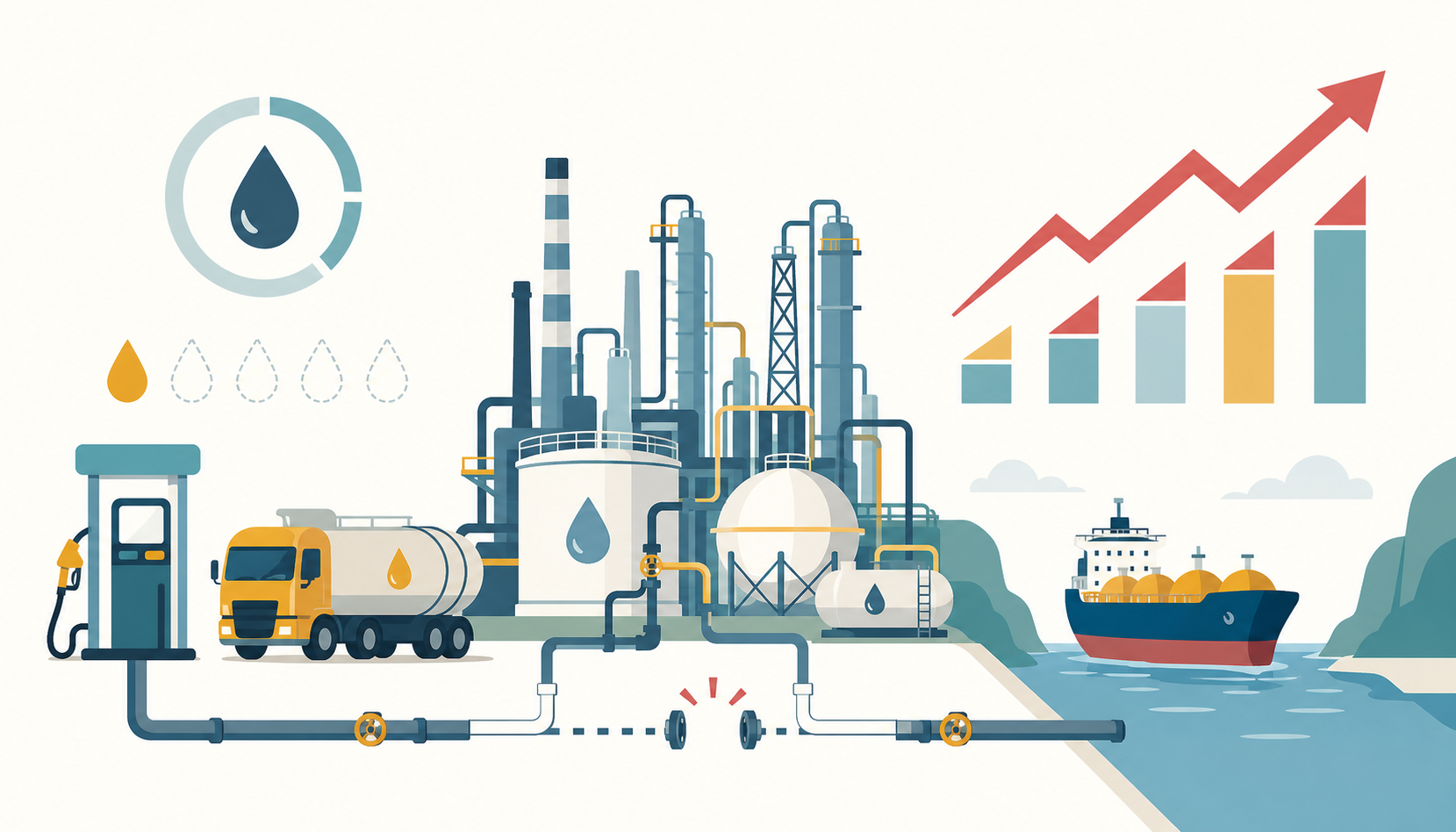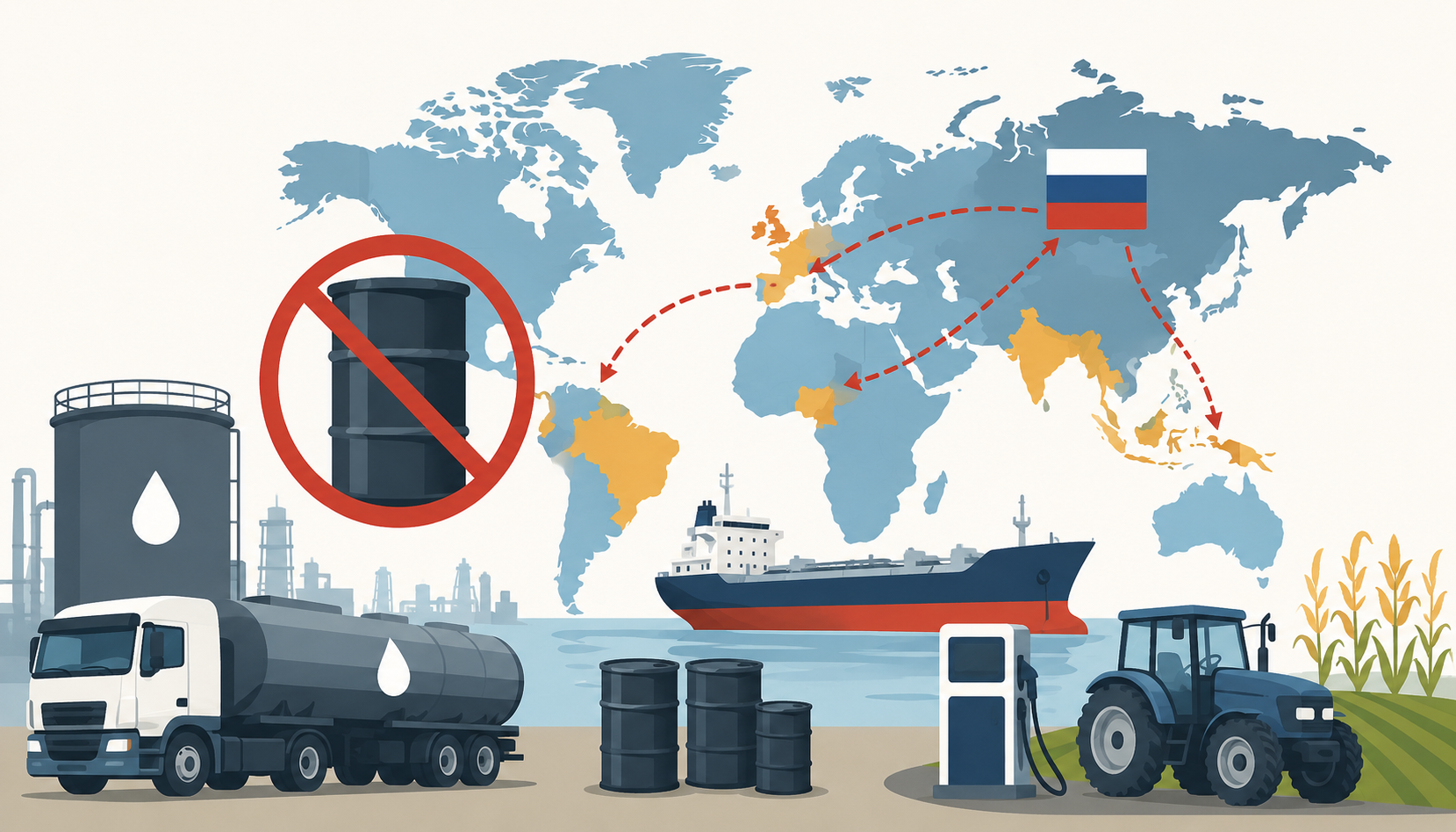
Russia extended its diesel export ban to fuel producers on 8 July 2026, removing the last domestic barrels that were still reaching international buyers and adding a fresh supply shock to a middle-distillate market already strained by the aftermath of the Gulf conflict. The measure took effect the same day, under government Resolution No. 854, and is scheduled to run until 31 July. Deputy Prime Minister Alexander Novak announced it at a televised government meeting chaired by President Vladimir Putin, describing it as one of a “raft of measures” to support the domestic market after sustained Ukrainian drone strikes on refineries triggered shortages and refuelling queues across several Russian regions (Reuters via U.S. News).
The immediate question is not only how much diesel disappears from world markets, but which importers and fuel-intensive sectors will absorb the replacement cost — and whether the ban stays confined to three weeks.
What Russia Actually Announced
Russia has run a temporary diesel export restriction since late January 2026, but until now it applied only to non-producers such as trading firms. Wednesday’s step extended the ban to producers themselves, closing the channel that had kept refiner-owned cargoes flowing abroad (TASS). Novak said the move would “increase supplies to the domestic market.” Russia’s official statement carved out one exemption: diesel exported under international intergovernmental agreements is not covered — a provision that preserves supply to certain partner states and allied trade blocs.
Two details matter for anyone modelling the impact. First, the ban is dated, not open-ended: the current end point is 31 July. Second, it is bundled with other emergency steps — Moscow has said it will begin importing fuel from Asia and has authorised refiners to produce lower-specification Euro-3 gasoline to plug domestic gaps. Gasoline output was already down roughly 25% against the June 2025 average, according to Reuters reporting.
How long the restriction lasts is unresolved. Russia imposed a comparable ban in 2023 and later extended it. Analysts at Kpler expect this one to be short-lived given the revenue Russia forgoes by not exporting, but that is a projection, not a scheduled outcome (CNN). The scale of refinery damage argues for caution: the IEA notes Russian refinery throughputs have been curtailed by the strikes, and reporting through early July indicates that all of Russia’s largest refineries have been hit at least once.
Why the Market Was Already Tight
Diesel is the workhorse fuel of the physical economy. It moves freight, powers tractors and combines, runs excavators and mining equipment, and supplies backup and off-grid generation. Diesel sits within the “middle distillates” — the mid-boiling-range refinery cut that also includes jet fuel and heating oil. The profitability of turning crude into that cut is measured by the “diesel crack,” the spread between the diesel price and the crude oil price; a wider crack signals product scarcity relative to crude.
That scarcity is exactly what the market is pricing. Russia supplied roughly 11% of global diesel in 2025 and ranks as the world’s second-largest diesel exporter, according to data compiled by Bloomberg from Vortexa (Bloomberg; OPIS). Much of that supply had already vanished before the formal ban. Russian seaborne diesel and gasoil exports fell about 39% month-on-month in June to roughly 1.8 million metric tons, down 46% from a year earlier, while Vortexa data via OPIS put average exports at around 480,000 barrels per day over 1–25 June, roughly 53% below the same period in 2025 (Global Banking & Finance / Reuters).
The ban lands on top of a distinctive market condition. In its July report, the IEA described a disconnect between apparently well-supplied crude markets and tight product markets, with refined-product cracks and refinery margins reaching four-year highs in early July as crude prices fell while product markets stayed tight. Global refinery runs rose in June but remained about 6 million barrels per day below a year earlier, with Middle East export refineries yet to restart and Russian throughputs curtailed (IEA Oil Market Report, July 2026). The backdrop is the Gulf crisis: the United States and Iran signed a memorandum of understanding on 18 June to end the conflict and reopen the Strait of Hormuz, but flows are recovering slowly and unevenly, and renewed exchanges of fire have kept the truce fragile (EIA Short-Term Energy Outlook, July 2026).
Inventories offer little cushion. U.S. distillate stocks fell by 5 million barrels in the week to 3 July, to 103.6 million barrels — against expectations for a small build — leaving them roughly 8% below the five-year average and pushing U.S. diesel futures up close to 10% on the day of the release (EIA Weekly Petroleum Status Report; Hydrocarbon Processing).
Where the Shock Travels
The most direct exposure sits with the buyers who had continued to take Russian barrels. In June, Turkey and Brazil were the dominant destinations, together absorbing at least half of available cargoes, with Morocco, Egypt and Senegal also emerging as significant importers (Reuters). These markets now compete for replacement cargoes from a shrinking pool.
Europe is exposed more indirectly. Domestic refining covers around 80% of EU demand, and North American refiners — mainly on the U.S. Gulf Coast — raised diesel and gasoil exports in the spring, with much of that volume directed to Europe, Africa and Asia. The pressure on Europe therefore arrives through globally elevated benchmark prices rather than through a direct loss of Russian supply, which Europe had already re-sourced. That benchmark moved sharply: the European diesel margin reached a record near $60/barrel after the ban was announced.
Inflation and Monetary-Policy Channels
Higher diesel prices feed inflation through freight and distribution costs, agricultural transport, and construction and mining expenses, and can lift consumer prices and inflation expectations. The observed European data already reflect the war-driven run-up: EU diesel prices rose about 29% year-on-year in May 2026, after a 33.7% jump in April, though on a monthly basis diesel had eased 5.8% in May as Gulf flows began to recover (Eurostat). The Russian ban risks interrupting that easing.
The projected path is where the policy tension lies. The European Commission’s spring forecast framed the shock as one that spreads progressively — hitting agriculture, distribution and transport first, then broadening — and warned that the ECB and most EU central banks would tighten or delay planned easing in response (European Commission, Spring 2026 Economic Forecast). Those are forecasts conditioned on the pace of supply normalisation, not settled outcomes; the incremental inflation attributable specifically to a three-week Russian diesel ban cannot be cleanly isolated from the larger Gulf shock.
Corporate and Sovereign Risk
On the credit side, the sensitivity concentrates in operators that consume diesel heavily and have limited pricing power: trucking and logistics firms, agricultural producers, construction companies, miners, and independent fuel distributors. The severity depends on hedging, contract pass-through clauses, operating leverage, and access to alternative suppliers. Larger integrated players with fuel-surcharge mechanisms pass costs through; smaller operators with fixed-price contracts absorb the squeeze in working capital and margins.
On the sovereign side, the burden falls on net fuel importers, particularly those that cap retail prices. Turkey has been managing the pass-through through Finance Minister Şimşek’s sliding-scale special consumption tax (ÖTV), which absorbs part of the price rise at fiscal cost. Brazil layered additional diesel and gasoline subsidies through Provisional Measure 1358/2026 in May, on top of an existing framework (IRU). The greatest vulnerability sits with economies that combine thin foreign-exchange reserves, weak currencies, large transport-fuel import bills and limited fiscal space — a group for which country-level conclusions require verified trade and reserve data rather than assumptions from past trade patterns.
Scenarios to Monitor
A brief interruption that ends on 31 July, with Russian refinery repairs progressing, would leave a price spike but limited structural damage. An extension — the 2023 precedent — would force sustained rerouting and keep cracks elevated into the autumn harvest and heating season. A partial resumption under the intergovernmental-agreement exemption would soften the headline loss while leaving spot-market buyers short. Additional refinery or shipping disruption, whether from further strikes on Russian infrastructure or renewed Hormuz interference, would compound the shock. A supply response — higher runs from U.S. Gulf, Indian and Middle East refiners as Gulf capacity restarts — would ease it. The relative probabilities are not fixed, and assigning them without named forecasts would overstate what the current data support.
Analyst’s View
For credit, the transmission runs through fuel-intensive borrowers with weak pass-through. Monitor trucking, agriculture, mining, construction and independent distribution names for margin compression and working-capital strain; the differentiator is contractual pass-through and hedging, not sector alone. For sovereigns, the exposure is fiscal as much as external — subsidy and tax-buffer mechanisms convert a price shock into a budget line, and the pressure point is reserve-constrained importers running retail price controls. For market positioning, watch the crude-to-product divergence directly: diesel cracks and regional gasoil margins, physical cargo premiums into Turkey, Brazil and West Africa, refinery utilisation, and distillate inventories. Widening cracks alongside falling inventories and rising physical premiums would confirm the shortage is deepening; narrowing cracks as Gulf refineries restart and Russian repairs progress would signal it is easing. This is a diagnostic to track, not a trade to recommend.
The dating of the ban is the variable that matters most. A three-week interruption is a price event; an extension into a market with four-year-high cracks and multi-year-low distillate inventories is a structural one.