Israel’s War Trauma Puts Mental Health Under Strain
Israel is confronting a mental-health burden that will outlast any immediate military phase of the conflict. Repeated exposure to violence, bereavement, displacement, reserve duty, and air-raid alerts has affected families, workplaces, schools, and public services. The hardest cases involve people directly exposed to the October 7 attacks, combat, captivity, or missile fire. The wider effect reaches far beyond those groups.
A recent Nikkei report, supplied as the source for this article, described a health system under pressure and cited estimates that a substantial share of Israel’s population may be coping with depression, anxiety, or post-traumatic stress symptoms. Those estimates should be read as assessments of need, not as a clinical count of diagnosed illness. The more firmly documented point is that Israel’s public institutions have expanded trauma services and continue to treat the psychological effects of the conflict as a national policy issue.
The Israeli Ministry of Health says that the events of October 7 left a lasting impact on people directly affected, including residents near Gaza, festival participants, and families of those killed or taken hostage. It describes common trauma reactions such as sleep problems, intrusive thoughts, anxiety, difficulty concentrating, and detachment. It also warns that persistent symptoms can develop into post-traumatic stress disorder, or PTSD, and that recovery follows no uniform timetable.
This is a social issue as much as a clinical one. When stress persists across a large population, the cost appears in missed work, interrupted education, family strain, lower productivity, and heavier demand on health and welfare systems. Israel’s challenge is to make care available early enough to reduce long-term impairment while preserving support for people whose needs become more complex over time.
Demand does not end when the emergency does
Trauma care has a different rhythm from emergency medicine. An attack, a missile strike, or a period of combat creates an immediate need for safety and crisis support. Psychological effects can emerge later, after a person has returned to work, military service, school, or family life. Some symptoms improve with time and social support. Others persist, worsen, or become harder to treat when care is delayed.
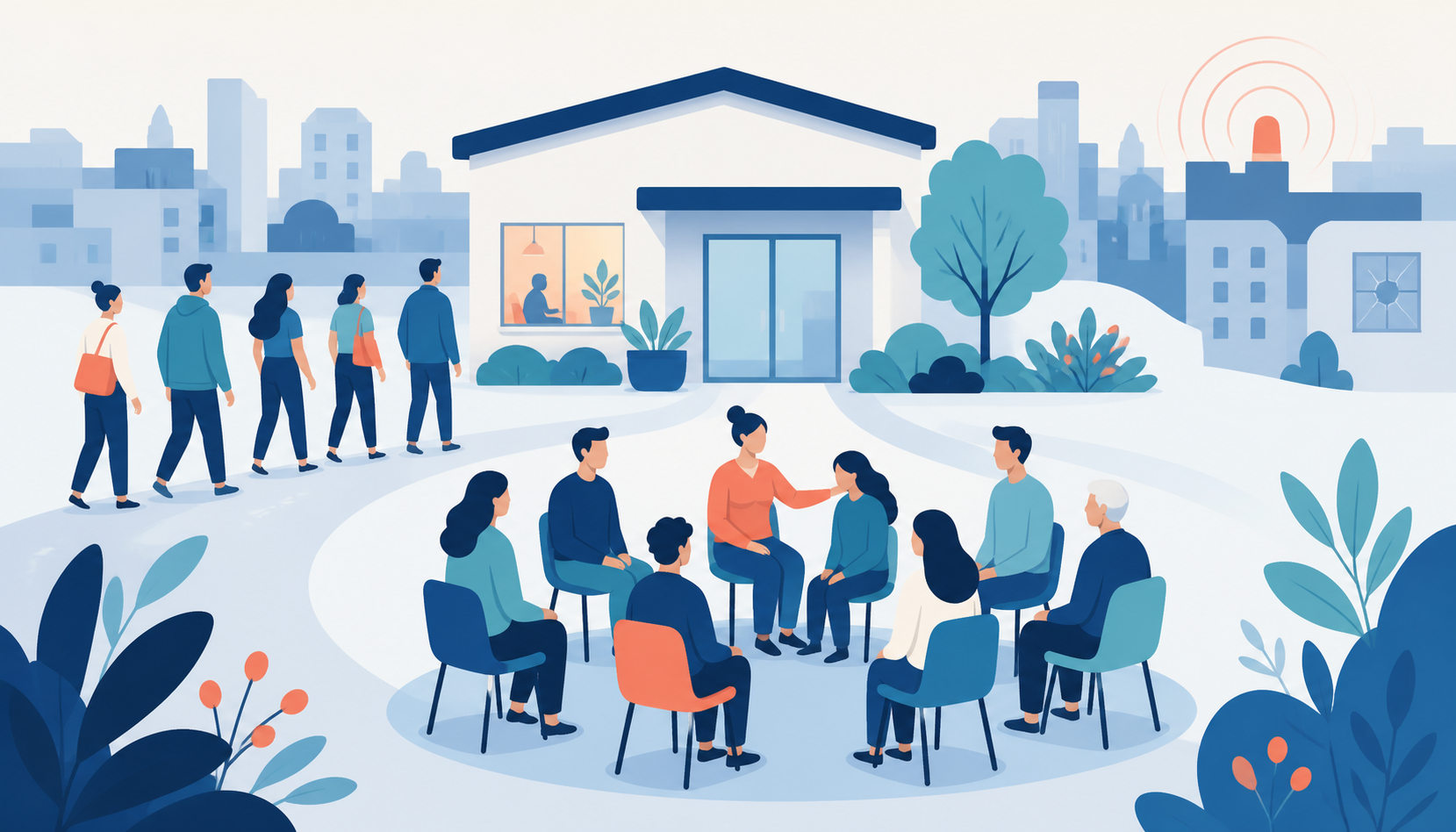
The Ministry of Health reports that 16 trauma-focused intervention and coping centers were established across Israel after October 7. These centers are operated by community mental-health providers and offer professional treatment, family and individual support, services for children and young people, support for evacuees, and training for professionals. The ministry also says insured people can receive an annual allocation of treatment sessions through their health funds, with the quota increased when needed.
That infrastructure matters because it moves the response beyond one-off crisis counseling. A durable system needs multiple entry points: primary-care doctors, health-fund clinics, specialist trauma centers, community organizations, hotlines, and services for people affected by violence or bereavement. It also needs enough clinicians, clear referral paths, and support for families that may be carrying care responsibilities at home.
The ministry’s guidance is careful about the difference between distress and diagnosis. Many people experience strong reactions after trauma without developing a lasting disorder. That distinction protects against treating every emotional response as illness. It should not be used to minimize the need for care. Persistent sleep disruption, avoidance, flashbacks, depressed mood, and impaired concentration can undermine daily functioning even when a person has not received a formal diagnosis.
The wider social spillovers
The supplied Nikkei report pointed to concerns about drug overuse, road safety, and domestic violence. Causation is difficult to establish in any individual case, and social problems have several drivers. Still, official records show that some stresses intensified during the war period.
In June 2024, the Knesset Committee on the Status of Women and Gender Equality discussed an increase in domestic-violence reports. The committee said the Ministry of Welfare and Social Affairs received 4,565 complaints between October 2023 and April 2024, compared with 2,760 in the corresponding period a year earlier. The same discussion noted concern that shelter use and calls to a dedicated welfare hotline had fallen, which can complicate interpretation of reported cases. Fewer requests for formal help do not necessarily mean lower need.
The policy lesson is that mental-health services cannot operate in isolation. A person experiencing trauma may first appear in a school, a workplace, a family clinic, a welfare office, or a legal service. Effective prevention requires professionals in those settings to recognize distress and know where to refer someone. It also requires a response that protects people at risk of violence without assuming that trauma itself causes violence.
War-related stress can affect economic decisions as well. Households facing uncertainty may postpone spending, move savings into more liquid forms, or reduce mobility. Employers may encounter higher absenteeism, lower concentration, and difficulty retaining staff. Small businesses are particularly exposed when owners or employees are called into reserve service or when customers avoid areas affected by security alerts. These are not abstract macroeconomic channels. They accumulate through individual disruptions.
A capacity problem, not only a funding problem
Increasing the mental-health budget is necessary, but it is insufficient on its own. Trained clinicians cannot be created instantly, and people in acute distress may struggle to navigate complex eligibility rules. Waiting times can reduce the value of early intervention. Service design therefore matters alongside funding.
Israel already has several elements of a broader response. Its health ministry describes support through health maintenance organizations, community clinics, trauma centers, resilience centers, and helplines. For survivors of the October 7 festivals and parties, the ministry describes trauma-focused treatment and coordinated support through government agencies and the National Resilience Center. These programs recognize that exposure, age, bereavement, displacement, and family circumstances can shape the care needed.
The question is whether this framework can keep pace if demand lasts for years. Health systems often manage the first wave of need with emergency funding and public attention. The more difficult phase begins when headlines move on while patients still require therapy, medication management, rehabilitation, employment support, or family services.
Continuity of care becomes especially important for veterans and reservists. Returning from service can involve a delayed adjustment to civilian life, while repeated mobilizations can interrupt treatment and employment. Children and adolescents require a different approach because trauma can affect learning, behavior, and family relationships. Older people, people with previous mental-health conditions, and communities that have experienced repeated displacement may also need targeted outreach.
Health, security, and social resilience
The World Health Organization says that violence since October 7 has continued to affect Israel’s population through physical and mental trauma. Its framing is useful because it places mental health within the wider protection of civilians and health services. Care systems need to remain accessible during periods of insecurity, and health workers need protection and practical capacity to continue operating.
For Israel, the stakes are institutional. A country can maintain strong emergency response capacity while still struggling with the long tail of trauma. The success of the response will depend on whether treatment is available before symptoms become chronic, whether services reach people outside the most visible survivor groups, and whether welfare, education, employment, and health agencies coordinate their work.
The political environment makes this harder. Public attention can focus on immediate security objectives, while people experiencing psychological distress may delay care because of stigma, exhaustion, cost, or the belief that others have suffered more. Those barriers make low-threshold services and confidential referral routes important.
Analyst's View
**Credit risk:** The longer mental-health needs persist, the more pressure may fall on healthcare providers, insurers, employers, and public budgets. Analysts should distinguish temporary emergency spending from the recurring cost of treatment, rehabilitation, and lost labor participation.
**Sovereign risk:** War-related trauma is a medium-term capacity issue for the state. The policy test is whether services can be sustained after emergency programs expire and whether support reaches displaced communities, reservists, young people, and families facing violence.
**Market positioning:** Companies operating in Israel should treat employee mental health and continuity planning as core operating risks. Access to care, flexible work arrangements, reserve-duty coverage, and clear crisis referral processes can affect retention, productivity, and business resilience.
The mental-health effects of war do not follow a single timeline. Israel’s public response has expanded, and that is meaningful. The harder task is to sustain access, measure unmet need carefully, and build support systems that remain available when immediate crisis conditions give way to long recovery.