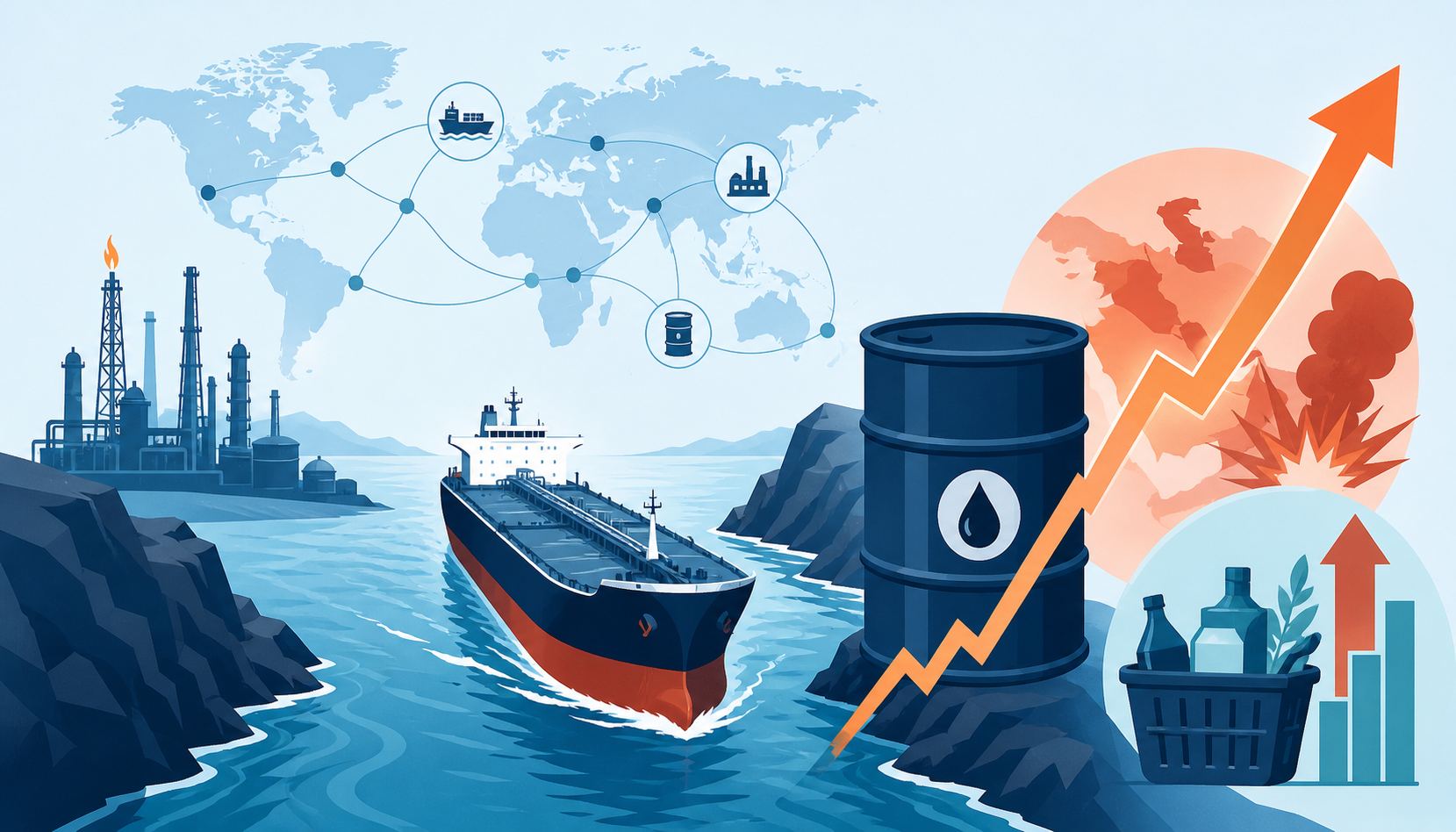
On 21 June, oil prices fell after talks between the United States and Iran improved expectations that shipping could resume through the Strait of Hormuz. The immediate market move was a relief after months in which restricted tanker traffic had turned a regional conflict into a global energy and inflation problem. It was also conditional. The economic gain depended on ships actually moving safely and regularly through the passage.
The June agreement aimed to reopen the Strait and provide a basis for a lasting peace, according to the White House. Reporting on 21 June showed tanker traffic starting to pick up and oil settling more than 3% lower as the talks eased supply concerns. The message from the market was straightforward: a credible path back to navigation can remove part of the risk premium built into crude and fuel prices.
The scale of the disruption explains the reaction. The International Energy Agency said flows through Hormuz had fallen from roughly 20 million barrels a day before the conflict to an average of 2.7 million barrels a day in March, April and May. It described the episode as the largest oil-supply disruption in the market’s history. The IEA also said cumulative supply losses from Middle Eastern producers had exceeded 1.3 billion barrels by late June.
Hormuz is a narrow passage, yet it connects producers in the Gulf with customers across Asia and elsewhere. Its economic role reaches far beyond crude oil. Restrictions affected petrochemical feedstocks, liquefied petroleum gas, diesel and jet fuel. Those products move through different supply chains and have different inventory buffers. A lower crude benchmark therefore did not guarantee an immediate return to normal prices for airlines, trucking fleets, factories or households.
A market moving on probability, not certainty
The agreement changed the outlook because it improved the probability of regular transit. It did not restore normal flows on the day it was announced. A shipping route reopens in stages. Vessel owners need to assess security, crews need instructions, insurers need to price the risk, and buyers need confidence that cargoes can arrive on schedule. A memorandum can move prices quickly because it changes expectations. Physical barrels take longer to move.
That distinction matters for interpreting the June 21 sell-off in oil. The price decline reflected a reduced fear of a prolonged interruption, rather than proof that the supply shock had ended. The IEA subsequently reported signs that exports had increased after the agreement, while continuing to stress that regular and unimpeded shipping was the lasting solution. Traders, refiners and governments still had to plan for setbacks.
The Federal Reserve’s decision on 17 June showed why the energy channel was already relevant beyond commodity markets. The FOMC kept its target range at 3.5% to 3.75%. Its statement said inflation remained elevated relative to the 2% goal, partly because supply shocks had raised prices in sectors including energy. The committee also cited elevated uncertainty linked in part to the Middle East conflict.
For central banks, a shipping disruption is awkward. Higher energy prices can raise headline inflation even as expensive fuel weakens demand. That leaves policymakers judging whether the shock is temporary, whether firms pass it through to broader prices, and whether inflation expectations move. A decline in crude after diplomacy eases one pressure, but the policy benefit becomes more convincing only when refined-product availability and transport costs improve as well.
Buffers bought time, but they were finite
The world did not face the full force of the physical shortfall at once. Before the conflict, the IEA estimated a global oil surplus of 3.7 million barrels a day for 2026 and global storage of 8.2 billion barrels. That cushion gave the system time to adjust. IEA member countries also agreed to release 400 million barrels from emergency stocks, the agency’s largest such release.
Other adjustments followed. Saudi Arabia increased exports through its East-West pipeline to the Red Sea port of Yanbu. The IEA said those exports rose from 2 million barrels a day before the conflict to more than 5 million barrels a day in early June. The United Arab Emirates used the Habshan-Fujairah pipeline, which bypasses Hormuz and can export 1.8 million barrels a day. Producers outside the Middle East increased shipments toward Asian markets, while refiners changed crude slates and consumers reduced demand.
These measures limited the damage; they did not make the Strait dispensable. Pipelines, stored oil and emergency releases are valuable buffers, but each has a capacity limit. They also solve the crude problem more readily than the shortage of refined fuels. The IEA noted that diesel and jet fuel were particularly exposed. A refinery can receive alternative crude and still face difficulties replacing product cargoes or matching the specifications required in its market.
The burden was uneven. Asian importers normally receive much of the oil and gas that passes through Hormuz, so disruptions quickly fed into their energy-security calculations. The IEA’s 16 June assessment of Southeast Asia called diversification of energy sources and supply routes a central priority. Its analysis connected the immediate disruption with a longer-term vulnerability: fast-growing energy demand can magnify the consequences of a single maritime choke point.
For importers, diversification has several layers. It can mean a broader group of crude suppliers, more storage, pipelines that reach ports outside a vulnerable passage, greater power-system efficiency and contracts that permit flexible destination changes. None of those measures is free. Storage ties up capital, alternative routes can cost more and supply diversification may reduce the bargaining power that comes with buying large volumes from a nearby producer. The crisis showed why governments and companies still value those options. They are insurance against a disruption whose cost is felt across the economy.
For exporters, the lesson is similar. A bypass pipeline or a Red Sea terminal can preserve some revenue, but it cannot always replace a major maritime route. Export capacity, port capacity, tanker availability and refinery operations must work together. The recovery in prices and flows after a diplomatic breakthrough therefore depends on a network, rather than on one policy announcement or one pipeline. That is why the pace of actual loading data remained more informative than the first market reaction.
Why the diplomatic signal reached every market
The June agreement affected oil, currencies, bonds and equities because it altered a common risk factor. Lower expected fuel costs can improve margins for transport and manufacturing firms, reduce the projected import bill for energy buyers and lessen pressure on current accounts. It can also reduce the chance that governments must widen subsidies or cut other spending to shield households from an energy spike.
The reverse is also true. A renewed interruption would threaten fuel availability, shipping schedules and confidence at the same time. The G7’s June statement called a swift return to free and safe transit through Hormuz imperative for mitigating pressure on energy, agricultural inputs and fertilizer supply chains. The statement also urged oil-importing countries to maintain effective reserve systems aligned with the IEA’s 90-day stockpiling requirement.
That language points to an important economic fact. The shock was never limited to the price of a barrel. Fuel enters freight rates, fertilizer costs, aviation, construction, industrial production and food distribution. The timing differs across sectors, and contracts can delay pass-through, but the transmission channels are broad. Diplomacy that improves navigation reduces a global cost risk even before every cargo route returns to normal.
What to watch after June 21
The most useful indicators were physical rather than rhetorical. First, tanker transits and loading volumes would show whether shipping companies regarded the route as workable. Second, crude exports and refined-product exports needed to be tracked separately. Third, the gap between crude prices and diesel or jet-fuel prices would indicate whether downstream shortages were easing. Fourth, insurance and freight rates would reveal how markets priced residual security risk.
Policy signals mattered too. A ceasefire framework needs implementation, verification and continued communication with shippers. Investors should treat a diplomatic announcement as a change in probability, not as a complete removal of supply risk. The IEA’s later assessment made the same point in practical terms: a full and unconditional reopening was still needed for regular flows.
Analyst’s View
Credit risk: Transport, aviation and fuel-intensive manufacturers gained from lower expected energy costs, yet their credit outlook still depended on refined-product availability and freight insurance. Companies with tight liquidity or short-term fuel procurement faced more risk than firms with diversified supply contracts or hedging.
Sovereign risk: Net energy importers in Asia and other regions remained exposed through trade balances, subsidy costs and inflation. Strategic reserves and alternative pipeline access offered time, while a prolonged disruption could have narrowed fiscal room and complicated monetary policy.
Market positioning: The agreement justified reducing the most extreme short-term oil-supply scenarios, but it did not eliminate volatility. A disciplined approach would monitor confirmed vessel movements, product spreads and official implementation steps instead of relying only on headline-driven price changes.
The June 21 market response captured a real improvement: a diplomatic path that could restore a vital shipping route. The economic payoff depended on whether that path produced durable, safe transit for oil, gas and refined products. In energy markets, confidence returns when cargoes move.