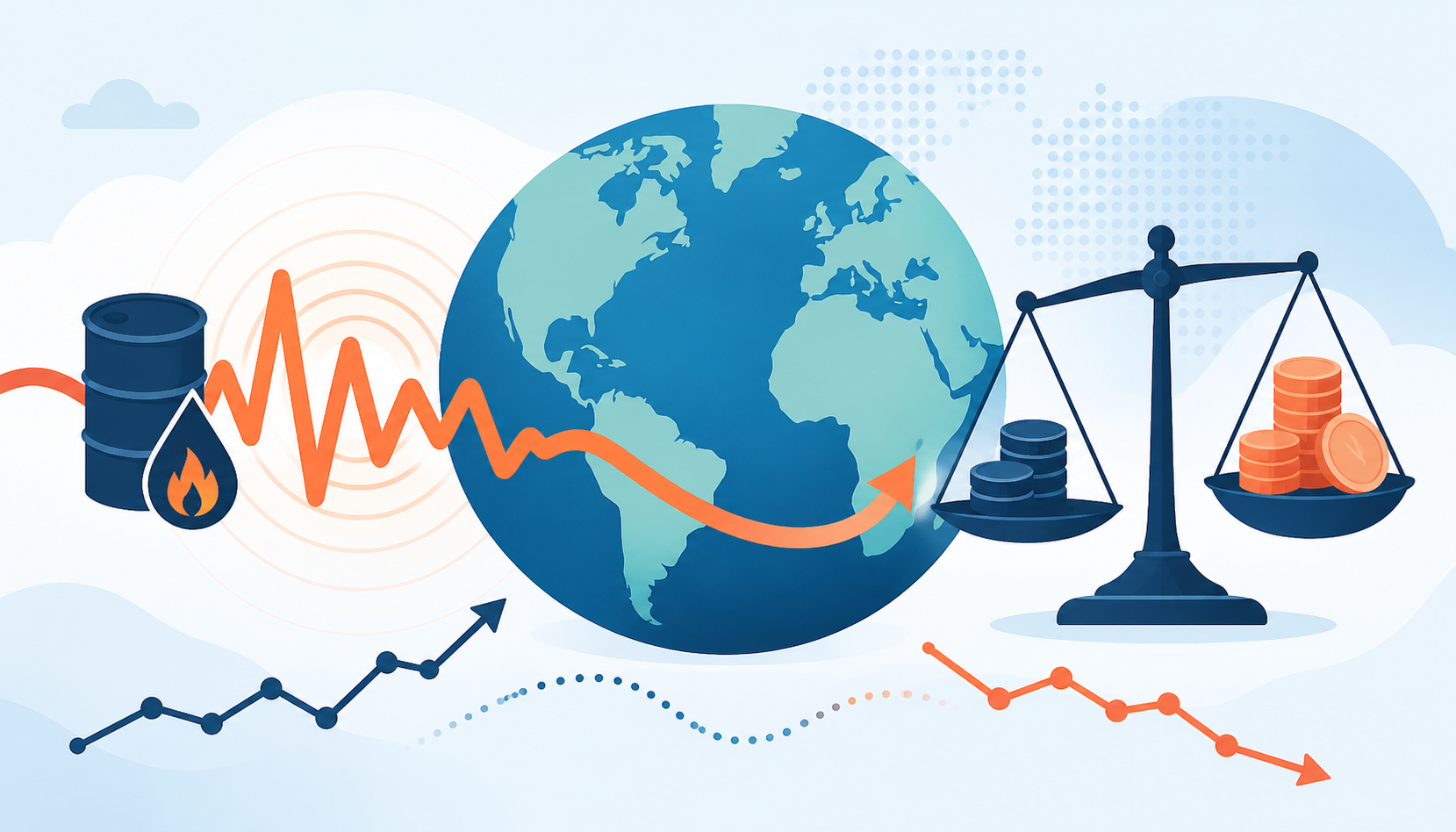
The global economy has absorbed the Middle East energy shock better than many policymakers feared, according to the International Monetary Fund. That resilience does not remove the strain on public budgets, price stability, and countries that import fuel and have little room to respond.
In its July World Economic Outlook update, the IMF projected global growth of 3.0% in 2026 and 3.4% in 2027. The Fund described a pattern in which the war's supply shock weakens growth this year before activity recovers next year. It also raised its forecast for global headline inflation to 4.7% for 2026 and said the disinflation process that had been under way since early 2024 had stalled.
The message is deliberately qualified. Growth has held up at the global level, while the costs have been uneven. Countries directly affected by conflict face the sharpest disruption. Energy importers, low-income economies, and governments with limited fiscal space face a harder policy mix: higher import bills and food costs can raise inflation while weaker activity narrows the tax base.
Why the shock has not produced a global recession
The IMF attributes the better-than-feared aggregate outcome to several buffers. Oil inventories were drawn down, production outside the Gulf expanded, and measures were taken to soften demand. Lower energy intensity and a rising share of renewable energy also reduced the effect of a given energy-price increase on output in many economies.
Those buffers matter for the global totals, but they do not make the supply shock harmless. The IMF's July briefing said commodity price assumptions implied an average oil price of $89 a barrel in 2026, based on market pricing as of June 10. Higher energy costs still flow through transport, power, fertilizer, and food. The timing and scale of that pass-through vary across countries, depending on exchange-rate movements, regulated prices, taxes, subsidies, and the energy mix.
The Fund's earlier assessment described the shock as global and asymmetric. More than 80% of countries are net oil importers, according to an IMF Finance & Development analysis. A country that imports fuel and food, has a weak currency, and already carries high debt has fewer ways to protect households without worsening its fiscal position. Exporters can benefit from higher prices, but may also face lost output, damaged infrastructure, or weaker demand from trading partners.
The contrast is important for investors. A headline growth forecast can conceal widening differences in current accounts, inflation paths, and refinancing needs. It can also conceal the distinction between economies that can let prices adjust and those that rely on controls or state-owned companies to hold them down.
Fiscal support can cushion households and create later liabilities
Governments have responded quickly to the rise in fuel and food costs. The IMF's Global Policy Tracker recorded nearly 900 measures across about 170 countries since the start of the war. Fiscal measures dominate the response, with governments seeking to limit the pass-through of higher energy prices to consumers and businesses.
The Fund warns that broad support can become expensive when it lasts. Subsidies and fuel-tax cuts can reduce immediate inflation pressure, yet they also keep consumption higher than it otherwise would be and can leave large fiscal costs. Price caps may shift the cost from the budget to state-owned energy companies, where losses can become contingent liabilities before they appear clearly in government accounts.
This is a practical issue for credit analysis. A temporary tax cut with a defined cost and expiry date can be priced into a fiscal forecast. An open-ended price freeze is harder to assess. Investors need to ask who carries the cost, whether the measure is funded, and whether the government has a credible plan to unwind it when market conditions improve.
The IMF recommends targeted support for vulnerable households and viable firms, rather than broad measures that subsidize all users of energy. Targeting is administratively difficult in some countries, but it limits the amount of public money spent on higher-income consumers and preserves more room for health, education, infrastructure, and debt service.
Inflation, rates, and the risk of persistence
The central-bank problem is equally difficult. An energy shock pushes headline inflation higher while weighing on real income and activity. Monetary policy cannot create oil or reopen a shipping route. It can, however, prevent an initial price shock from becoming a broader wage-price process or from unanchoring inflation expectations.
The IMF said there was limited evidence of second-round effects as of its July update. That is encouraging, yet it remains a conditional finding. A prolonged disruption, a renewed jump in oil prices, or currency depreciation in importing countries could produce a different outcome. Policymakers will watch core inflation, wage settlements, inflation expectations, and the extent to which firms pass energy costs into other prices.
For advanced economies, the result may be a slower path toward lower policy rates than markets expected before the shock. For emerging markets, the pressure can be more acute when higher import costs coincide with external financing needs. A weaker currency can amplify the local-currency price of oil, while higher global rates raise the cost of rolling over debt.
The appropriate response therefore differs by country. Economies with credible inflation-targeting frameworks and deep local markets may be able to absorb part of the shock. Economies with low reserves, high dollar debt, or fragile fiscal credibility may need to preserve liquidity and avoid policies that worsen external pressure.
Resilience is not a reason for complacency
The IMF's central view is that the world economy has weathered the shock so far. Its joint statement with the International Energy Agency, World Bank Group, and World Trade Organization also stressed that the effect has been highly uneven, affecting energy supplies, food security, commodities, and activity across countries and regions.
That unevenness should shape the next policy decisions. The priority is to protect households facing the sharpest loss of purchasing power while preserving fiscal credibility. Energy-importing governments need transparent measures, clear sunset clauses, and realistic financing plans. International institutions and creditor governments have a role where fuel and food shocks threaten balance-of-payments stability or social conditions in low-income countries.
The outlook also depends on the course of the conflict and the restoration of energy infrastructure and shipping. A faster normalization would reduce pressure on oil and gas markets and make it easier to remove emergency support. A more persistent disruption would prolong the inflation challenge and expose the countries that entered the shock with the smallest buffers.
Analyst’s View
For sovereign-risk investors, the main divide is fiscal space. Countries using broad energy subsidies should be assessed for the duration, funding source, and off-budget effects of those measures. A short-lived, funded program is different from an indefinite commitment that erodes a state energy company's balance sheet.
For credit markets, energy-intensive companies and transport-dependent sectors face a margin test even where headline growth remains stable. The relevant questions are pricing power, hedging, working-capital needs, and exposure to regulated energy prices. Stronger firms may pass through part of the cost; weaker firms can face delayed but substantial pressure on cash flow.
For market positioning, the IMF's outlook argues against treating the global growth number as a uniform signal. Import-dependent economies with high external financing needs remain more exposed to oil, exchange-rate, and rate volatility. Markets with credible policy frameworks and visible fiscal plans have a better chance of absorbing the same shock without a sharp repricing of risk.
The global economy has shown capacity to absorb an energy disruption, supported by inventories, supply adjustments, and lower energy intensity. The next test is whether governments can target relief, protect fiscal space, and keep inflation expectations anchored while the underlying geopolitical risk remains unresolved.