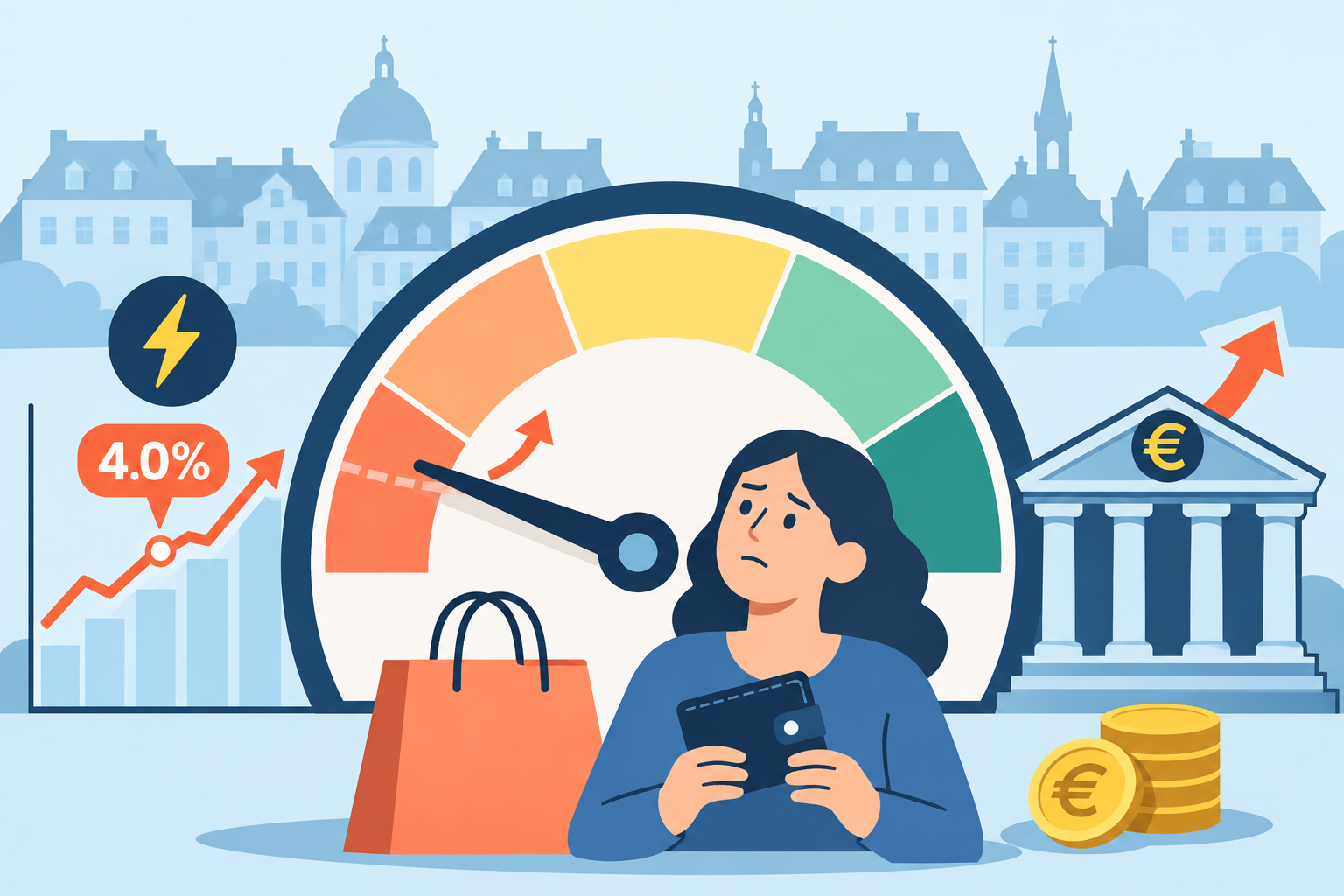
Euro area consumer confidence rose 1.0 point to -16.9 in November 2026, the European Commission’s flash estimate showed on November 20, its first gain since August. The improvement is small, and it arrives as ECB officials, including Bundesbank President Joachim Nagel, argue for a December rate increase with inflation at 4.0%. That hike would land on households whose confidence remains far below normal, most of all in France and Italy, which had the lowest October readings among Germany, France, Italy, Spain and the Netherlands.
Key Takeaways
- The Commission’s flash consumer confidence indicator for the euro area rose to -16.9 in November 2026 from -17.9 in October; the EU reading rose 0.8 points to -16.5.
- November’s reading is 6.2 points below the euro area average of -10.7 since 2000 and below the -12.9 recorded in November 2025.
- Euro area annual inflation reached 4.0% in October 2026, with energy prices up 21.0% from a year earlier, Eurostat reported on November 18.
- Nagel said on November 3 that a December rate hike was “very likely necessary”; the ECB meets on December 16 and 17.
Lenders and retailers face cautious households and rising costs
The pressure point for credit is household finances. In the Commission’s October statistical annex, the euro area balance for households’ expected financial situation over the next 12 months was -6.4, against an average of -1.4 since 2000. In France, that balance dropped from -9.2 in September to -14.4 in October.
For consumer lenders, weaker purchase intentions mean slower loan growth, and higher prices strain borrowers already stretched by energy bills. Banks with large unsecured consumer books in France and Italy, where confidence is lowest among those five countries, have the most exposure if sentiment fails to recover. A December rate increase would add to borrowing costs for the same households.
Retailers were already under strain before November’s small improvement. In its October survey release, the Commission reported that EU retail trade confidence dropped 1.7 points, mainly because retailers judged their recent business situation more negatively. At the same time, managers’ selling price expectations rose in all four business sectors, including a 2.8-point rise in retail.
That combination squeezes margins from two sides. A clothing or electronics chain facing weaker footfall and higher supplier prices has to choose between passing costs on to cautious shoppers or absorbing them. November’s gain gives that chain some relief heading into the holiday season, without changing the underlying squeeze.
Households also feel prices more sharply. The Commission said EU consumers’ perception of price rises over the past 12 months increased by 3.9 points in October, while their inflation expectations for the next 12 months stayed unchanged at a high level. Consumers’ uncertainty about their future financial situation rose to its highest level since April 2025.
Spain is the least gloomy of the five despite 4.9% inflation
The country detail holds the most surprising result. National October figures, the latest available, show wide gaps among Germany, France, Italy, Spain and the Netherlands. In the Commission’s annex, consumer confidence stood at -4.4 in Spain, -14.5 in Germany, -19.0 in the Netherlands, -21.9 in France and -23.3 in Italy.
France moved most in October, with its index falling from -18.5 in September to -21.9. Of these five economies, Spain was the only one in which the October reading improved, edging up from -4.8.
These gaps line up with inflation only in part. Eurostat’s October data show annual inflation of 4.9% in Spain and 3.7% in France, so Spanish households are the least gloomy of the five despite faster price growth. This suggests that job and income prospects weigh as heavily as prices in how households judge their position.
ECB officials signal a December rate increase
Eurostat’s October inflation release put euro area annual inflation at 4.0%, up from 3.8% in September. Energy rose 21.0%, services 3.3% and non-energy industrial goods 1.2%. Inflation excluding energy, food, alcohol and tobacco was 2.6%.
The ECB’s deposit facility rate stands at 2.5%, according to the ECB Data Portal. Reuters reported on November 3 that the ECB had left the rate on hold at its late-October meeting. In the same report, Nagel said in a Berlin speech: “From today’s perspective, an interest rate hike in December is very likely necessary.” He added: “There seems to be little alternative to an interest rate hike unless the inflation outlook improves significantly.”
Bulgaria’s central bank chief Dimitar Radev took a similar line, Reuters reported: “The October pause was a decision to assess the evidence, not a conclusion that monetary policy tightening is over.”
For the Governing Council, November’s confidence gain cuts both ways. A small rebound lowers the risk that a rate increase tips spending into a sharp contraction. Confidence still well below average means a hike would land on consumers who are already cautious. Policymakers will see November inflation on December 1, two weeks before they decide.
The 2026 slump has only partly reversed
The November flash release put the EU indicator at -16.5 alongside the euro area’s -16.9 and said confidence “remains well below its long-term average”. Monthly figures in the Commission’s statistical annex trace the euro area path this year:
- February 2026: -12.3
- April 2026: -20.5, the low point of the year so far
- August 2026: -15.6
- October 2026: -17.9
- November 2026 (flash): -16.9
Prices moved the other way. Eurostat’s figures show annual energy inflation at -0.9% in October 2025, 10.8% in May 2026 and 21.0% in October 2026. Confidence recovered through the summer, then slipped again in September and October as prices kept rising.
Against the long run, November’s reading is weak but far from a crisis level. The annex records a euro area average of -10.7 since 2000 and a low of -27.5 in September 2022, the weakest reading in that period. November’s -16.9 sits closer to the average than to that low.
The flash estimate is a first reading, collected from November 1 to 19 across 26 EU countries, all except Estonia. The Commission also flags a structural break in Italian consumer data between August and September 2026, so month-on-month moves since September are cleaner than longer comparisons. Final November results follow on November 27.
Our earlier coverage of euro zone inflation reaching 3.8% in September explains how energy costs pushed prices higher, and our report on the ECB holding rates during the energy shock sets out the bank’s earlier reasoning.
Market Context
For sovereign borrowers, the cost side has moved the wrong way. Germany’s 10-year government bond yield averaged 3.42% in October 2026 on a monthly basis, compared with 2.66% in November 2025. That rise of roughly three-quarters of a percentage point over 11 months raises refinancing costs for euro area governments while weak consumer demand holds back their tax receipts.
| Indicator | Latest value | Date | Source |
|---|---|---|---|
| ECB deposit facility rate | 2.50% | November 22, 2026 | ECB Data Portal |
| US dollar per euro, ECB reference rate | 1.0990 | November 20, 2026 | ECB Data Portal |
| Germany 10-year government bond yield (monthly) | 3.42% (2.66% in November 2025) | October 2026 | FRED |
Analyst’s View
- Consumer credit risk: Lenders with heavy unsecured consumer exposure in France and Italy carry the most risk. Households’ expected-finances balance of -6.4 sits far below its long-run average, and a December rate increase would lift loan costs further.
- Sovereign risk: Weak household demand slows consumption tax receipts at the same time as higher yields raise refinancing costs. Governments with large refinancing needs and the weakest consumer sentiment face the tightest squeeze on 2027 budget plans.
- Market positioning: A one-point confidence gain is unlikely to change the ECB’s December decision on its own. Positioning in short-dated euro area bonds will depend more on the November inflation flash; investors betting on a hike gain if energy keeps headline inflation near 4%, while a sharp fall in confidence in the final survey would strengthen the case for a pause.
What to Watch
- November 27, 2026: The Commission publishes the full Business and Consumer Survey for November, including final consumer confidence results.
- December 1, 2026: Eurostat releases its flash estimate of euro area inflation for November.
- December 16-17, 2026: The ECB Governing Council holds its monetary policy meeting, with a press conference on December 17.
- December 17, 2026: Eurostat publishes final November inflation data.