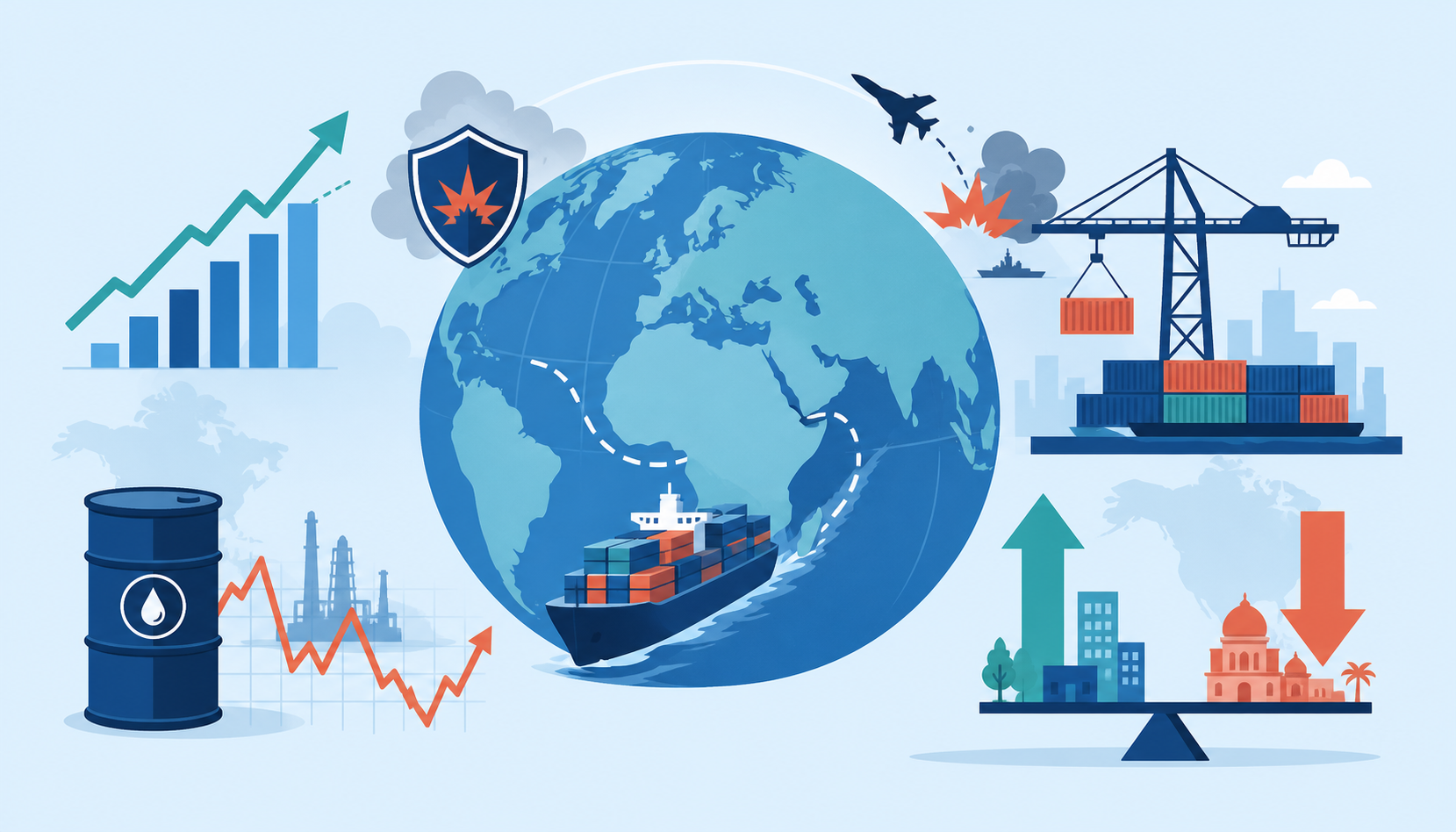
The global economy has absorbed the first shock from the Middle East war better than many forecasters feared. The International Monetary Fund still expects world output to grow 3.0% in 2026, while four multilateral institutions say the damage has fallen unevenly across countries. Their message is cautious: lower fuel and fertilizer prices have eased immediate pressure, yet disrupted energy routes, weak policy buffers and high uncertainty still threaten growth and price stability.
Reuters reported on July 8 that the heads of the International Energy Agency, IMF, World Bank Group and World Trade Organization described the global economy as broadly resilient after a July 7 meeting. Their joint statement said the war had affected energy supplies, food security, commodity markets and activity across many countries and regions. It also urged progress toward reopening the Strait of Hormuz and protecting freedom of navigation.
The wording matters because it separates the global aggregate from the countries carrying the largest burden. Oil and gas importers face a direct rise in import bills. Food-importing economies can face another pass-through from fuel and fertilizer costs. Governments with high debt or thin foreign-exchange reserves have less room to soften those pressures. Exporters, technology producers and economies with lower energy intensity can experience a different path.
Growth holds up, while inflation remains elevated
The IMF’s July 2026 World Economic Outlook Update projects global growth of 3.0% this year and 3.4% in 2027. The Fund said demand linked to the technology cycle has supported countries connected to that value chain, while the war shock has weighed on energy importers and vulnerable economies.
Inflation presents the harder policy problem. In opening remarks for the update, IMF staff projected global headline inflation at 4.7% for 2026 and said the disinflation trend that had run since early 2024 had stalled. The Fund’s baseline assumes that conditions in the Strait of Hormuz begin to normalize in mid-July and return to their pre-war state by March 2027. Forecasts therefore depend on a transport and energy assumption that could change with events.
That assumption helps explain the apparent contrast between resilience and risk. Growth has not collapsed because inventories, production outside the Gulf and demand responses contained the first oil-price spike, according to the IMF. Financial conditions also eased after a sharp tightening in April. Those offsets do not erase the supply shock. They buy time for households, companies and public finances to adjust.
The July update also places the energy shock beside a second force: investment tied to artificial intelligence and related technology. That investment has lifted demand in parts of the global technology supply chain. It does not protect all countries. A country that imports fuel, food and capital while relying on tourism or remittances can face the war shock without the same investment offset.
Why the Strait of Hormuz remains central
The institutions’ joint statement put the Strait of Hormuz at the centre of the economic risk. The route affects energy cargoes and the transit of other goods. A disruption can raise the cost of moving fuel and feedstocks, delay cargoes and change the working-capital needs of importers. The effect then spreads through transport, power generation, industrial inputs and food production.
Fuel and fertilizer prices had fallen since the institutions’ June meeting, the statement said. That relief matters for countries where farm input costs and diesel prices feed into food prices. It also matters for shipping, airlines and manufacturers. Yet the statement stressed that uncertainty remained high and that strains persisted in energy markets and goods transit. A price decline after a shock does not restore supply chains at once.
For central banks, the issue is the difference between a temporary commodity jump and a broader inflation process. The IMF said there was limited evidence of second-round effects so far. If energy costs rise again, wage demands, inflation expectations and currency depreciation could make that assessment less comfortable. The right response will vary with the source of inflation, the exchange-rate regime and the credibility of each central bank.
Fiscal policy faces a similar split. Some governments have used energy-related support to cushion households and firms. The IMF said such support should be unwound as the shock fades, while fiscal space should be rebuilt. Broad price subsidies can protect demand in the short term, but they can also increase borrowing needs and blur the signal to conserve scarce energy. Targeted support offers a cleaner route where governments can identify vulnerable households.
Trade, food and financing channels
The World Trade Organization’s role in the joint statement points to a risk beyond headline oil prices. Trade disruption can reach importers through freight, insurance, port congestion and delivery timing. Firms may hold more inventory or seek longer routes, tying up cash. Smaller importers can pay more for credit and freight at the same time.
Food security deserves equal attention. Fertilizer prices influence planting decisions and harvest costs with a lag. A government may see fuel prices fall in one month while farmers still pay more for imported inputs agreed earlier. Countries that import grain, fertilizer or both can face pressure on consumer prices and public budgets before any slowdown appears in global output data.
External financing can amplify those pressures. A rise in commodity costs can widen current-account deficits for importers. If investors then demand higher returns or reduce risk exposure, domestic currencies can weaken and make imports more expensive. That chain is most dangerous where central-bank reserves, fiscal capacity and access to concessional finance are limited. The aggregate growth forecast cannot show the full distribution of that risk.
The joint statement called on governments and international institutions to support recovery, protect jobs and livelihoods, strengthen energy and food security, improve port infrastructure and trade facilitation, and prepare for future shocks. Those are broad goals, yet the order of priorities will differ. An energy importer may focus on emergency supplies and targeted fiscal support. A trade hub may focus on ports, customs and shipping access. A low-income country may need balance-of-payments support before it can finance resilience investments.
What investors and companies should watch
Markets will watch the physical evidence behind the forecast. Tanker traffic, freight rates, refined-product inventories, fertilizer prices and delivery times offer a faster read than quarterly growth data. A durable reopening of the Strait would support the IMF baseline. Renewed disruption would challenge it through oil prices, inflation expectations and tighter financial conditions.
Companies with long supply chains should examine cash exposure as well as input prices. Longer transit times can increase inventory needs and pressure suppliers with limited financing. Firms that have alternative routes, diversified energy sources or flexible contracts may absorb a disruption more easily. Those advantages can matter even when the headline commodity price has retreated.
Investors should also distinguish between an energy-price move and a country-risk move. Exporters may gain revenue from higher prices, yet face geopolitical, logistics or fiscal risks. Importers may see their currencies, sovereign spreads and domestic inflation move together. Credit analysis needs to test revenue, refinancing and policy capacity in the same scenario rather than treating oil as an isolated market.
Analyst’s View
First, sovereign risk will remain uneven even if world growth holds near 3.0%. Energy and food import dependence, reserve coverage and the cost of subsidizing households can create large differences between countries with the same reported growth rate. Investors should compare import bills and financing needs against available policy buffers.
Second, credit risk may emerge through transport and working capital before it appears in default data. Shipping delays, higher insurance costs and larger inventories can strain smaller importers, manufacturers and distributors. Lenders should test covenant headroom and liquidity assumptions against longer delivery periods and a renewed rise in energy costs.
Third, market positioning should account for the IMF baseline as a conditional forecast, not a guarantee. The forecast assumes a staged normalization of the Strait of Hormuz. A faster normalization could reduce inflation pressure and support risk assets. A renewed disruption could lift commodity volatility, weaken importers’ currencies and force central banks to preserve tighter policy for longer.
The institutions’ assessment offers a restrained conclusion. The world economy has not suffered the broad contraction feared during the first phase of the shock. Its resilience depends on routes reopening, energy markets remaining supplied and vulnerable countries retaining access to trade and finance. Those conditions need monitoring through the second half of 2026.