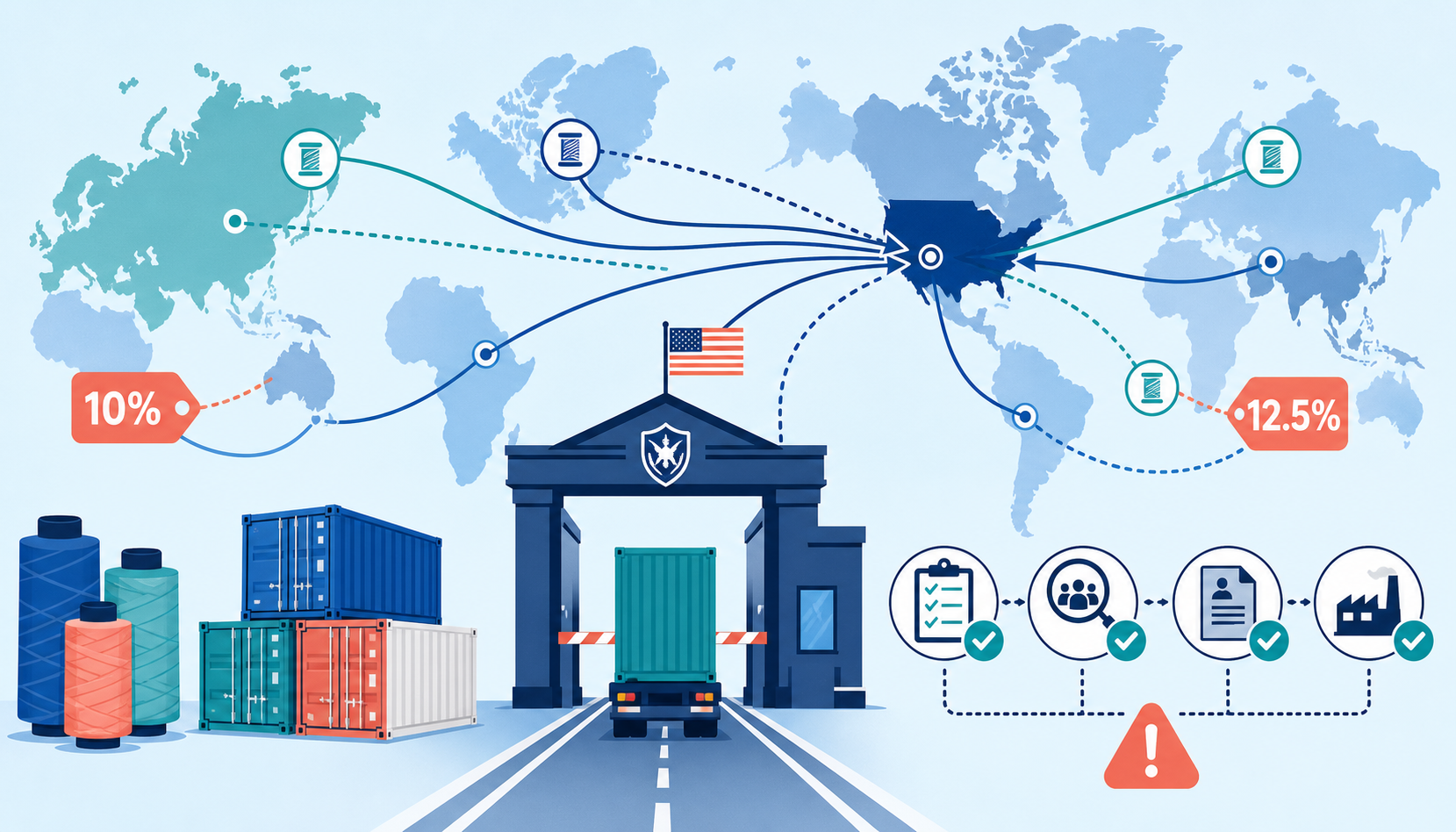
The United States has turned forced-labor enforcement into a broad tariff instrument, imposing new duties on goods from 60 economies after a Reuters report said Washington moved to replace an expiring temporary global tariff with Section 301 measures. The Reuters story, by David Lawder, reported that the new duties apply at 10% or 12.5% and drew objections from several trading partners because the measures cover a large part of U.S. import flows.
The primary documents confirm the core event. A July 23, 2026 White House memorandum directed the U.S. Trade Representative to impose tariffs after investigations into whether 60 economies failed to prohibit or effectively enforce prohibitions on imports made with forced labor. The memorandum set a 10% tariff for goods from 17 named economies, a tariff net of most-favored-nation rates for the European Union, Taiwan, Japan, Korea and Switzerland, and a 12.5% tariff for goods from the other investigated economies.
USTR's July 23 press release framed the move as final action under Section 301 of the Trade Act of 1974. USTR said its investigations included hearings, more than 2,100 public comments and engagement with trading partners. Its fact sheet said trading partners that made commitments to adopt and enforce forced-labor import prohibitions would face 10%, while partners that had failed to adopt such a prohibition would face 12.5%.
The legal chain started earlier. A June 5, 2026 Federal Register notice, formally cited as 91 FR 34272, said USTR had initiated 60 investigations on March 12, 2026. The notice said USTR determined that 54 of the investigated economies had failed to impose and effectively enforce a forced-labor import prohibition, while six had failed to enforce one effectively. USTR also proposed additional duties with exemptions and sought public comments before the final action.
For global economy readers, the importance of the Reuters story is less the label attached to the tariffs than the channel through which the policy operates. Section 301 allows the United States to treat other countries' import enforcement systems as a trade barrier when USTR finds the practice unreasonable and burdensome to U.S. commerce. That creates a compliance-linked tariff floor that reaches across sectors unless specific products are exempted.
The country list is extensive. The White House memorandum names economies across North America, Europe, Asia, Latin America, the Middle East and Africa, including Canada, Mexico, the European Union, China, India, Japan, South Korea, Switzerland, Vietnam, Brazil, Australia and the United Kingdom. The memorandum's first rate bucket applies a 10% tariff to Argentina, Bangladesh, Cambodia, Canada, Ecuador, El Salvador, Guatemala, Honduras, India, Indonesia, Jordan, Malaysia, Mexico, Pakistan, Sri Lanka, the United Kingdom, and Trinidad and Tobago.
The second bucket matters for developed-market supply chains. For products of the European Union and Taiwan, the United States is to impose a Section 301 tariff so that the combined most-favored-nation tariff and Section 301 tariff equals 10% when the MFN tariff is below 10%. For products of Japan, Korea and Switzerland, the combined rate is capped at 12.5% when the MFN tariff is below that level. Where the existing MFN tariff already meets or exceeds the relevant threshold, the Section 301 tariff is zero.
The third bucket applies a 12.5% tariff to goods of the other investigated economies. That rate design creates a tiered incentive system. Economies with existing laws, partial regimes or commitments receive the lower rate. Economies without such systems face the higher one. In trade policy terms, Washington is using border costs to pressure partners to build forced-labor import controls rather than relying only on diplomatic pressure or domestic labor-law commitments.
The exemptions deserve attention because they shape the economic hit. The White House memorandum directed USTR to exempt products in an annex, including raw materials where tariffs could create supply shortages, products that could cause economy-wide disruptions, goods that cannot be grown or produced in sufficient quantities in the United States or sourced elsewhere, and some goods where exemption could encourage partner economies to enact or enforce import bans. Reuters reported additional practical exemptions, including oil and gas, fertilizer, certain food items, aircraft and parts, critical minerals, and goods already subject to Section 232 national-security tariffs.
Those carve-outs reduce the immediate inflation shock in some commodity channels. They also make the measure more complicated for importers. A company can no longer look only at country of origin and headline tariff rate. It must assess whether its goods fall under a listed exemption, whether an MFN offset applies, whether a separate Section 232 duty already covers the product, and whether supplier documentation can withstand forced-labor scrutiny.
The textile mechanism adds another layer. The White House memorandum directs USTR to establish tariff-rate quotas for Bangladesh, Cambodia, Indonesia and Malaysia for an initial three-year period once implementation is feasible. The stated aim is to encourage those economies to import more U.S. textile goods and cotton, reducing reliance on inputs that USTR views as more likely to contain forced-labor content. Until those quotas are established, imports covered by the future mechanism remain subject to the applicable 10% Section 301 tariff.
For apparel, footwear and consumer-goods supply chains, this is a shift from a simple cost story to a documentation story. The tariff rate matters, but the broader risk is that importers must prove more about the upstream origin of fiber, fabric, components and intermediate goods. Firms with short supplier lists and traceability systems may absorb the new regime more easily than firms using multi-country sourcing chains with frequent supplier changes.
The Reuters report said trading partners challenged the justification. That reaction is predictable because forced-labor policy is politically difficult to dispute in principle, while broad tariffs are costly in practice. Countries that have domestic forced-labor laws or recent commitments may argue that Washington is using a human-rights rationale to preserve import barriers. The White House memorandum anticipated legal fragmentation by stating that each tariff action is separate and should remain operative even if another action is held invalid.
For markets, the immediate price action reported by Reuters was limited, with investors focused on other risks. That calm should not be read as indifference. Tariffs of 10% and 12.5% can alter sourcing decisions, landed-cost calculations and working-capital needs over several quarters. The effects arrive through contract renewals, supplier negotiations, inventory placement and customs classifications rather than a single market repricing.
Inflation risk is uneven. Exemptions for energy, fertilizer, some food items and other sensitive inputs should soften the pass-through to broad consumer prices. Yet non-exempt consumer goods, machinery parts, household items and intermediate components may still face higher border costs. Businesses with thin margins must decide whether to absorb the hit, raise prices, shift suppliers or redesign products. Each option carries execution risk.
Credit risk also changes. Import-heavy retailers, apparel brands, distributors and small manufacturers may face higher cash requirements at the border and more volatile gross margins. Banks and trade-credit insurers should watch borrowers with concentrated sourcing from higher-rate jurisdictions, limited pricing power or weak customs-compliance controls. The risk is most acute where companies finance inventory before final tariff treatment is clear.
Sovereign and country-risk analysts should read the policy as another sign that access to the U.S. market is being tied to domestic enforcement systems abroad. Countries that move quickly to enact and enforce import bans may protect part of their export competitiveness. Countries that resist may face a durable cost disadvantage in U.S.-bound trade. The rule also gives Washington a recurring review mechanism, since USTR can modify or terminate tariffs, exemptions or quotas under the memorandum.
The policy may also influence supply-chain geography. Some importers will look for jurisdictions in the 10% group, while others may find that the administrative burden offsets rate differences. The EU, Japan, Korea, Switzerland and Taiwan receive an MFN-offset structure, which can limit incremental duties for products already carrying higher standard tariffs. That design reduces some bilateral friction, but it does not remove the need for product-by-product analysis.
Legal risk remains part of the macro story. Reuters linked the move to the administration's effort to rebuild a broad tariff wall after earlier reciprocal duties were struck down under a different legal authority. Section 301 has a longer trade-law history than emergency-power tariffs, but broad application across 60 economies will still invite scrutiny. Investors should expect litigation, requests for exclusions and diplomatic bargaining to develop alongside the economic effects.
Analyst's View
First, the credit channel is likely to show up before headline inflation. Importers may need more working capital for duties, documentation, supplier audits and customs reviews. Lenders should refresh covenant sensitivity for companies exposed to apparel, furniture, consumer electronics, industrial inputs and private-label retail.
Second, sovereign-risk analysis should include forced-labor import enforcement as a market-access variable. Countries with credible inspection systems, transparent customs rules and cooperation with USTR may preserve export share. Countries with weaker traceability will face a higher risk premium in U.S.-bound supply chains.
Third, market positioning should separate tariff headlines from exemption detail. Broad indices may absorb the news calmly, while individual companies face large dispersion by product code, sourcing map and pricing power. The better trade is likely in balance-sheet selection, not in a single macro call on tariffs.
The Reuters story is therefore a high-impact trade-policy signal. The United States has not only imposed new duties; it has connected forced-labor enforcement, customs treatment and global sourcing into one tariff framework. The result is a 2026 trade-risk map where legal compliance, supplier documentation and country policy choices matter as much as the headline tariff rate.