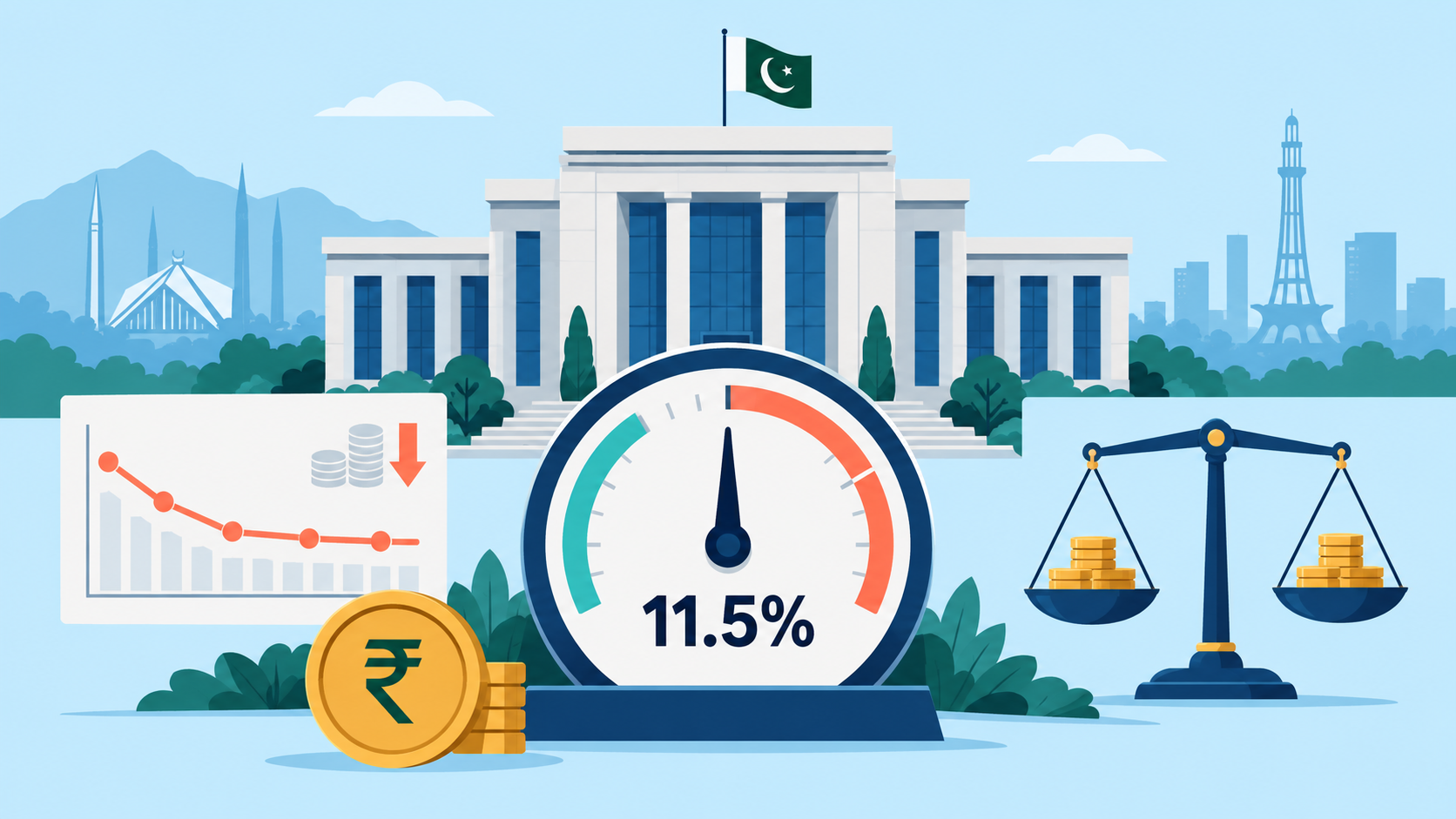
Pakistan's Monetary Policy Committee kept the policy rate unchanged at 11.5 percent on September 14, leaving borrowing costs at the level set after the State Bank of Pakistan's earlier tightening. The bank's official decision notice states that the committee made the decision at its September 14 meeting. The choice arrives as Pakistani households, banks, exporters, and government debt managers assess an economy where price stability, growth, external financing, and fiscal credibility remain closely connected.
The immediate decision is simple: the policy rate did not move. Its interpretation is less simple. A central bank can leave its rate unchanged because inflation is moving toward comfort, because it expects a temporary shock to fade, because activity is weakening, or because it wants more information before committing to another move. The September notice confirms the rate decision, while the detailed policy statement was still pending when the notice appeared. That means a careful reading should separate the confirmed decision from explanations that will require the fuller statement and later data releases.
The 11.5 percent setting is important because the policy rate influences the price of short-term liquidity through the banking system. It does not mechanically determine every lending rate, deposit rate, government-bill yield, or corporate borrowing cost. Banks price credit with their own funding costs, risk assessments, maturity structures, and capital constraints. Even so, the policy setting is a central reference point for money-market conditions and for expectations about the direction of financial conditions.
Pakistan's central-bank framework gives the decision a clear institutional purpose. The State Bank's monetary-policy mandate identifies domestic price stability as its primary objective, while also requiring the bank to contribute to financial-system stability. That wording matters for investors. It frames rate decisions around inflation and the durability of disinflation, while recognizing that strains in banks, markets, or external financing can alter the cost of holding a restrictive stance.
Keeping the rate unchanged avoids sending a premature signal that the inflation problem has been settled. A cut would reduce the cost of credit and could support domestic demand, but it could also weaken confidence if inflation expectations, currency pressures, or import costs were still unsettled. A further increase would reinforce an inflation-fighting message, yet it could raise debt-service costs and make investment decisions harder for firms that depend on bank finance. Holding the rate keeps both options open while the committee evaluates the next set of evidence.
The decision also matters for the federal government's financing bill. Pakistan's public sector relies heavily on domestic borrowing, and policy rates influence the yields demanded on shorter-dated instruments as those securities are auctioned or refinanced. A rate hold does not freeze that bill, because market yields respond to expected inflation, auction supply, liquidity, and risk sentiment. Still, it prevents an additional policy-rate increase from immediately adding to the pressure on the domestic curve. That can be meaningful when budget planning depends on predictable financing conditions.
For commercial banks, a stable policy rate can preserve an existing margin structure, though the outcome depends on the speed with which assets and liabilities reprice. Deposit competition, the composition of government securities, and credit quality will shape the effect. Banks with large holdings of government paper remain exposed to changes in yields even when the policy rate is unchanged. They also face the practical question of whether borrowers can service loans if high real borrowing costs persist for an extended period.
For companies, the signal is mixed. Firms with short-term working-capital facilities may welcome the absence of another rise, especially where inventory, energy, and imported-input costs are already high. But a hold at 11.5 percent is still a restrictive starting point for many borrowers. Businesses will focus on whether inflation eases enough to make future reductions possible and whether currency conditions allow importers to plan purchases without abrupt changes in costs. Exporters will watch the same variables from a different angle, since exchange-rate stability and access to trade finance can matter as much as the headline policy rate.
Households face the decision through food, transport, rent, wages, and the cost of consumer credit. Monetary policy works with lags, so a September hold cannot solve a current price shock. Its value lies in setting the conditions under which inflation expectations can become more stable. When households believe that prices will keep rising rapidly, they may bring purchases forward and demand larger wage adjustments, creating a more difficult environment for the central bank. A credible, data-led policy process can limit that feedback loop, although credibility also depends on fiscal discipline and reliable communication.
External accounts are another channel. Pakistan's need for foreign-currency liquidity makes confidence in macroeconomic policy especially important. Higher domestic rates can support demand for rupee assets, but they are not a substitute for export earnings, remittances, foreign investment, or sound debt management. A hold at 11.5 percent signals continuity rather than a new policy regime. Investors will therefore look beyond the announcement to reserve developments, the current account, external repayment schedules, and the availability of official and private financing.
The committee's timing is also useful context. The State Bank publishes an MPC calendar and identifies the September 14 meeting in its policy materials. Scheduled decisions can reduce uncertainty because markets know when an official reassessment will occur. They leave uncertainty about the result, yet they create a regular point at which the central bank can explain how incoming inflation, activity, and financial-market evidence has changed its judgement.
The detailed statement will be the next essential document. It should clarify the committee's assessment of recent inflation, core-price behavior, demand conditions, the external account, fiscal developments, and the balance of risks. Until it appears, readers should avoid treating the rate hold as proof that inflation has reached a preferred level or that future cuts are imminent. The confirmed fact is narrower: the MPC retained an 11.5 percent policy rate at its September meeting.
Market pricing will provide a second test. Treasury-bill and bond auctions show how investors translate policy signals into expected returns across maturities. If short-term yields remain close to the policy rate while longer yields rise, markets may be demanding compensation for inflation, fiscal, or currency risk. If the curve eases broadly, investors may be gaining confidence that inflation will fall without renewed pressure on financing. Those moves should be assessed alongside auction demand rather than in isolation.
The inflation path will remain the central variable. A single monthly reading can be affected by food, fuel, tax, or base effects. Policymakers will need to judge whether changes are temporary or broad-based. Core measures, expectations, wage dynamics, and import prices can help distinguish between the two. The State Bank's mandate makes that distinction more than a technical exercise: it guides whether maintaining the present stance is sufficient to protect domestic purchasing power.
Analyst's View: For sovereign-risk investors, the rate hold keeps attention on refinancing capacity and the credibility of the wider policy mix. Lower funding costs would eventually help the fiscal position, but an early easing cycle that destabilized inflation or the currency could produce a larger risk premium. For banks, the key issue is the interaction between high rates, government-security valuations, and borrower repayment capacity. For companies with Pakistan exposure, the useful planning case is continued caution: base cash-flow assumptions on the current rate setting, test sensitivity to higher import costs, and wait for the detailed MPC explanation before treating the decision as a directional shift.
Pakistan's September decision therefore offers stability rather than a new impulse. The MPC has chosen to retain the existing benchmark while more evidence arrives. That approach can support confidence if later data and communication show that inflation is easing on a durable basis and that external financing conditions remain manageable. If those conditions deteriorate, the unchanged rate will not remove the need for a new response. The next statement, subsequent inflation releases, and market reaction will determine whether the September hold becomes the start of a sustained pause or only an interval in a still uncertain policy cycle.