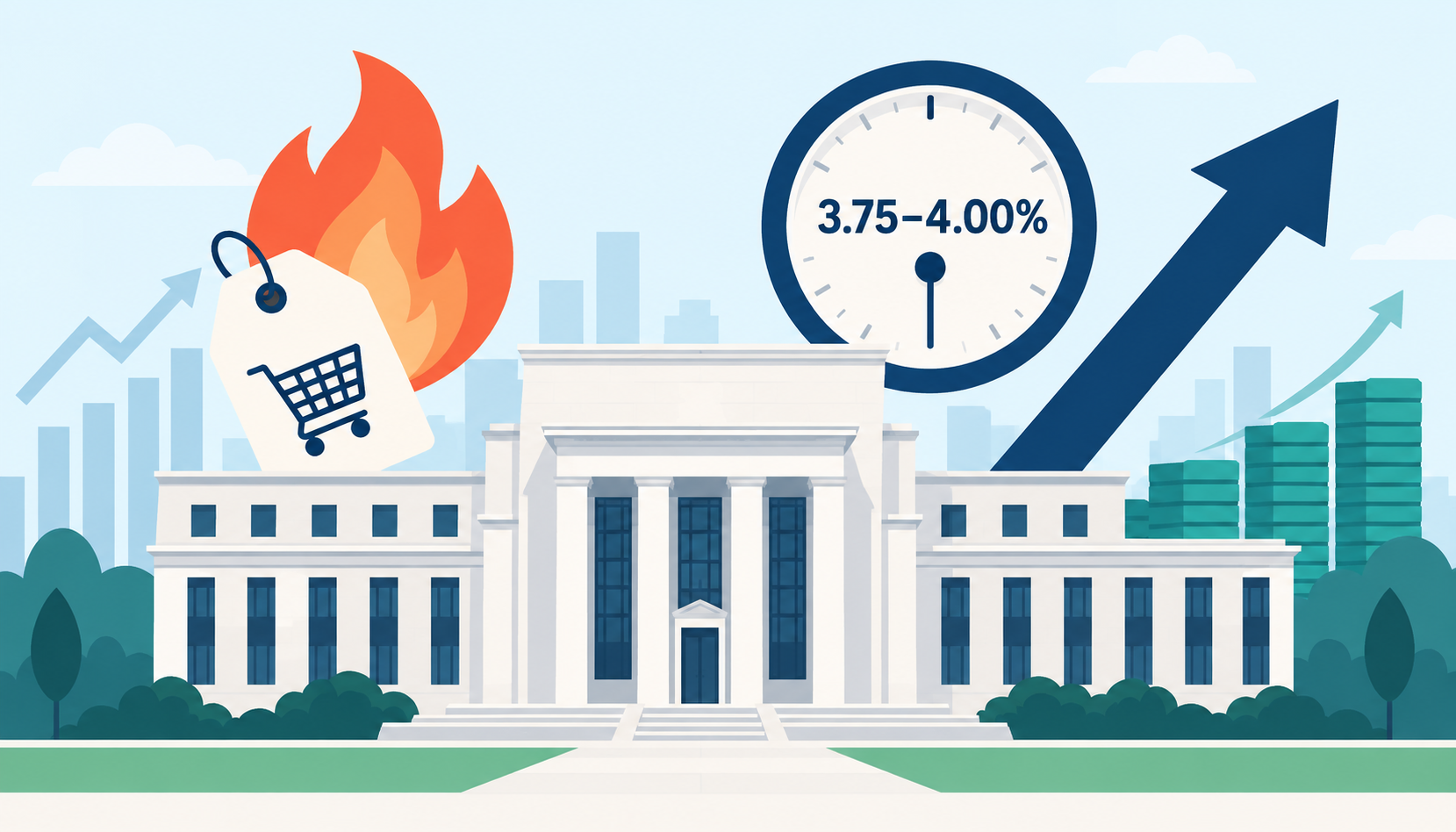
The Federal Reserve raised its target range for the federal funds rate by a quarter percentage point on September 16, taking it to 3.75% to 4.00%. The unanimous decision was the first increase in three years and came with a direct explanation: inflation remains elevated even as the U.S. economy continues to expand at a solid pace. In its policy statement, the Federal Open Market Committee said domestic spending had been resilient, productivity growth strong, and capital investment robust.
The move changes the near-term calculation for borrowers, investors, and governments that have grown used to policy easing. It also places the Fed at a different point from central banks that are still weighing the damage from high energy prices, trade friction, and geopolitical disruption. A higher U.S. policy rate can pull capital toward dollar assets, raise funding costs abroad, and sharpen attention on countries with large refinancing needs.
A unanimous rate increase
The FOMC voted 12-0 to raise the range from 3.50% to 3.75% to the new 3.75% to 4.00% band. Its statement did not frame the decision as a response to a single data release. Instead, it paired solid activity with inflation that had not returned to the Committee’s 2% goal. The Committee said the action would support a timelier return to price stability.
That language is significant because it describes inflation as the binding constraint even while the labor market has avoided a marked deterioration. The Fed said job gains had kept pace with the workforce and the unemployment rate had changed little. It also acknowledged elevated uncertainty tied partly to geopolitical developments. The combination gives policymakers a difficult balance: growth and investment reduce the case for emergency support, while supply shocks and price pressure leave little room to declare victory.
The formal operating changes match the new stance. In its implementation note, the Board said the interest rate paid on reserve balances would rise to 3.90% effective September 17. The primary credit rate would also rise to 4.0%. The New York Fed’s trading desk was directed to maintain the new target range through open-market operations while the system continues to operate with ample reserves.
Those details matter for money-market transmission. The target range signals the direction of policy, while administered rates and the Fed’s operating instructions help move overnight market rates toward that range. Banks, money-market funds, and other short-term investors will adjust first. Consumer and corporate borrowing costs usually follow through different channels and at different speeds.
Inflation has reshaped the policy path
The central bank’s public assessment points to an economy that has been more durable than a simple slowdown narrative would imply. Consumer spending has held up, firms have continued to invest, and productivity growth has been strong, according to the FOMC statement. Those conditions can sustain demand even when rates are already restrictive.
At the same time, the Fed’s statement singled out inflation rather than describing it as a fading risk. That distinction will be closely watched by markets. A rate increase after a lengthy pause can change how investors interpret the reaction function: the hurdle for a further increase may be lower if price measures remain firm, while the hurdle for quick cuts becomes higher.
The official FOMC meeting materials show that the September decision followed the Committee’s September 15-16 meeting. The Fed’s own policy-rate table records the 25-basis-point increase as effective September 17, with a 3.75%-4.00% target range. The current decision therefore has an immediate operational date rather than an open-ended implementation timetable.
Markets will now parse forthcoming inflation, employment, wage, and consumption data through the lens of this statement. A softer report can still ease expected policy rates. Yet the Fed has made clear that one favorable reading would have to be assessed against broader evidence on inflation and demand. This is a stance built around persistence, not a promise of an automatic sequence of increases.
The dollar and global funding channel
For the global economy, the immediate issue is the price of dollar funding. A higher federal funds range can lift returns on short-dated U.S. instruments and support the dollar when other factors are unchanged. That can tighten financial conditions for sovereigns and companies that borrow in dollars, especially where local currencies are already under pressure.
The effect will vary across countries. Economies with deep reserves, long debt maturities, and credible monetary frameworks can absorb a modest move more easily. Countries facing heavy external refinancing, large current-account deficits, or imported inflation have less room. A stronger dollar can raise the local-currency cost of servicing external debt and make fuel, food, and capital goods more expensive.
The rate move also arrives while energy costs and geopolitical risks remain important to other central banks. The Bank of Canada’s September 2 decision held its policy rate at 2.25% and noted that high oil prices and refined-product margins were keeping inflation high in many countries. Divergent settings can create sharper exchange-rate and capital-flow adjustments when investors reassess relative returns, even without producing instability.
For corporate treasurers, the practical question is less about the headline rate than about refinancing calendars. Borrowers that need to roll floating-rate debt soon will feel the change quickly. Companies with fixed-rate debt have more time, but their next issuance will be priced against a higher benchmark and the credit spread investors demand. Investment plans tied to long-lived assets are particularly sensitive when both the risk-free curve and spreads rise.
What the Fed did not promise
The September statement offered no preset path for the next meeting. It did not say that one increase completes the job, and it did not announce a campaign of consecutive moves. The Committee instead linked its decision to its dual mandate and stated that it would deliver price stability. That leaves policy dependent on incoming information and on how conditions evolve.
This ambiguity is deliberate. A central bank that pre-commits can lose flexibility when supply shocks, fiscal developments, or financial stress change the outlook. The cost is that markets must infer the path from data and from the Committee’s language. After this meeting, the most important phrase is that inflation remains elevated. It puts a clear condition on any expectation that easing will resume quickly.
There is also a fiscal dimension. Higher short-term rates increase debt-service costs as Treasury securities mature and are refinanced. The impact builds over time because the federal debt stock has a range of maturities. State and local borrowers, households with variable-rate obligations, and private issuers will face their own timelines. A quarter-point rise is manageable in isolation, yet repeated increases would compound the effect.
Analyst’s View
For credit risk, the rate increase raises the value of balance-sheet detail. Investors should separate issuers with near-term floating-rate exposure from those with locked-in funding and reliable operating cash flow. The latter may absorb higher benchmarks; the former can face a rapid reduction in interest coverage if revenue growth slows.
For sovereign risk, dollar liabilities and external financing needs deserve closer attention. Countries that import energy and depend on portfolio inflows face a double pressure when commodity prices stay high and U.S. yields rise. Reserve adequacy, debt maturity profiles, and the credibility of domestic inflation policy will shape the outcome more than the Fed decision alone.
For market positioning, the decision supports a cautious approach to duration and to highly leveraged assets until evidence shows inflation is easing on a sustained basis. It also argues for distinguishing between a stronger dollar caused by rate differentials and one driven by risk aversion. The first can fade if foreign central banks catch up; the second can spread quickly through funding markets.
The Federal Reserve has moved from patience to action. Its September decision leaves the path of rates for the year ahead unsettled, while establishing the current priority: inflation has not fallen far enough for the Committee to rely on growth resilience alone. The next test will be whether demand, prices, and global shocks allow that priority to be met without a more damaging tightening cycle.