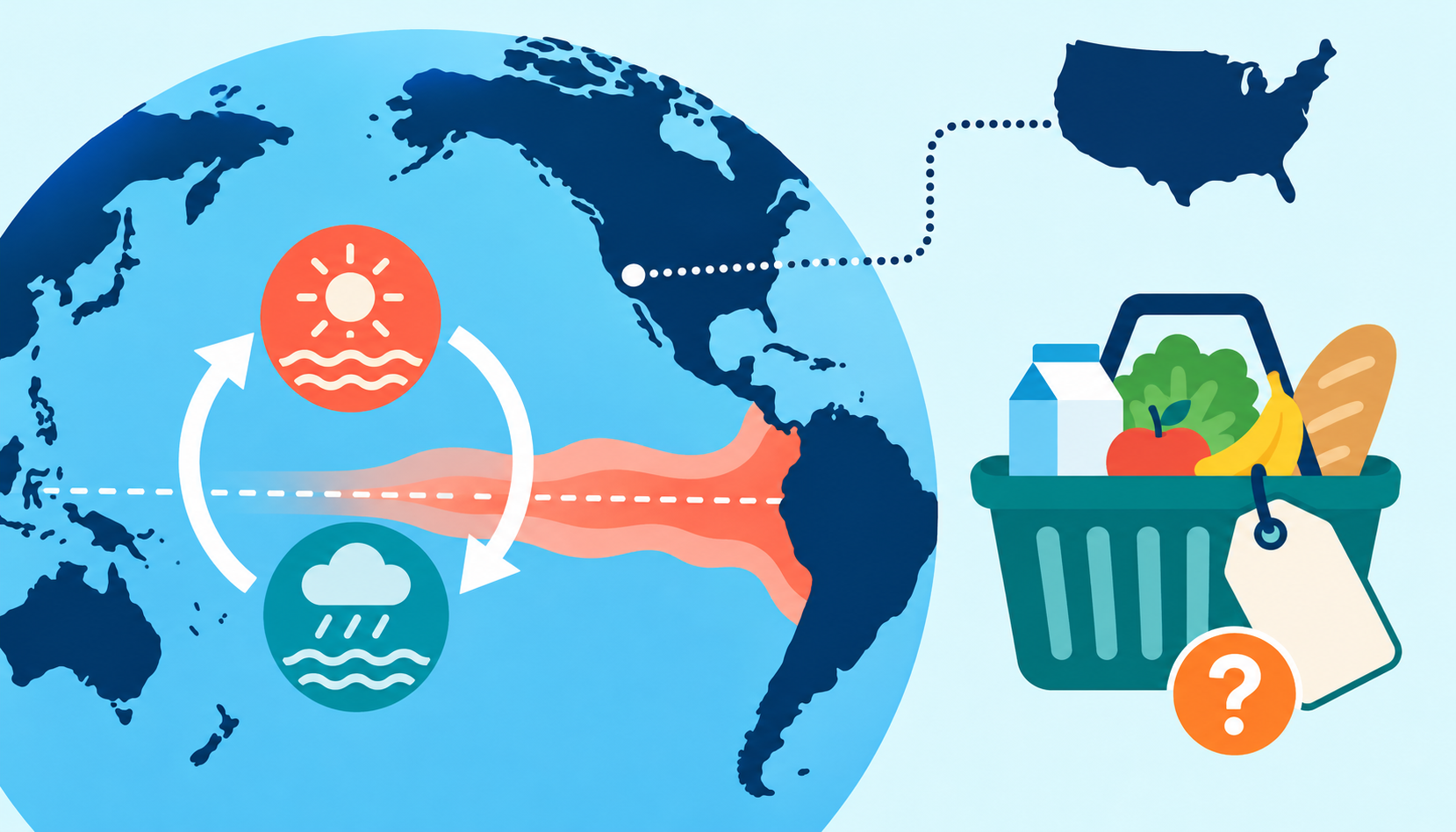
El Niño could add to US inflation in 2027, researchers at the Federal Reserve Bank of San Francisco said in a November 2 Economic Letter. Their new analysis identifies a conditional risk from the Pacific weather cycle, rather than a forecast of how much prices will rise. Households and businesses preparing next year’s budgets face another source of uncertainty over their costs.
The release comes as inflation remains above the Federal Reserve’s goal. Investors now have to assess a possible weather-related price shock alongside the usual questions about demand, wages and financing costs. The study offers a reason to test those exposures, without establishing a new path for interest rates.
The weather outlook behind the economic question
The Climate Prediction Center’s October 8 ENSO discussion said El Niño was strengthening and placed the probability of a strong-to-very-strong event continuing through January–March 2027 above 83 percent. That is a probability for the weather pattern’s strength. It does not measure the likelihood of a particular inflation outcome.
NOAA’s October 15 US winter outlook favors warmer conditions across much of the northern United States and wetter conditions across the southern tier and East Coast. NOAA also stresses that seasonal outlooks describe probabilities for temperature and precipitation; they do not specify the weather on a particular day.
That geographical detail prevents a simple national winners-and-losers story. A business could benefit from lower heating demand at one location while facing delivery delays at another. Rain could improve water availability, yet excessive rainfall could interrupt work. Those are possible operating channels, whose financial effects depend on the location, timing and severity of actual conditions.
A conditional price estimate for 2027
The San Francisco Fed letter applies historical relationships to the current episode. It suggests an additional rise of roughly 1 percent in the PCE price level over 2027 if La Niña follows El Niño. Without that transition, its model expects no further net price effect in 2027. Whether La Niña develops remains uncertain. The authors therefore present the result as an inflation risk, not their forecast.
For a budget planner, a conditional estimate has a different use from a central forecast. It can inform an adverse scenario while the base case remains tied to current contracts, customer demand and observed costs. Assigning the full estimated effect to every company would overlook differences in spending patterns and the ability to change suppliers or prices.
Nor does the result imply that each monthly inflation release next year will surprise on the upside. A cumulative price-level effect can unfold unevenly. Analysts need to compare like periods before translating it into a year-over-year rate or a forecast revision.
Historical evidence has limits
The underlying October working paper by Brigitte Roth Tran estimates responses to El Niño using a measure of its strength and separate monthly effects. It organizes the analysis around twelve-month periods beginning in May, allowing the response to vary with the season. The approach addresses an event that develops over months and affects different regions in different ways.
The historical sample provides limited guidance for an unusually powerful episode. The paper notes that only four events in the historical record were very strong and cautions about extrapolating from past relationships. More intense rainfall, for example, can produce damage beyond the benefits associated with moderate precipitation.
The working paper also finds subsequent employment gains across sectors and states. Unlike the later price effect, those gains do not depend on a following La Niña. Its results therefore allow higher prices and stronger employment to coexist. They do not identify the payroll outcome for a specific city or employer.
The practical implication is to avoid treating El Niño as a uniform recession signal. A lender examining one borrower needs local operating evidence. An economist assessing national activity needs the aggregate data as it arrives. Neither can replace that work with an ocean-temperature indicator alone.
PCE prices and the inflation baseline
The Bureau of Economic Analysis defines the PCE price index as a measure of prices paid for consumer goods and services, including purchases made on people’s behalf. Its latest published reading shows September 2026 prices 3.6 percent above a year earlier, after 3.4 percent in August. These are observed annual changes, with September data released on October 29.
The research’s conditional effect over 2027 and September’s annual inflation rate describe different periods and comparisons. Adding them together would not produce a defensible forecast for next year’s inflation. That calculation would require a baseline price path, the timing of the additional effect and assumptions about other forces affecting prices.
Households also experience different costs from the national average. In practical budget analysis, the relevant question is which bills could change and how quickly. A family with large variable utility expenses has a different exposure from a business whose main concern is deliveries or insurance. The aggregate index helps assess monetary conditions; it cannot specify each household’s cost increase.
The study does not determine the Fed’s next decision
At its October 28 meeting, the Federal Open Market Committee kept the federal funds target range at 3.75–4.00 percent. It described inflation as elevated and said additional information would help determine the appropriate stance. Two members preferred a quarter-point increase. That decision preceded the November 2 letter.
A research finding about weather supplies one input to the policy debate. It does not announce a Committee decision. The Fed would still need to assess actual prices and employment, alongside the persistence and breadth of any new pressure.
For market analysis, the key distinction is between an initial change in costs and a sustained change in inflation expectations or pricing behavior. A temporary supply disruption could reverse. Repeated pressure on costs could prove harder for firms and households to absorb. The new research does not establish which outcome policymakers will face.
Business effects depend on contracts and cash flow
Consider a hypothetical food distributor whose customers buy under fixed-price contracts while its own replacement stock costs more. If weather disrupts supply, the distributor could face a margin squeeze until it can reset selling prices. A competitor with flexible pricing or different sourcing might experience a smaller loss. The weather exposure becomes a credit issue through the contract terms and the cash available to bridge that gap.
A utility could face a different combination of demand and recovery costs. Warmer weather might reduce heating sales, while storms could require repairs. Whether that hurts near-term cash flow depends on the company’s service area, insurance and ability to recover costs. These are illustrative channels, rather than losses estimated by the San Francisco Fed study.
Cross-border suppliers introduce another layer. A US company may have little direct exposure at its headquarters while relying on production elsewhere. A useful review would map important purchases to their origin and delivery route, then identify alternatives before disruption occurs. That exercise requires evidence from the business; the national inflation estimate supplies no supplier-specific loss figure.
Analyst’s View
For credit risk, focus on the period between a cost increase and its recovery from customers. Borrowers with thin margins, concentrated suppliers or limited working capital may need more cash even if annual sales remain stable. Lenders can test a temporary interruption and a slower repricing scenario against existing liquidity. The study supports asking those questions, without providing a default probability.
For sovereign and country risk, separate the US estimate from exposures elsewhere. An economy reliant on imported food or energy could face budget pressure if international costs rise, while a commodity exporter might experience a different trade effect. Applying the US coefficient to another country would ignore its economic structure and weather exposure. Country analysis should instead examine trade dependence, fiscal support commitments and foreign-currency financing needs.
For market positioning, monitor both subsequent NOAA updates and the composition of incoming inflation data. A change in the expected Pacific transition would affect the relevance of the study’s 2027 scenario. Evidence of broader price persistence would affect the economic assessment through a different channel. Keeping those conditions explicit makes it easier to revise a view as information changes, without assuming that today’s weather warning has already become next year’s inflation outcome.