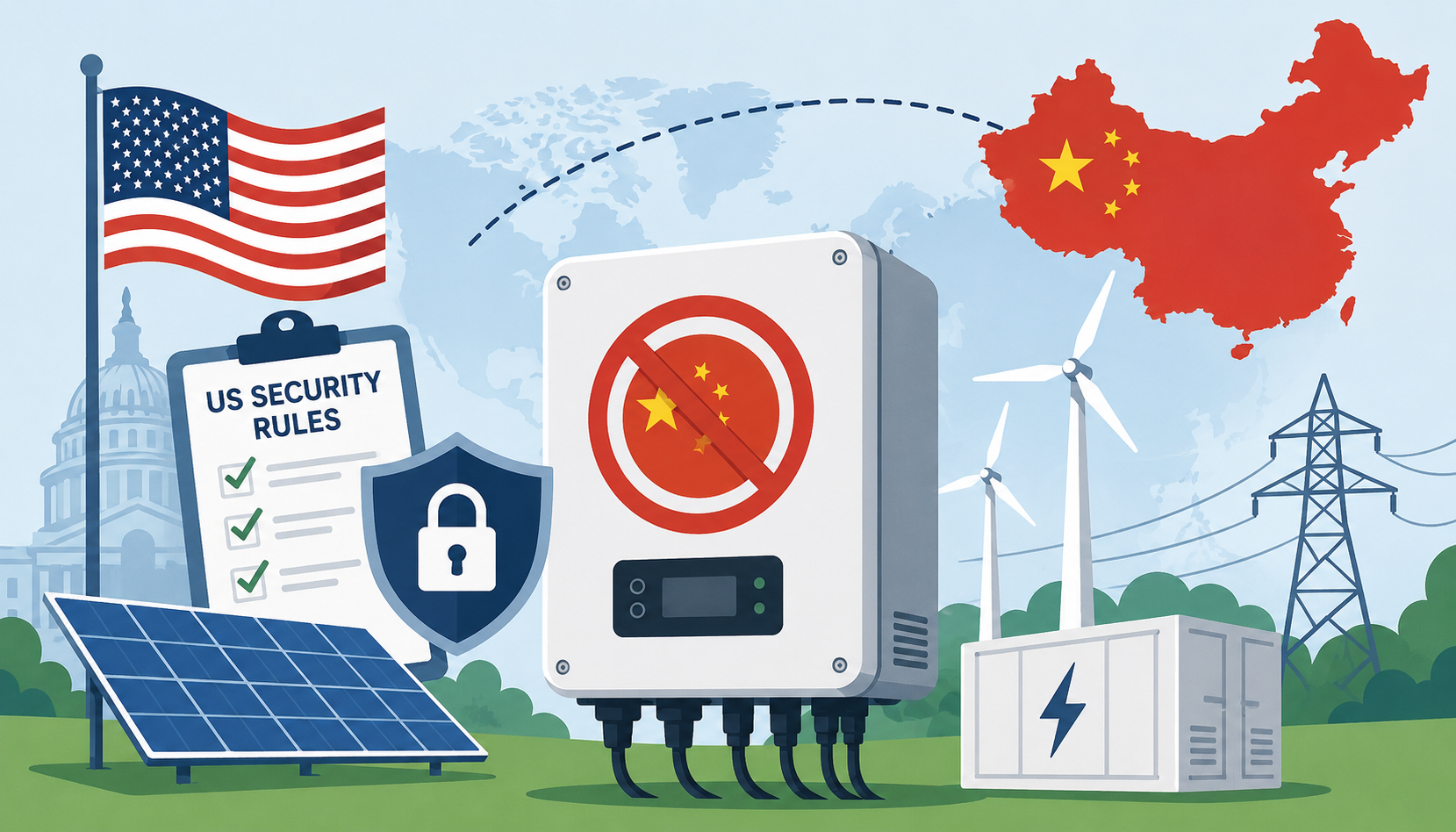
A possible US ban on Chinese energy inverters would mark a new phase in Washington’s economic-security strategy: moving beyond chips and telecom equipment into the hardware that connects renewable power to the grid.
On June 30, 2026, Reuters reported that the Trump administration is drafting a rule to restrict imports of foreign inverters over concerns that China could use them to disrupt US power supplies. Citing five people familiar with the matter, Reuters said the measure is being written by the Federal Communications Commission (FCC), would apply to new foreign models, and could be published as early as this year. The same sources cautioned that the proposal could still be watered down or shelved. The FCC and the White House declined to comment.
That last caveat matters. This is a draft, not a rule. But the direction of travel — in Washington and in Brussels — is unusually clear, and it has direct consequences for developers, lenders, and utilities.
Why inverters sit at the center of the grid
An inverter converts the direct current (DC) produced by solar panels or stored in batteries into the alternating current (AC) the grid actually runs on. Every solar array, battery system, and much of the wind fleet depends on them. Modern “smart” inverters do more than convert power: they regulate voltage, manage reactive power, respond to frequency changes, and — crucially — connect to the internet for monitoring and remote firmware updates.
That remote-access capability is the whole security question in miniature. An inverter is a networked control point sitting between distributed generation and the grid. Whoever can reach it can, in principle, change its settings or switch it off.
What the reported US measure would target
The draft FCC rule would bar new foreign models of inverters, following the template the agency already used for drones (December 2025) and routers (March 2026). Those earlier bans were framed as country-neutral and allow companies to apply for waivers — though, per Reuters, no Chinese firm has been granted one so far.
Some restrictions are already in force. Under the National Defense Authorization Act for fiscal 2026, the US military is prohibited from procuring solar cells, modules, or inverters made by a “foreign entity of concern,” which captures Chinese manufacturers. Separately, the effort to broaden that into a general import ban has a history: last summer the White House’s National Energy Dominance Council instructed the Commerce Department to draft an expedited ban, but the work stalled during a period of détente with Beijing. The FCC has since become the vehicle of choice.
Why Washington is concerned
The immediate trigger dates to May 2025, when Reuters revealed that US experts stripping down grid-connected equipment had found undocumented communication devices — including cellular radios — in some Chinese-made solar inverters and batteries. Security specialists warned that such components could bypass utility firewalls and, in a coordinated scenario, destabilize the grid.
The evidence, however, is more nuanced than the headlines suggested — a distinction worth holding onto. In an analysis dated January 20, 2026 and shared with industry (reported by pv magazine and Reuters), the US Department of Energy said it had inspected roughly 30 inverters and found no definitive evidence of intentionally introduced malicious wireless functionality. Two units showed communications that differed from their documentation, but the DOE judged these “non-malicious” and “non-intentional,” and characterized grid-wide risk as low: a single compromised inverter is unlikely to matter, though coordinated manipulation across many sites would be harder to pull off but more consequential.
In other words, the government’s own technical finding stops short of confirming sabotage. What it does confirm is a structural exposure — opaque supply chains, remote connectivity, and heavy import dependence — that policymakers are treating as unacceptable regardless of intent. Republican Senator Tom Cotton put the political read plainly, telling Reuters that reliance on China for inverters “puts our entire electrical grid at risk.” More than 50 House Republicans made a similar case to Commerce Secretary Howard Lutnick late last year.
The market and supply-chain math
This is where the policy meets a hard commercial reality: the alternatives are thin.
China dominates the inverter business. In Wood Mackenzie’s H1 2025 global ranking, Huawei and Sungrow held the top two spots, with Germany’s SMA, Austria’s Fronius, and China’s Ginlong/Solis rounding out the top five; the top ten producers accounted for roughly 90% of 2024 global shipments. The US is exposed at both ends. The US-China Economic and Security Review Commission has estimated that nearly 24% of inverters imported into the US in 2024 came from China, while a Strider Technologies study cited by The Washington Post found around 85% of surveyed US utilities use inverters assembled by firms tied to the Chinese state or military.
Removing that supply is not free. Domestic capacity is expanding — SMA is now assembling utility-scale inverters in the US under Inflation Reduction Act domestic-content incentives, and Enphase manufactures microinverters stateside — but US-made utility-scale units are expected to carry a price premium over imports while the ecosystem matures. The demand backdrop compounds the pressure: per the SEIA/Wood Mackenzie US Solar Market Insight, the US added 7.8 GW of solar in Q1 2026, and solar plus storage made up 91% of all new generating capacity. Constrain the hardware and you constrain the fastest-growing source of new supply on a grid that is already capacity-tight.
A transatlantic pattern
Washington is not moving alone, and that is arguably the more important signal. Effective May 1, 2026, the European Commission restricted EU funding — including through the European Investment Bank and European Investment Fund — for solar, wind, and storage projects using inverters from four “high-risk” countries: China, Russia, Iran, and North Korea. Brussels acted through existing financial-regulation tools rather than new legislation, with a phased timeline running to April 2027. The restriction reaches beyond country of manufacture to any entity owned or controlled by those states.
Beijing’s response has been consistent across both fronts. China’s Ministry of Commerce called the EU move “unfair and discriminatory” and warned it would jeopardize Europe’s own green transition, and the Chinese Embassy in Washington objected to the “overstretching of the concept of national security.” Reuters’ sources said the EU decision was itself part of what revived the US effort — a feedback loop in which each side’s action lowers the political cost of the other’s.
Analyst’s View
From a country-risk and credit-risk seat, the useful frame is not “is the spyware real?” but “how does this reprice risk across a portfolio?” Three implications stand out.
Completion and refinancing risk in renewables lending. For project-finance exposures, an inverter ban is a completion-risk event before it is anything else. Procurement built around Chinese equipment may require re-specification, re-tendering, and delivery from a tighter supplier pool at a premium — the classic ingredients of schedule slippage and cost overrun. Under IFRS 9, lenders should be asking whether affected renewable exposures warrant reassessment of the probability of default and of stage migration, particularly where a single supplier concentration sits on the critical path. The EU’s own phase-out already shows the mechanism: Reuters has reported that Brussels’ exclusion could affect more than a fifth of new EU solar capacity.
Supplier-concentration and stranded-asset risk. A ban applying only to new models leaves a large installed base untouched but freezes its upgrade path. Utilities and independent power producers carrying heavy Huawei or Sungrow fleets face a slow-burn question about long-term serviceability, spare parts, and firmware support if relations deteriorate further. That is an operational-risk and, potentially, an impairment question for asset owners — not a headline-cybersecurity one.
Policy-driven decoupling as a standing risk factor. The clearest lesson is that clean energy is no longer insulated from national-security policy. Energy-hardware exposure now belongs in the same risk bucket as semiconductors and telecom. For sovereign and corporate analysts, the transatlantic alignment is the variable to weight: coordinated US-EU action raises the probability that “high-risk supplier” designations spread to other jurisdictions and other components, and it compresses the window in which developers can adjust. I would treat concentrated Chinese energy-hardware dependence as a rising, not stable, risk parameter through 2027.
What to watch next
Four markers will tell you whether this hardens into rule or fades into another shelved draft. First, whether the FCC actually publishes a proposed rule this year, and whether it is country-neutral or explicit. Second, the exemption and waiver design — grandfathering of the installed base and any carve-outs for allied suppliers from Japan, South Korea, or Europe. Third, Beijing’s response: China’s dominance in inverters is matched by its leverage over the rare earths and power electronics that go into the alternatives, and retaliation there would raise costs on both sides. And fourth, how quickly non-Chinese capacity in the US and Europe can actually scale — because that, more than any statement of intent, sets the real price of decoupling.