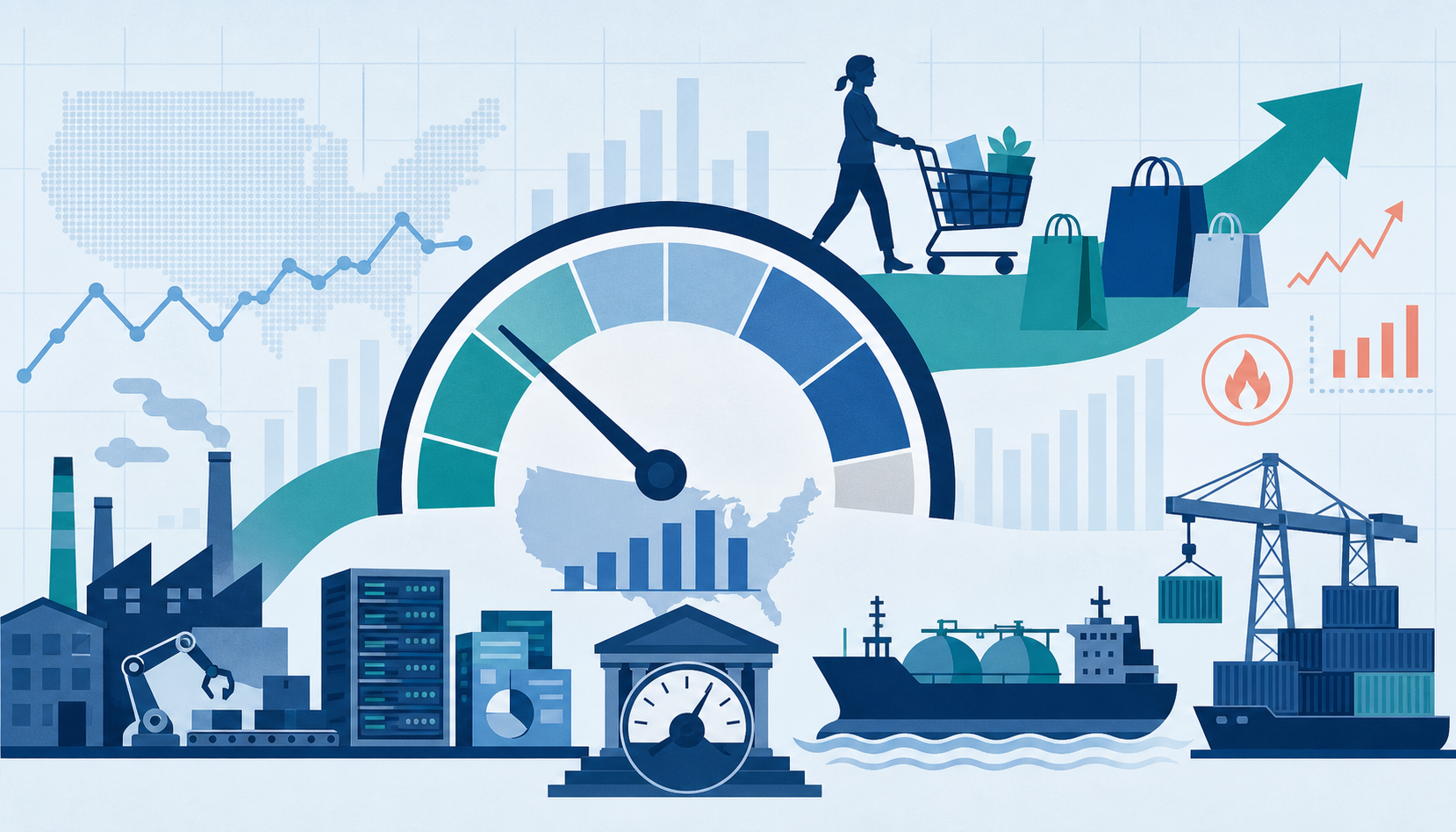
U.S. economic growth slowed in the second quarter even as households and businesses kept domestic demand firm. Real gross domestic product increased at a 1.5% annual rate from April through June, down from 2.1% in the first quarter, the Bureau of Economic Analysis said in its advance estimate.
The headline rate understates the strength of private demand. Real final sales to private domestic purchasers, which combine consumer spending and gross private fixed investment, rose 3.9%. That measure increased 1.7% in the first quarter. The gap between the two figures shows that weaker government spending, faster imports and changes in inventories weighed on GDP while households and companies continued to spend.
Consumers carried more of the expansion
Consumer spending, business investment and exports contributed to second-quarter growth. A decline in government spending offset part of those gains, while imports increased and reduced the GDP calculation. Consumer spending accelerated from the first quarter and covered both goods and services.
Households increased purchases of prescription drugs, new light trucks, furniture and other household equipment. Spending also rose at restaurants and hotels, while financial services and insurance added to service consumption. These categories point to broad demand rather than one temporary purchase cycle.
June data add detail to that picture. BEA’s personal income report showed that real consumer spending rose 0.4% from May. Current-dollar personal consumption expenditures increased $65.2 billion, or 0.3%, while personal income and disposable income each rose 0.2%. The personal saving rate fell to 2.7%, leaving households with a thinner buffer if employment or real income weakens.
Equipment and software supported investment
Business investment gained from equipment and intellectual property products. Industrial machinery, transport equipment and information-processing equipment led the equipment increase. Software and research and development supported intellectual property investment. Private inventories and nonresidential structures moved in the opposite direction, with manufacturing construction accounting for much of the structures decline.
Trade flows also reveal strong capital demand. Imports rose as U.S. buyers brought in telecommunications equipment, semiconductors and industrial machinery. Exports increased on petroleum and related products, while travel and financial-service exports declined. Imports subtract from GDP accounting, but capital-goods purchases can expand productive capacity in later quarters if companies put the equipment to work.
Federal spending fell in the quarter. BEA traced much of that decline to Strategic Petroleum Reserve sales, which national accounts deduct from government consumption. The oil appears in other GDP components, so the transaction has no direct net effect on total GDP. Investors should avoid reading the government-spending line as a clean measure of fiscal restraint.
Inflation leaves the Federal Reserve little room
The growth report arrived with a sharp price signal. The gross domestic purchases price index rose at a 5.7% annual rate, compared with 3.6% in the first quarter. The PCE price index increased 5.1%, while the core PCE index excluding food and energy rose 3.4%.
The separate June report showed a softer monthly reading but persistent annual inflation. Headline PCE prices fell 0.1% from May and core prices rose 0.1%. Over 12 months, headline PCE inflation stood at 3.7% and core inflation at 3.3%, both above the Federal Reserve’s 2% objective.
The Federal Open Market Committee kept its target range at 3.5% to 3.75% on July 29. Three officials dissented because they preferred a quarter-point increase. The combination of 3.9% private domestic demand growth and above-target inflation supports the case for holding rates high. The 1.5% GDP figure gives officials a reason to watch for a broader slowdown before tightening again.
Credit and market risks split in two directions
Consumer lenders face a mixed signal. Spending and employment have supported loan performance, but income grew less than nominal consumption in June and the saving rate sits at 2.7%. Households with variable-rate debt or limited cash reserves carry more risk if borrowing costs remain high. Banks should focus on payment behavior and debt-service capacity rather than treat the GDP slowdown as proof of an imminent credit contraction.
Corporate credit also divides by sector. Equipment, software and research spending favor firms tied to capital formation. Manufacturing construction and inventory weakness can pressure borrowers with high fixed costs or excess stock. A high policy rate raises refinancing costs for both groups, so balance-sheet quality should matter more than the broad GDP number.
For U.S. sovereign risk, the report shows nominal GDP expanding at a 7.9% annual rate, which supports the revenue base in the near term. Strong price growth accounts for much of the gap between nominal and real output. Persistent inflation can keep Treasury financing costs elevated, while softer real growth limits the economy’s capacity to absorb those costs. This policy mix tightens the trade-off facing the central bank and Treasury market.
Analyst’s View
The 1.5% headline looks weak beside first-quarter growth, yet private domestic demand tells a different story. Consumers increased spending, companies bought equipment and software, and imports of capital goods rose. The domestic economy still has momentum.
Inflation poses the larger market constraint. Investors who expect rapid rate cuts need evidence that demand and prices are cooling together. This release supplies the first half of that case through slower GDP, while the 3.9% private-demand reading and 3.7% annual PCE inflation undermine the second half.
Short-maturity yields may remain sensitive to each inflation release and FOMC vote. Long-duration bonds could benefit if later GDP estimates confirm a deeper slowdown, but sustained price pressure would erode that support. Equity investors may favor companies with pricing power, low refinancing needs and exposure to business equipment or software. Consumer-facing firms face a narrower margin for error as households spend faster than income and save less.
BEA will publish its second estimate on August 26. The agency will also begin its annual update of national, industry and regional accounts on September 30. Revisions could change the balance among consumption, investment and trade, so investors should treat the 1.5% figure as an early reading rather than a final verdict.