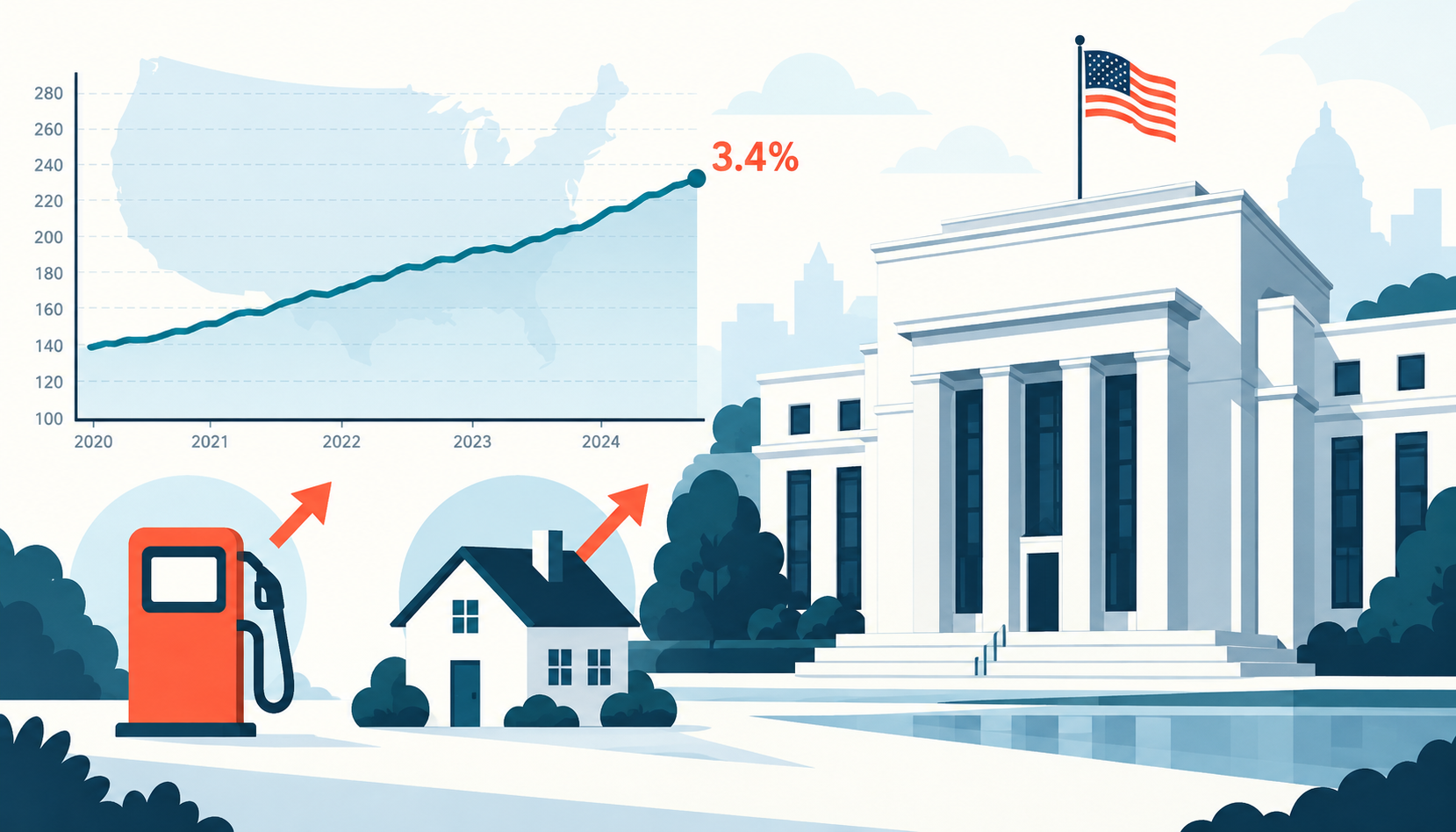
US consumer prices rose 0.4% in August on a seasonally adjusted basis, lifting the annual Consumer Price Index increase to 3.4%, the Bureau of Labor Statistics reported on September 11. The monthly gain followed a 0.1% increase in July. Gasoline rose 3.9% during the month and accounted for more than one third of the all-items increase, while the energy index gained 2.1%.
The report arrived days before the Federal Open Market Committee meets on September 15 and 16. It gives officials an uncomfortable mix of signals: headline inflation remained well above the Federal Reserve’s 2% objective, core inflation firmed on the month, and energy provided much of the immediate acceleration. The data do not settle the policy decision. They do raise the cost of assuming that the disinflation seen earlier in the year will continue without interruption.
A firmer monthly reading
The August headline increase was the strongest monthly CPI rise since May. Shelter increased 0.3% after a 0.1% gain in July. Food rose 0.1%, with food away from home up 0.3%. The index excluding food and energy, often called core CPI, increased 0.3% after a 0.2% July rise. Communication, lodging away from home, airline fares, education, and used cars and trucks moved higher, while medical care and motor vehicle insurance declined.
For households, the distinction between annual and monthly changes matters. The annual all-items rate stayed at 3.4%, the same as July, but the monthly acceleration means that a stable year-over-year rate can conceal a renewed pressure point. The BLS reported a 16.3% annual increase in energy and a 2.7% annual increase in food. Core CPI slowed to 2.4% over twelve months from 2.5% in July, yet its August monthly gain was still stronger than the prior month.
Energy carries a special role in this release. Fuel prices can reverse quickly and policymakers usually examine core measures to judge underlying inflation. Even so, higher gasoline affects household budgets immediately and can shape near-term inflation expectations. The BLS methodology also shows why one report should be read carefully: seasonally adjusted CPI isolates changes that are unusual for the time of year, while unadjusted figures describe the prices consumers actually paid.
The Federal Reserve’s decision window
Federal Reserve Governor Christopher Waller had set out a conditional approach before the release. In a September 3 speech, he said continued progress toward 2% would make him willing to support holding the policy rate at its current setting; if inflation came in hot, he would consider a rate increase. His remarks identified the August reading and the next employment report as important inputs for the September meeting. The speech also described policy as only slightly restrictive and said a small adjustment could be warranted if progress toward 2% reversed.
That statement is not a promise of action by the Committee. It is a description of one governor’s reaction function, and the FOMC decides collectively. Yet it makes the CPI composition important. A report driven only by a volatile fuel move would offer one interpretation. A report that also shows renewed persistence in shelter or a broadening of core services would offer another. August contained both a large energy contribution and a 0.3% core increase, which leaves the Committee with less room to dismiss the report as a single-category event.
The policy rate affects the economy through borrowing costs, credit conditions, asset prices and expectations. Its effect arrives with lags, so officials must decide before they can observe the full consequences of their previous decisions. A rate increase would signal that the Committee sees the risk of entrenched inflation as greater than the risk of unnecessarily slowing demand. A hold would signal that officials judge the latest acceleration to be temporary or that existing restraint remains sufficient.
Reading the components
Shelter deserves close attention because it has a large weight in consumer spending and tends to move slowly. Its 0.3% August rise followed a softer July reading. A single month does not establish a new trend. It weakens the claim that housing costs are providing reliable, rapid disinflation. The annual shelter index rose 3.0%, according to the BLS. Rent, owners’ equivalent rent, and related housing services also transmit changes into inflation with a delay, which can keep the index elevated after market rents have turned.
Gasoline had a more direct effect. The 3.9% monthly increase raises transport costs for households and can affect margins in distribution-intensive sectors. The broader energy index rose 2.1% in August, while annual energy inflation reached 16.3%. Such moves may reflect global oil conditions rather than domestic demand alone. Monetary policy cannot produce more fuel supply, but the Fed must assess whether energy shocks feed into wages, pricing decisions, and longer-lived expectations.
Several categories also point to a consumer economy with uneven price pressure. Airline fares and lodging away from home rose during the month, while medical care and vehicle insurance declined. Food prices were comparatively restrained, with food at home unchanged on a seasonally adjusted basis. These offsets are useful, yet they do not erase the aggregate increase. Investors will examine coming reports for evidence about whether services inflation is cooling after temporary energy effects are removed.
Markets, borrowers, and fiscal policy
For bond markets, the release shifts attention from the annual headline number to the path of policy over the next several meetings. Short-dated Treasury yields are especially sensitive to expectations for the federal funds rate. If investors conclude that the FOMC is more likely to tighten, yields at the front of the curve can rise even before a decision. Longer maturities respond to a wider set of forces, including expected inflation, fiscal borrowing, growth, and the term premium.
Corporate borrowers face a related issue. Companies refinancing debt in the near term have to consider both the level of Treasury yields and credit spreads. A further policy tightening could raise benchmark costs, while a credible response to inflation could reduce the risk that long-term inflation expectations drift higher. The net effect differs by issuer. Highly leveraged businesses with floating-rate debt are more exposed to short-term policy changes than investment-grade issuers that have already termed out their liabilities.
Consumers face the transmission through mortgages, auto loans, credit cards, and savings returns. Mortgage rates do not move one-for-one with the policy rate. An expectation of sustained restraint can keep financing costs high. Household cash flow also responds directly to fuel and shelter expenses. The August data therefore matter beyond the financial markets: they describe a budget pressure that can alter discretionary spending even if headline inflation does not accelerate further.
What could change the outlook
The next few releases will determine whether August was an inflection point or a temporary rebound. The FOMC will have to weigh the September labor-market information against CPI, financial conditions, and its assessment of supply shocks. A softer employment report could strengthen the case for patience. Another broad inflation surprise would make it harder to argue that the current policy setting is restrictive enough.
The BLS cautions that CPI is constructed from a broad sample of consumer purchases and that seasonally adjusted series can be revised as new seasonal factors are introduced. That does not reduce the importance of the release. It is a reminder to focus on a sequence of data rather than treating one month as a complete diagnosis. The all-items index reached 334.980 in August on its 1982-84 base, while CPI-W increased 3.5% over twelve months and the chained CPI-U increased 3.3%.
The comparison with July also needs discipline. Core CPI’s annual rate eased, while its monthly increase accelerated. Headline inflation held at 3.4% over twelve months, while the seasonally adjusted monthly all-items gain rose from 0.1% to 0.4%. Those movements can coexist because annual rates include earlier months and monthly rates can be volatile. The policy question is whether August marks a broader change in inflation momentum. Evidence from September prices, wages, hiring, and consumer spending will be more useful than a mechanical extrapolation from one report. Until then, the prudent reading is that inflation has not returned to a path that permits policymakers or borrowers to assume rapid relief in financing costs.
Analyst’s View
For credit risk, the immediate issue is the prospect of higher-for-longer financing costs. Firms that expected declining policy rates to relieve interest expense may need to revise liquidity and refinancing assumptions. Lenders should distinguish between borrowers whose revenue can absorb higher input costs and those facing weak pricing power alongside variable-rate obligations.
For sovereign and market positioning, a renewed US inflation impulse can support the dollar and pressure duration-sensitive assets if it moves expectations toward another rate increase. That response can tighten financial conditions outside the United States, especially for borrowers with dollar debt. The central case still depends on subsequent inflation and employment data, but the August report gives the FOMC a clear reason to preserve optionality rather than declare its inflation task complete.