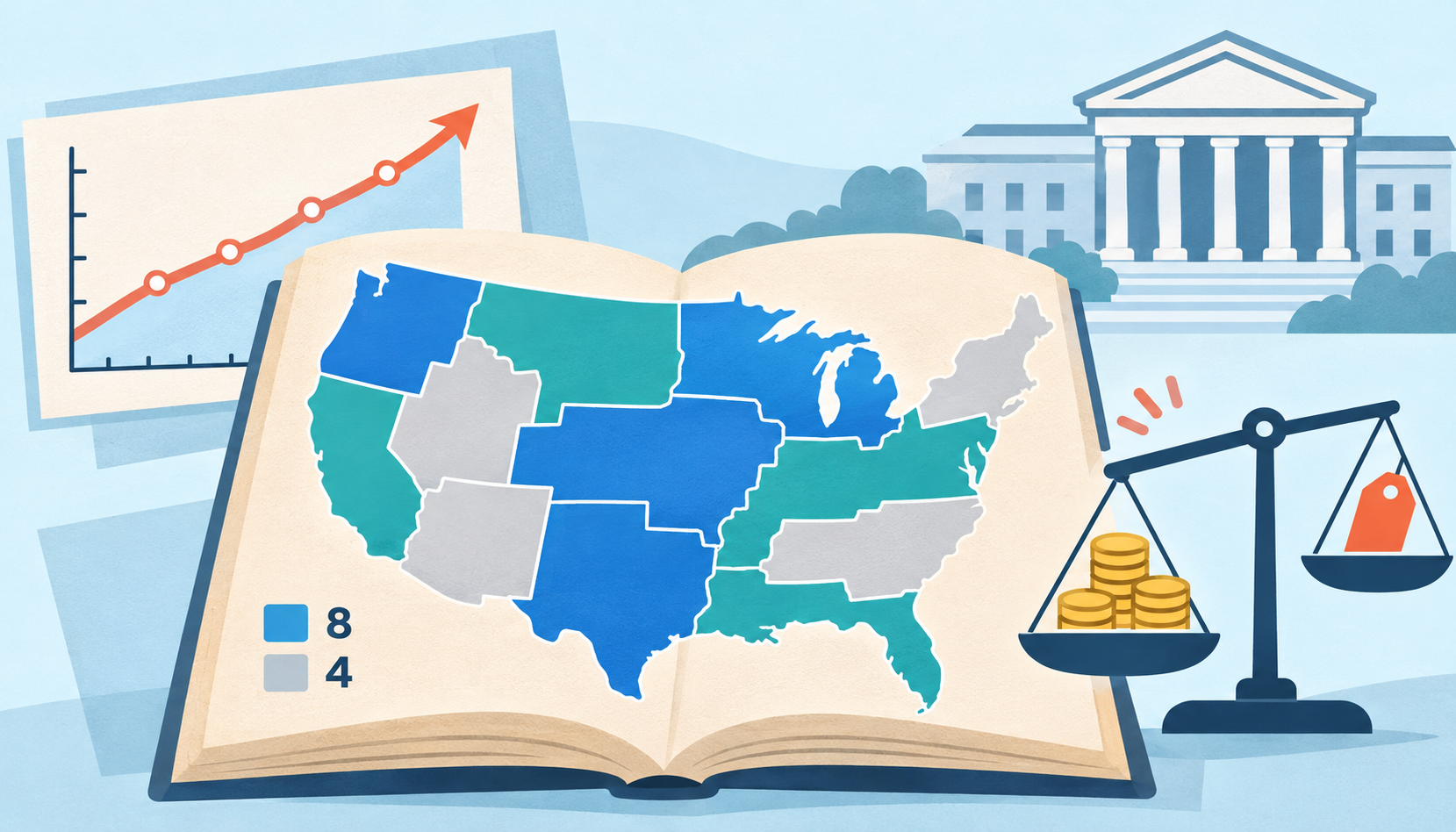
The Federal Reserve’s November 2026 Beige Book, published November 25, found wages and benefits rising moderately, up from modest in the prior report, while employment rose only slightly and four of 12 districts reported no growth. The Fed held rates on October 28 by a 10-2 vote, with two members wanting a hike, and it meets again December 8-9.
Key Takeaways
- Employment rose only slightly, with many firms hiring mainly to replace departures and only a minority reporting meaningful increases.
- Input costs generally rose faster than selling prices, and contacts expected both costs and prices to keep rising.
- Eight of 12 Fed districts reported growth, down from eleven in the July report, with the November information collected through November 16, 2026.
- The Fed’s target range stands at 3.75% to 4.00%, and the next policy meeting is December 8-9, 2026.
Wage growth stepped up while employers kept hiring cautious
The Beige Book is the Fed’s regular collection of reports from business contacts across its 12 districts, and its labor section carries the most market-relevant line this month. Wages and benefits rose moderately, an uptick from the modest increases in the previous report. The Beige Book attributes the pressure to hard-to-fill positions, cost-of-living adjustments and rising benefit costs. Philadelphia said wage inflation accelerated to a moderate pace, and Dallas also reported faster wage growth.
Employment, by contrast, rose only slightly. Many firms kept head counts stable and hired mainly to replace people who left, and only a minority reported meaningful increases. Labor supply was generally stable and workers were often easy to find, except for skilled and technical roles. Employers said they were using existing staff more efficiently. The October report had already flagged that five districts saw firms cutting through attrition, delaying hiring or expecting less job creation after investing in artificial intelligence.
The combination matters for the Fed’s reading of inflation. Pay is rising faster in a labor market where firms are not expanding payrolls. That suggests pressure on the pay of existing workers rather than a hiring boom. St. Louis added a counterpoint, reporting that job openings picked up even though employment was unchanged.
Four districts reported no growth, one more than in October
The November national summary says eight districts saw growth in the slight to moderate range and four saw none. The district summaries show where the stall sits: Boston described activity as roughly unchanged, Chicago as unchanged, Kansas City as little changed and San Francisco as having changed little. Dallas, which led the October report with robust manufacturing growth, now describes expansion that slowed to a modest pace.
The trend over three reports shows the breadth of growth narrowing, although most districts still expected slight to moderate growth in November:
| Beige Book | Districts with growth | Districts with no change |
|---|---|---|
| July 2026 (late May and June) | 11 | 1 |
| October 2026 | 9 | 3 |
| November 2026 | 8 | 4 |
Consumer spending was little changed. Households stayed price sensitive and became more selective with discretionary purchases, while tourism and travel were solid. Manufacturing grew modestly as strong demand in several industrial segments offset weakness in consumer-facing and housing-related goods. Port volumes slipped on weather disruptions, even as imports tied to data centers rose.
Firms are absorbing costs faster than they can raise prices
Prices increased moderately overall, the same pace as in the prior report. Contacts cited sustained cost pressure from energy, transportation, healthcare, insurance and tariff-related expenses, along with raw materials, metals, freight and specialized imports. The summary says input cost growth generally outpaced increases in selling prices because competition and customer price sensitivity limited how much firms could pass on. Contacts expected both expenses and prices to keep rising in the coming months.
District detail shows how uneven that is. Cleveland reported nonlabor cost pressures that stayed robust for the twelfth straight period, and its selling prices also grew robustly. St. Louis said prices rose at a robust and widespread pace. New York reported that selling price increases eased slightly while input prices continued to rise strongly. The October report had said higher oil prices appeared in every district report, and that firms expected further price increases as hedge and delivery contracts came up for renewal.
Who gains and who loses
Manufacturers and travel-linked businesses sit on the gaining side. Manufacturing activity grew modestly overall, Cleveland described demand as robust, and travel activity was solid. Workers in hard-to-fill and skilled roles also gained, since those are the positions where wage pressure was concentrated.
Housing, autos and consumer-facing firms sit on the losing side. Residential real estate weakened as affordability challenges suppressed demand, and construction declined amid higher borrowing costs and elevated construction costs. Contacts attributed softer auto sales to elevated fuel prices and higher interest rates. Kansas City said consumer-facing firms saw lower revenue as moderate price increases strained affordability. Households under pressure from high housing and essential costs raised demand for social services and stretched nonprofit capacity, according to the summary.
The policy reaction is contested inside the Fed. In its October 28 statement, the Federal Open Market Committee held the target range at 3.75% to 4.00% by a 10-2 vote. Lisa D. Cook and Beth M. Hammack voted against, preferring to raise the range by a quarter percentage point. No source consulted for this article reports how either official reacted to the November Beige Book, so whether the wage uptick changes any vote remains open. The Beige Book itself states that it is not a commentary on the views of Federal Reserve officials.
The Beige Book and the FOMC statement describe the economy differently
The October statement said economic activity was expanding at a strong pace, domestic spending had been resilient, productivity growth was strong and inflation remained elevated. The Beige Book, with information collected through November 16, describes flat consumer spending, a housing pullback and four districts with no growth. The two documents use different methods. The statement is the Committee’s own assessment, and the Beige Book is a qualitative summary of what businesses and community groups report.
Reading them together suggests that firm-level conditions are softer than the Committee’s wording, while the price and wage evidence keeps the inflation concern intact. That is a judgement, and the Beige Book does not say it. Our earlier report on the September rate increase to 3.75%-4.00% covers how the Fed reached its current range, and our report on US retail sales covers the latest consumer spending data.
Market Context
Short-term and long-term Treasury yields both sat above the policy rate in the week before the report. The effective federal funds rate was 3.88% on November 24, inside the 3.75% to 4.00% target range. The 2-year Treasury yield was 4.63% that day, 0.75 percentage point above the policy rate. The 10-year yield was 4.91%, down from 5.10% on November 17. A 2-year yield above the policy rate is consistent with investors expecting higher short-term rates, though these series do not show what drove the moves.
| Indicator | Latest value | Date | Source |
|---|---|---|---|
| Effective federal funds rate (daily) | 3.88% | November 24, 2026 | FRED, DFF |
| 2-year Treasury yield (daily) | 4.63% | November 24, 2026 | FRED, DGS2 |
| 10-year Treasury yield (daily) | 4.91% | November 24, 2026 | FRED, DGS10 |
Analyst’s View
A December hike would land on floating-rate borrowers first. Moderate wage growth and a persistent gap between input costs and selling prices give the two October dissenters more anecdotal support. If the Committee raised the range in December, small businesses and developers with floating-rate debt would face higher interest costs while their own prices are not keeping up with their input costs.
Credit risk sits with firms that cannot pass on costs. Consumer-facing and housing-linked businesses carry the earliest credit risk, since the Beige Book reports subdued loan demand and weak affordability. Lenders may see weaker applicants before they see higher volumes.
Markets had already moved before the report. The information runs through November 16, and the 2-year and 10-year Treasury yields both fell between November 17 and November 24. Whether the wage line moves prices further is not something these data show.
What to Watch
- December 8-9, 2026: The Federal Open Market Committee meets, and the Fed’s calendar marks this meeting as one with a Summary of Economic Projections.
- December 23, 2026: The Bureau of Economic Analysis publishes personal income and outlays for November 2026, according to its release schedule.
- December 23, 2026: The Bureau of Economic Analysis releases the third estimate of third-quarter 2026 GDP.