@{value=
International Monetary Fund Managing Director Kristalina Georgieva said on October 17 that she hoped Washington and Beijing could reach an agreement that would prevent a cutoff in rare-earth supplies to the global economy. Speaking during the IMF and World Bank annual meetings in Washington, she warned that restrictions would have a 窶徇aterial impact窶・on growth and would deepen uncertainty around an already weaker global outlook. Reuters窶・account of the press conference records the warning and its timing.
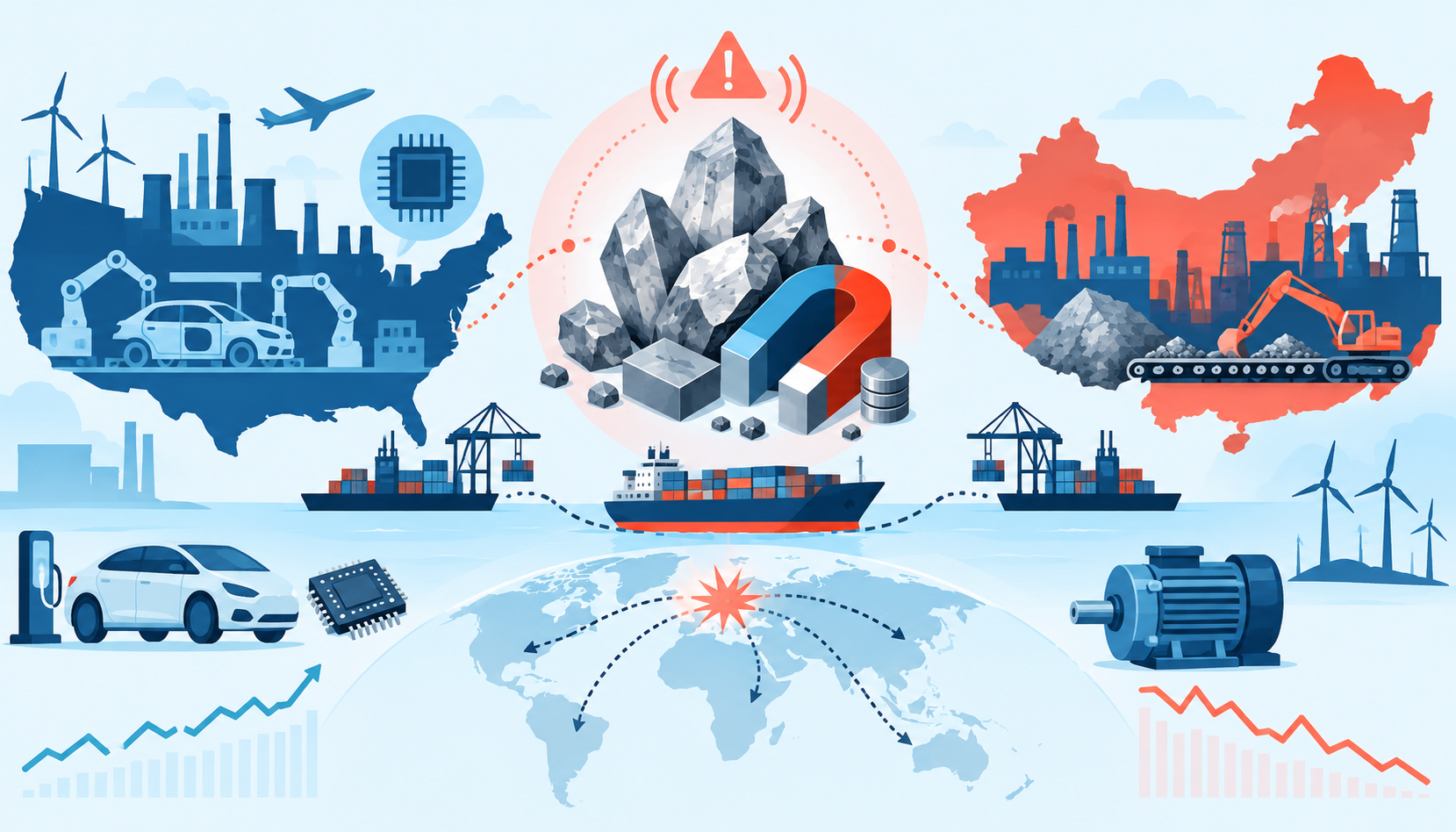
The comment put a strategically important industrial input at the center of the autumn trade dispute. Rare earths are used in permanent magnets, electric motors, electronics, wind turbines, defense equipment and other manufactured goods. Their value in global trade is modest compared with oil or semiconductors, yet their processing and magnet production are concentrated in China. That concentration gives export controls an influence that is much larger than the headline dollar value of the minerals themselves.
Why rare earths became a macroeconomic issue
The immediate concern was the possibility that US-China trade restrictions could move from tariffs and technology controls into physical supply. A disruption would reach manufacturers through several channels. Companies could face longer lead times, higher prices for magnets and components, production stoppages, and pressure to redesign products around less efficient substitutes. The result would be a supply shock that could affect output even if final consumer demand remained intact.
The IMF窶冱 later work helps explain the mechanism. Its working paper on rare-earth supply-chain disruptions describes rare earth elements as critical inputs for high-technology manufacturing and models an 80% reduction in available rare-earth inputs for several major economies. Under low substitutability, which the paper treats as the relevant condition over horizons shorter than one year, the modeled GDP losses reach 1.8% for Japan, 1.5% for the United States and 1.2% for Germany. Those figures are stress-scenario results, not forecasts, but they show why a supply interruption can matter to national output.
The same analysis finds that losses vary with production networks, sector composition and the ability to substitute. A country can be exposed even when its direct import bill looks manageable. Motor vehicles, electrical equipment and computers buy rare-earth-intensive inputs and also supply parts to other industries. A bottleneck at one stage can therefore transmit through several layers of domestic production.
China窶冱 leverage sits downstream
Rare-earth supply is not a single market. Mining, separation, refining, alloy production and permanent-magnet manufacturing are distinct stages. China窶冱 strongest position is in the downstream steps that turn mined material into usable industrial inputs. The IMF窶冱 research notes that China accounts for roughly 85% to 90% of global oxide-separation capacity and 90% to 95% of metal-refining capacity. It also identifies China窶冱 share of permanent-magnet manufacturing as about 90%.
That structure makes diversification slow. New mines cannot immediately replace a missing refined product, and a mine outside China still depends on processing equipment, chemical expertise, financing and transport infrastructure. Magnet plants also require engineering know-how and a customer base large enough to support investment. Importers can reduce their exposure, but the adjustment requires years of capital spending and commercial coordination.
China demonstrated the sensitivity of the chain in April 2025, when it introduced export licensing requirements for seven rare earth elements and related permanent magnets. The IMF窶冱 World Economic Outlook commodity analysis says Chinese permanent-magnet exports fell sharply between April and June before returning toward their previous growth path. The episode was short-lived, yet manufacturers in the United States, Europe and India reported disruption. A temporary licensing shock was enough to reveal the cost of dependence.
A deal could reduce immediate risk without removing structural exposure
Georgieva窶冱 preference for a US-China agreement reflected the difference between a negotiated pause and a resilient supply chain. A deal could prevent an abrupt cutoff, give manufacturers time to secure inventories and reduce the chance that trade policy would trigger a manufacturing recession. It could also help lower the risk premium attached to companies whose production schedules depend on Chinese magnets or refined materials.
That relief would be conditional. Export licensing is an administrative instrument that can be tightened, delayed or applied selectively. Even if formal restrictions are suspended, firms may continue to carry more inventory, qualify alternative suppliers and redesign products. Those defensive measures raise working-capital needs and can reduce margins. They also create a permanent incentive to treat rare earths as a strategic input rather than an ordinary commodity.
The broader trade relationship matters as well. The WTO窶冱 October 2025 Global Trade Outlook emphasized the pressure that policy uncertainty and cooling demand place on world trade. Rare earths add a supply-side constraint to that environment. When tariffs reduce trade and export controls threaten inputs, companies face a double test: they must find new customers while rebuilding the production system that serves them.
What manufacturers and governments can do
Manufacturers are likely to respond in layers. The first is inventory. Holding more magnets or refined material can protect production against a short interruption, though it ties up cash and cannot solve a prolonged embargo. The second is supplier qualification. Companies can sign contracts with producers in Australia, the United States, Japan, Europe or other jurisdictions, even when those suppliers are more expensive or operate at smaller scale. The third is engineering: product teams can reduce rare-earth intensity, redesign motors or use alternative magnet technologies.
Governments face a more difficult balance. Subsidies and public financing can accelerate mines, separation plants, refineries and magnet factories. Strategic stockpiles can absorb a temporary shock. Trade agreements can improve access to non-Chinese supply. Yet support that focuses only on mining may leave the most constrained processing stages untouched. A credible policy must cover the full chain, including recycling, workforce skills, environmental permitting and long-term offtake contracts.
Policy coordination also matters because fragmented support can inflate costs without creating a reliable market. The United States, Europe, Japan, Australia and emerging-market manufacturers all have an interest in diversification, but each government has different fiscal resources and industrial priorities. Shared standards and cross-border financing could make alternative capacity more commercially viable. They could also reduce the temptation to replace one concentrated dependency with several small, fragile projects.
Recycling is another part of the adjustment. End-of-life motors, hard-disk drives and other equipment contain recoverable material, although collection and separation are technically demanding. Recycling cannot replace primary supply in the short run because the stock of discarded equipment is limited and recovery systems are uneven. Over time, however, it can reduce the amount of newly mined material required and create a domestic source that is less exposed to border controls.
Substitution has similar limits. Some applications can use ferrite or other lower-performance magnets, but the redesign may require a larger motor, higher weight or lower efficiency. That trade-off is especially important for electric vehicles, robotics and industrial equipment, where size and energy consumption affect the economics of the final product. A manufacturer may therefore accept a higher input price before it accepts a technically inferior substitute.
These constraints explain why markets can react before a physical shortage appears. Buyers may bid up prices to secure supply, while banks and insurers reassess the resilience of borrowers. The financial effect can arrive through inventory finance, delayed deliveries and canceled capital spending. A supply-chain disruption is therefore capable of tightening conditions for smaller manufacturers even when large multinational firms can negotiate priority access.
For policymakers, the relevant measure is resilience per dollar spent. A project that produces a small volume of ore but lacks refining, transport or customer commitments will not protect an economy during a crisis. Investment should be judged by the number of dependable stages it adds and by whether private buyers can keep the facilities operating after subsidies end.
Analyst窶冱 View
First, the rare-earth dispute is a credit-risk issue for manufacturers with thin inventories, concentrated suppliers and limited pricing power. An agreement between Washington and Beijing would reduce near-term tail risk, yet lenders should continue to test what happens if licensing delays last several months. Working-capital requirements, customer penalties and the cost of redesign should appear in downside cases.
Second, sovereign risk is uneven. Countries that import refined rare-earth products and export vehicles, electronics or clean-energy equipment face a combined terms-of-trade and industrial-output shock. Japan, Germany and the United States appear particularly exposed in the IMF窶冱 stress scenarios, although the actual effect depends on substitution and inventory. Countries with credible processing capacity, reliable electricity and access to strategic minerals may attract investment, but fiscal incentives can become a burden if projects fail to reach commercial scale.
Third, market positioning should distinguish between a short supply interruption and a lasting reallocation of capital. A temporary agreement can support industrial equities and ease commodity anxiety. It does not eliminate the value of firms that own processing technology, recycling capability or secure offtake. Investors should watch licensing decisions, magnet export volumes, inventory commentary and project financing rather than treating a diplomatic announcement as proof that the supply chain has been repaired.
Georgieva窶冱 warning therefore points to a larger lesson. Rare earths are a small market with a large network effect. The next US-China agreement may prevent an immediate shock, but it will not remove the incentives created by concentrated processing capacity and strategic rivalry. The global economy can lower its vulnerability only by turning temporary diversification efforts into durable industrial capability.
; PSPath=C:\Users\sakam\Documents\Codex\2026-09-10\global-economy-blog-drafter-plugin-global\outputs\rare-earths-us-china\article.md; PSParentPath=C:\Users\sakam\Documents\Codex\2026-09-10\global-economy-blog-drafter-plugin-global\outputs\rare-earths-us-china; PSChildName=article.md; PSDrive=; PSProvider=; ReadCount=1}